systems
The arithmetic that drifts
It is 1962, and the mainframes are confidently printing nonsense: a satellite-orbit computation runs for six hours, each floating-point operation rounding a hair, and the hairs compound until the final digits — the ones the engineers act on — are pure fiction, delivered to eight authoritative-looking places. Diagnose the disease and build the numerical discipline against it: analyze how rounding error propagates through an algorithm, distinguish the stable formulations from the catastrophic ones — subtracting nearly equal quantities, inverting ill-conditioned matrices — and attach to every computed answer an honest statement of how many digits deserve belief. The purpose of computing is insight, not numbers. Get it wrong and the machine becomes a generator of confident garbage, trusted precisely because it is a machine.
Who this problem belongs to
The two figures whose methods fit it best, out of 49 in contention.

This is Hamming's signature problem, almost word for word. At Bell Labs in the 1950s and 1960s he watched engineers trust printouts to eight digits while the actual accumulated rounding error had eaten most of that precision, and his answer became a career: error-correcting codes for transmission, numerical analysis for computation, and the aphorism he made famous, 'the purpose of computing is insight, not numbers.' His work on stability analysis, on distinguishing well- from ill-conditioned formulations, and on teaching engineers to attach honest error bars to machine output is precisely the discipline this problem demands. He wrote the textbook other numerical analysts assigned. No one on this roster diagnosed 'confident garbage from a trusted machine' more directly, more often, or earlier than Hamming did. Score: maximal.
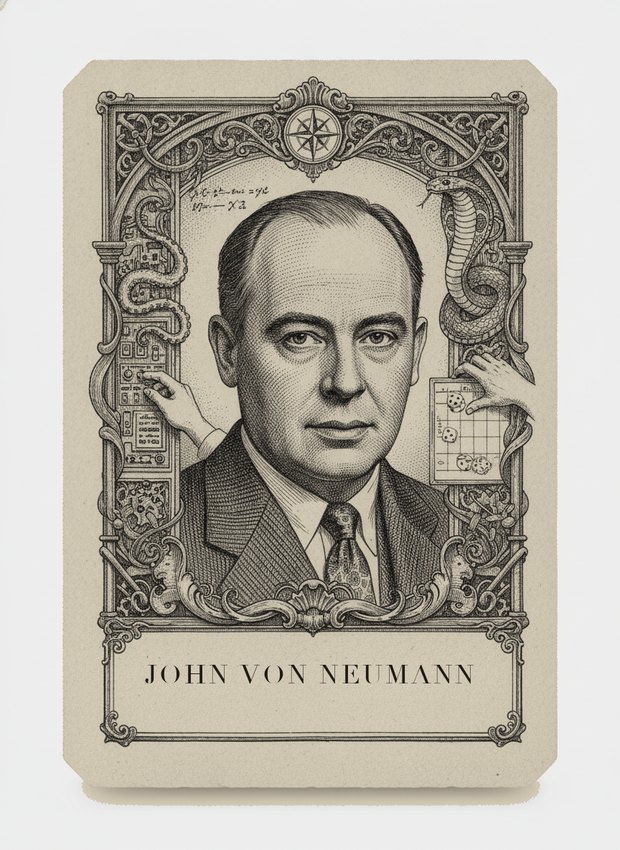
Von Neumann, with Herman Goldstine, wrote the 1947 paper 'Numerical Inverting of Matrices of High Order,' the founding document of rigorous error propagation analysis for digital computation — precisely the satellite-orbit rounding disaster this problem stages, a decade before it would have happened. He identified that naive Gaussian elimination could catastrophically amplify small rounding errors through ill-conditioned matrices, and pushed for pivoting strategies and condition-number thinking that remain standard. As architect of the stored-program computer itself, he understood floating-point arithmetic's failure modes from the hardware up, not as an abstraction. His Monte Carlo work with Ulam also forced him to reason carefully about how error compounds across many iterations. The only reason he is not the top score is that Hamming built the field's applied discipline more completely; von Neumann supplied its founding proof.
49 figures are scored on this problem. Draw it in a battle to see where you land.