causality
Roll the dice at Los Alamos
It is 1946 in Los Alamos, and the neutron-diffusion calculations for the new weapons defeat every analytic technique: the geometry is irregular, the physics branching, the integrals intractable. A convalescing mathematician playing solitaire has the heretical idea — stop solving and start sampling. Estimate the quantity by simulating thousands of random neutron histories on the new ENIAC, and make the method honest: quantify the sampling error, design variance-reduction tricks so the answer converges before the machine time runs out, and generate the random numbers themselves on a deterministic computer without fooling yourself. Get it wrong and criticality calculations carry silent errors measured in kilotons; get it right and stochastic simulation becomes a permanent third pillar of science beside theory and experiment.
Who this problem belongs to
The two figures whose methods fit it best, out of 64 in contention.
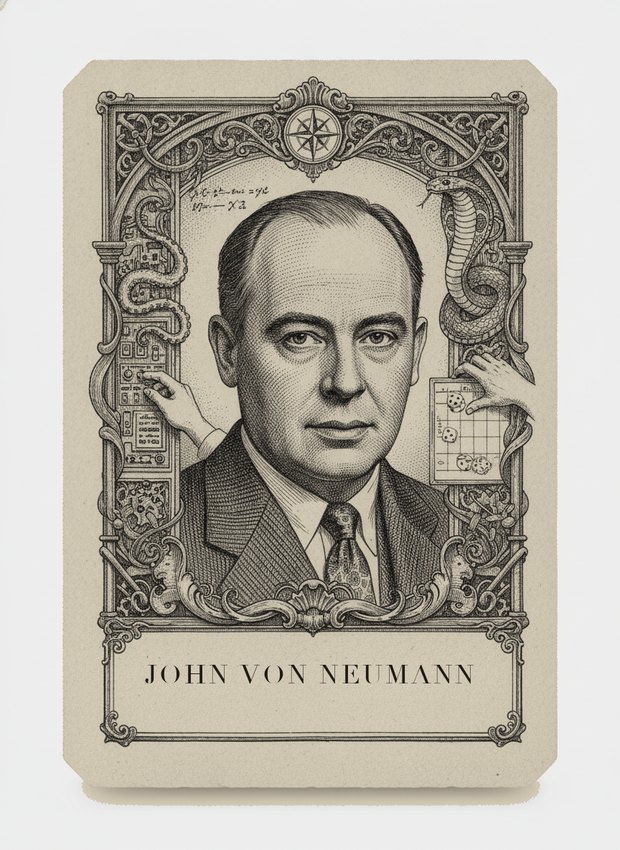
Von Neumann is the direct historical actor here. In 1946, corresponding with the convalescing Stanislaw Ulam about neutron diffusion calculations for the new weapons, he saw that stochastic sampling could replace intractable analytic integrals, and he formalized the idea into a computational program for the ENIAC, the first electronic computer capable of running it. He proposed the middle-square method for generating pseudo-random numbers on a deterministic machine, explicitly worried about the method's flaws, and pushed for statistical tests of randomness quality, exactly the honesty about pseudo-randomness the problem demands. He also drove early thinking on importance sampling as a variance-reduction trick to make Los Alamos criticality calculations converge within available machine time. This is not adjacent expertise; it is the event itself, which is why the score sits near the ceiling.
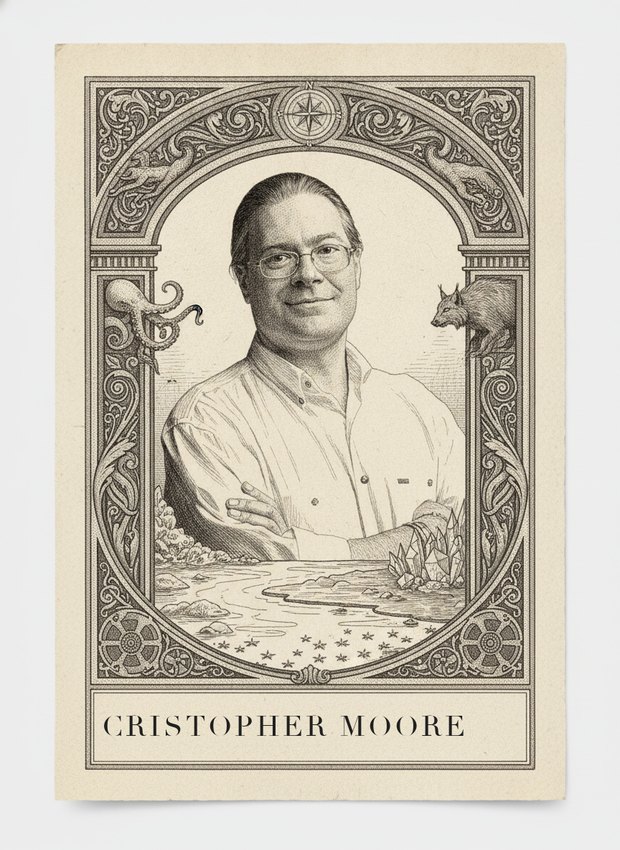
Moore's research on phase transitions in inference and the statistical physics of algorithms sits squarely in the intellectual lineage the Los Alamos problem opened: Monte Carlo methods and statistical mechanics became permanently intertwined once physicists needed to simulate systems too complex for closed-form solutions, and Moore's work on when computational and statistical problems become tractable versus intractable directly extends that tradition into modern complexity theory. His Nature of Computation textbook treats sampling-based algorithms and their convergence behavior with real rigor. The gap is chronological and institutional: Moore's career runs from the 1990s onward, applying these tools to computer science and physics problems far from weapons calculations, and he had no hand in the original ENIAC-era method or its wartime variance-reduction engineering, which the actual 1946 problem centers on.
In the mind map
The same ideas, as concepts rather than history — in John's ML knowledge map.
64 figures are scored on this problem. Draw it in a battle to see where you land.