games
The zero-sum room
It is 1928 in Berlin, and John von Neumann has been staring at parlor games long enough to suspect they conceal a theorem. Two players, opposed interests, mixed strategies allowed — poker without the cards. Prove an optimal strategy exists and compute it for a 5x5 payoff matrix, by hand, because no computer will exist for another two decades. This is not recreation: within twenty years this mathematics will sit at the center of RAND Corporation and shape how two nuclear superpowers reason about each other. If the existence proof is wrong — if some games have no rational solution — then the entire edifice of strategic analysis is built on sand. Get the minimax right; the century depends on it.
Who this problem belongs to
The two figures whose methods fit it best, out of 45 in contention.
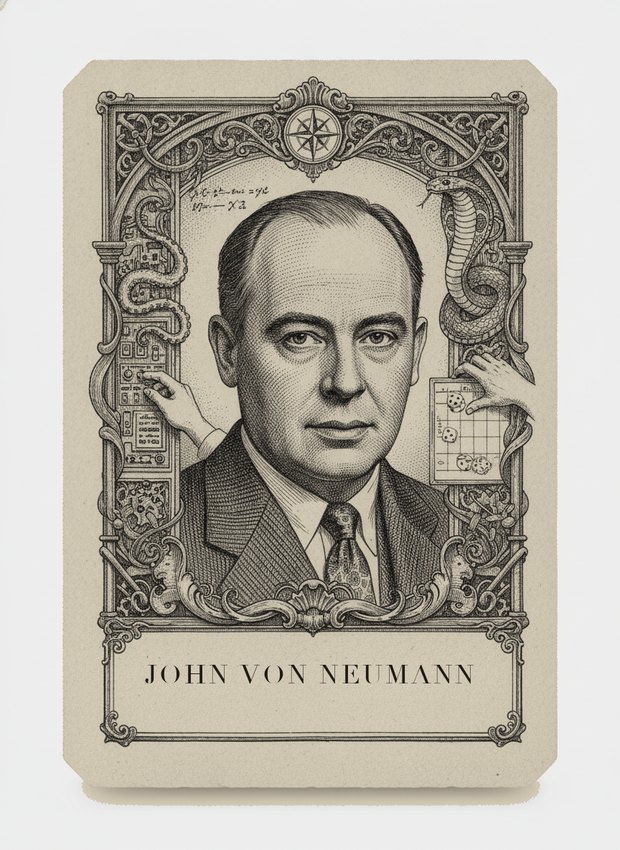
This is not a hypothetical for him — it is his actual 1928 paper, 'Zur Theorie der Gesellschaftsspiele,' written at exactly this moment in his career. He proved the minimax theorem for finite two-person zero-sum games, showing that with mixed strategies the maximin and minimax values coincide; his original proof leaned on a fixed-point-flavored analytic argument he later streamlined via convexity and separating hyperplanes in the 1944 book with Morgenstern. Computing a 5x5 matrix game by hand is squarely within his documented habits: he was legendary for mental calculation, and solving small games reduces to identifying strategy supports and solving linear equations for equalizing probabilities. The problem's framing — RAND, nuclear strategy — is his own biography. No era gap exists; the problem is him.
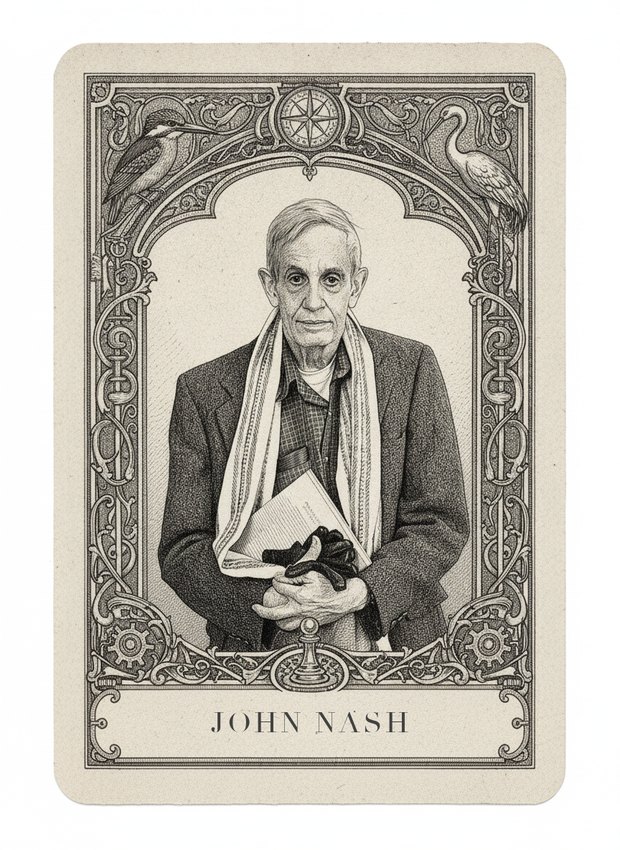
Nash arrives one generation after the theorem but owns its deepest generalization: his 1950 Princeton thesis proved equilibrium existence for arbitrary finite non-cooperative games using Kakutani's and then Brouwer's fixed-point theorem, of which the zero-sum minimax theorem is a special case. He would deliver the existence proof cleanly — arguably more elegantly than von Neumann's 1928 original — and the by-hand computation is routine for him: for a 5x5 zero-sum game, guess the support, equalize expected payoffs across the opponent's active strategies, solve the resulting linear system, verify. His work at RAND in the early 1950s put him inside the exact strategic-analysis institution the problem invokes. The only reason he trails von Neumann is priority: in 1928 the specific machinery is von Neumann's own.
In the mind map
The same ideas, as concepts rather than history — in John's ML knowledge map.
45 figures are scored on this problem. Draw it in a battle to see where you land.