games
Split the river by axiom, not by force
It is 1976, and the Farakka Barrage has just finished its first dry season diverting Ganges water toward Calcutta's harbor, leaving Bangladesh's fields short exactly when rice needs the flow. Six rounds of talks have collapsed because each delegation keeps restating raw historical claims — upstream sovereignty against downstream survival — with no principled way to convert either into a number. You are not asked to mediate; you are asked to derive the split. Fix the disagreement point: the flow each side keeps if talks fail and India runs the barrage alone. State the properties any acceptable division must satisfy — no wasted water either side still wants, no advantage from which country is named first, no dependence on how benefit is scaled, no swing from dropped irrelevant alternatives — and prove they force exactly one allocation: the split maximizing the product of both nations' gains over their fallback. Get the axioms wrong and the number you hand negotiators is either not unique, or violates one nobody checked.
Who this problem belongs to
The two figures whose methods fit it best, out of 8 in contention.
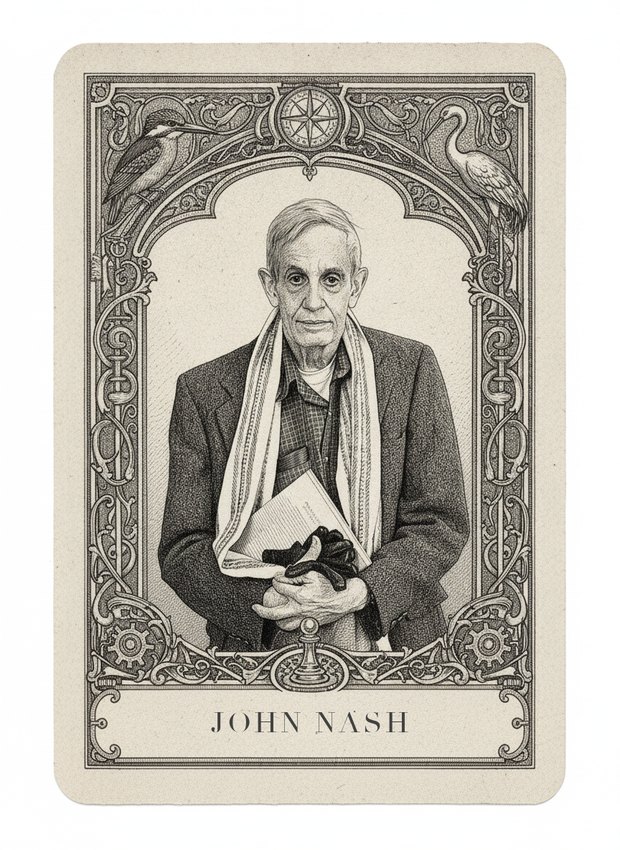
This is Nash's own instrument, unmodified. His 1950 Econometrica paper "The Bargaining Problem" states exactly four properties any two-party division must satisfy — Pareto efficiency, symmetry, invariance to affine rescaling of utility, and independence of irrelevant alternatives — and proves they force one point: the allocation maximizing the product of each party's gain over the disagreement outcome, the solution restated in his 1953 "Two-Person Cooperative Games." Fixing the disagreement point at each nation's unilateral-diversion payoff and maximizing the gain-product over the feasible dry-season schedule is the theorem applied verbatim; nothing about the Ganges changes the mathematics, only the utility numbers. The honest deduction: Nash never touched an actual river treaty, so translating flow-cubic-feet into comparable utility scales — his invariance axiom's whole point — is applied economics he'd have to do himself, not derive from the axioms. The technique is entirely his; the dataset is not.
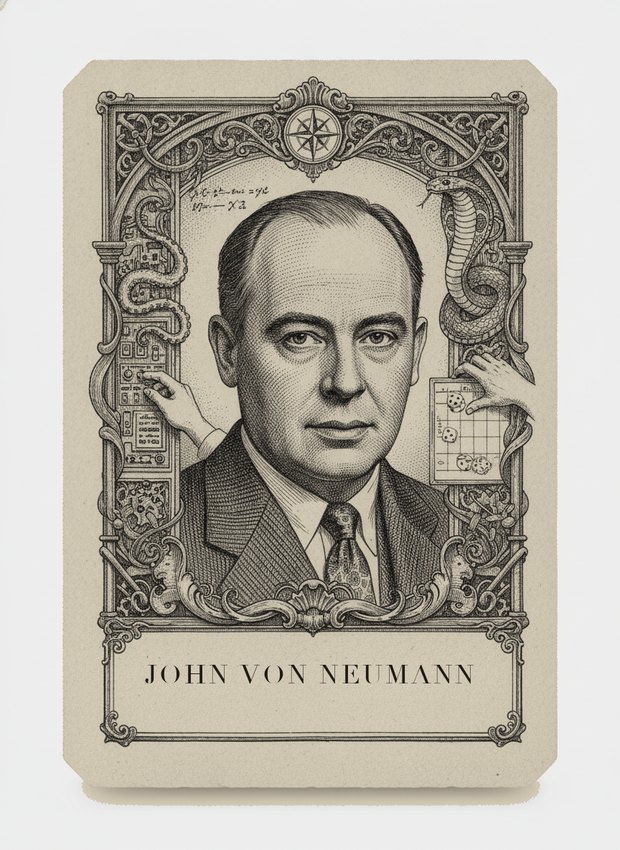
Von Neumann built the machinery this problem needs before Nash arrived: Theory of Games and Economic Behavior (1944, with Morgenstern) introduced characteristic functions, imputations, and coalitions for exactly this kind of multi-party division. But his own cooperative solution concept — the stable set — deliberately does not deliver a single point; it characterizes a whole set of self-enforcing outcomes and can admit many stable sets or none, the opposite of Nash's insistence on uniqueness. He reportedly waved off Nash's equilibrium paper as 'just a fixed point theorem' and never engaged with the bargaining paper's axiomatic style, which subordinates his richer coalitional bookkeeping to four spare requirements. He would grasp the river's payoff structure faster than anyone alive in 1976, and could compute the core of the underlying cooperative game, but the specific instrument — derive uniqueness from IIA and invariance — is Nash's departure from him, not his own tool.
8 figures are scored on this problem. Draw it in a battle to see where you land.