games
Design the auction
It is 2002 in Mountain View, and a young search company must sell advertising slots beside its results — millions of tiny auctions a day, run by algorithm, against bidders who are themselves algorithms. Design the auction: sell ad slots to strategic bidders so that truth-telling is each bidder's best strategy and revenue is predictable. Naive designs invite shading, sniping, and bid-cycling wars that destroy revenue and trust alike; the theory of mechanism design says incentives can be engineered, if the rules are chosen with mathematical care. The stakes compound absurdly: this auction will run billions of times daily and fund most of the consumer internet. A subtle incentive flaw here is not a bug — it is a permanent tax on the entire web.
Who this problem belongs to
The two figures whose methods fit it best, out of 51 in contention.
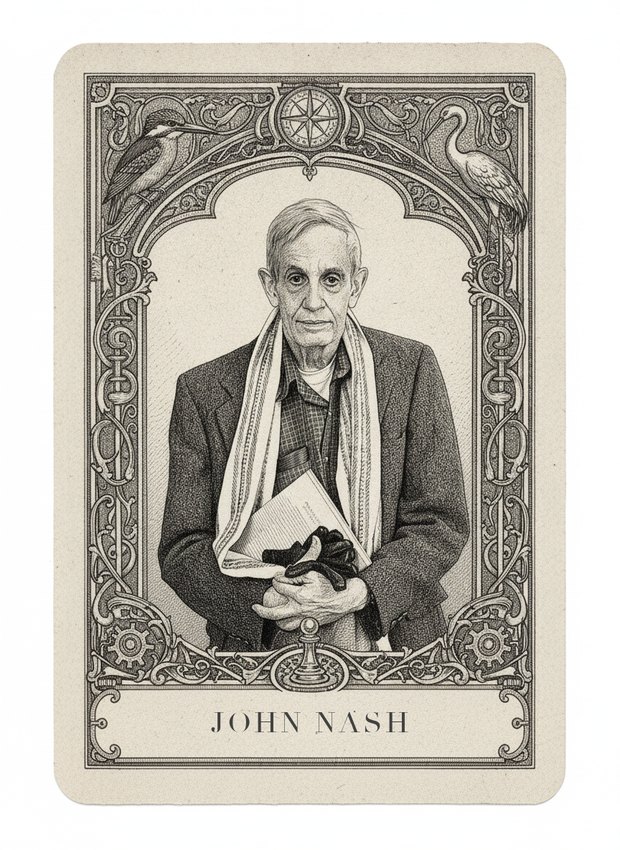
This problem is analyzed, top to bottom, in concepts Nash created. His 1950 thesis defined equilibrium for exactly this situation — many self-interested players, no cooperation assumed — and proved existence; his bargaining solution and the Nash program tied cooperative outcomes to non-cooperative play. Mechanism design is the engineering inverse of his theory: choose the game so that its Nash equilibria (ideally, dominant strategies) do what you want, and the canonical analysis of the generalized second-price auction proceeds by characterizing its Nash equilibria and comparing revenue with truthful VCG outcomes. The honest caveats: Nash predates Vickrey (1961) and Myerson (1981), never designed a market himself, and his RAND-era experience left him skeptical of naive rationality assumptions. But no carrier's actual mathematics is more load-bearing here. The auction's stability is defined in his terms.
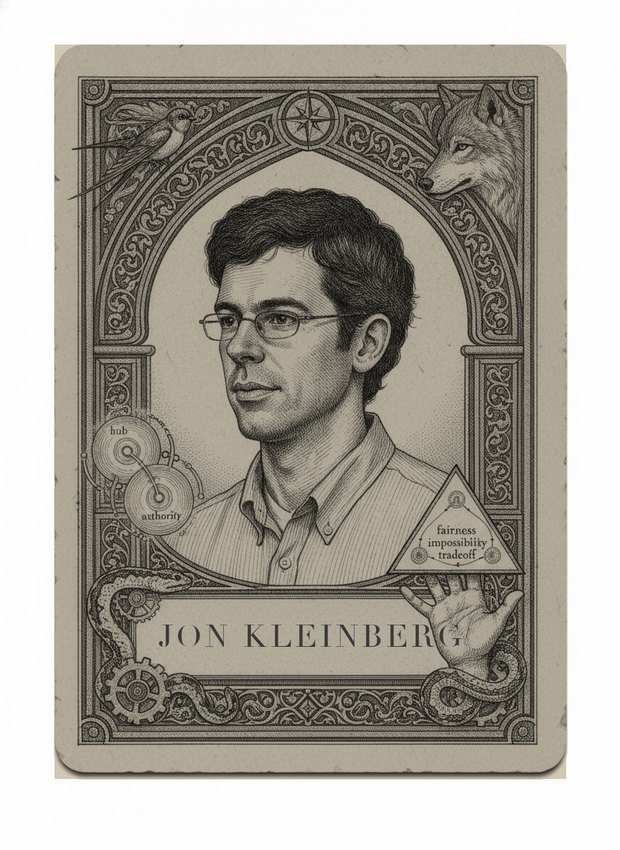
Kleinberg stands at the precise intersection this problem occupies: web-scale algorithms meeting economic incentives. His 1998 HITS algorithm shaped link analysis at the birth of modern search; his small-world results treated emergent structure among self-interested actors; and he became a central figure in algorithmic game theory as it crystallized around 2000, later co-authoring with Tardos the standard textbook treating matching markets, VCG, and sponsored-search auctions explicitly. In 2002 he is an active, working expert on exactly the web infrastructure in question, fluent in both the approximation-algorithm mindset the billions-per-day scale demands and the equilibrium analysis truthfulness requires. He is not a classical auction theorist — Myerson's optimal-auction machinery is economics he applies rather than originated — which is the only daylight between him and the top score.
In the mind map
The same ideas, as concepts rather than history — in John's ML knowledge map.
51 figures are scored on this problem. Draw it in a battle to see where you land.