optimization
Fold the surface, keep every distance
It is 1954 at MIT, and Riemannian geometry carries a nagging philosophical problem: an abstract manifold is defined purely by its metric, with no ambient space, so some geometers doubt it truly "curves" anywhere at all. Settle it concretely: embed the manifold isometrically in ordinary Euclidean space, preserving every distance exactly, not merely its smoothness (Whitney already gave you that). Linearize the metric-matching equations and correct with Newton's method, the obvious approach — except inverting the linearized operator differentiates the unknown, so every correction costs a derivative you do not have, and naive iteration exhausts its own smoothness and diverges in finitely many steps, however small the starting error. The fix is to intersperse smoothing operators between corrections, at a precisely increasing scale, and prove with delicate a priori estimates that the smoothing's gain outpaces the derivative loss. Miscalibrate it and either the correction evaporates with the smoothing, or the iteration blows up before reaching the manifold you started with.
Who this problem belongs to
The two figures whose methods fit it best, out of 8 in contention.
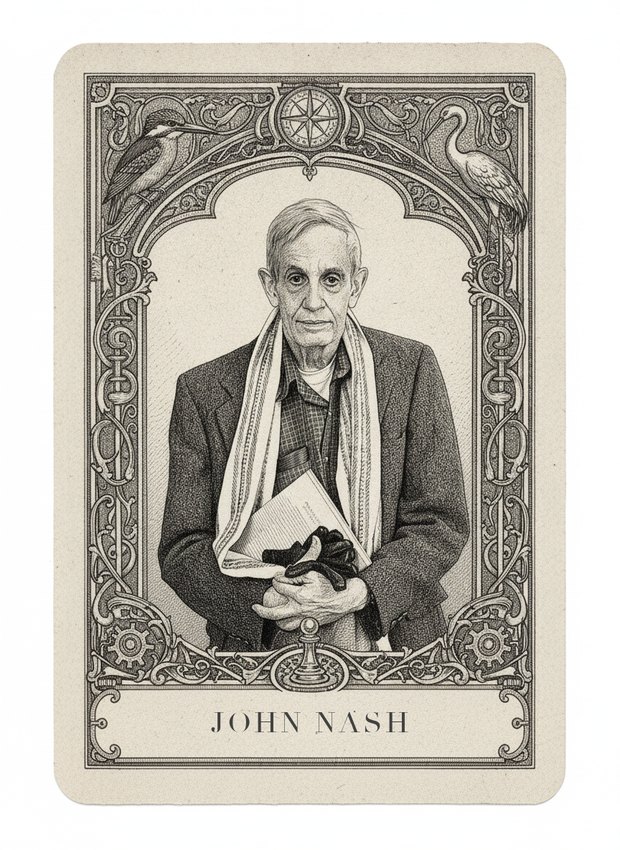
This is Nash's own desk, not an analogy. His 1954 Annals paper gives the C1 embedding (any short embedding can be perturbed to isometric, almost paradoxically, since C1 has no room to lose derivatives), but the real fight is the 1956 "The Imbedding Problem for Riemannian Manifolds": the smooth case, where naive Newton iteration on the metric equations genuinely does lose a derivative per step and diverges. Nash's fix — intersperse smoothing operators between Newton corrections at a carefully chosen, geometrically increasing scale, then prove via delicate estimates that the smoothing gain beats the derivative loss — is exactly this problem's engine. Jurgen Moser abstracted it in 1961 into the general Nash-Moser implicit function theorem; Nash's own version was the ad hoc, ungeneralized original, which is the one point keeping this off 100.

Tao did not invent this technique but he is among its most fluent living practitioners and expositors. His work on quasilinear wave equations, water waves, and local well-posedness for Navier-Stokes-type systems runs on the same currency — paradifferential calculus and Littlewood-Paley decompositions that track exactly how much regularity each nonlinear step costs and how much a mollifier buys back. He has written explicit expository treatments of the Nash-Moser theorem and used loss-of-derivatives iteration schemes in his own papers on wave maps. What keeps him well below Nash: his signature contributions — the Green-Tao theorem, compressed sensing, the Navier-Stokes blowup construction — lie elsewhere, and here he is executing and refining a machine Nash built seventy years earlier, arriving generations after the problem's date.
8 figures are scored on this problem. Draw it in a battle to see where you land.