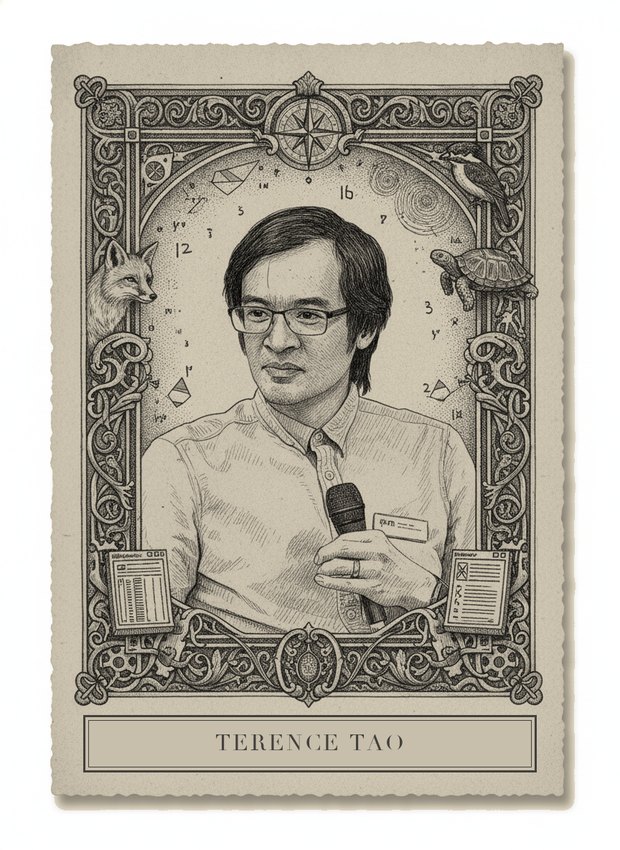
Terence Tao
Fields Medal; compressed sensing (with Candes); the universal mathematician
Played by Uma
Strongest on
Battles
In the mind map
The same ideas, as concepts rather than history — in John's ML knowledge map.
Life and career
Terence Tao's biography has been recited so often that it risks becoming a list of records rather than a life. He was born in Adelaide, South Australia, in 1975. He competed at the International Mathematical Olympiad while still a child, taking a gold medal at thirteen — still the youngest ever to do so. He finished his undergraduate and master's work in Australia and then went to Princeton, where he completed a doctorate under Elias Stein at twenty-one, working in harmonic analysis. He joined UCLA immediately afterward and became a full professor there at twenty-four. He has remained at UCLA ever since.
What the prodigy narrative obscures is the shape of the mature career, which is far more interesting. Tao did not settle into a narrow subfield and defend it. He became the most conspicuously *mobile* mathematician of his generation, producing significant results in harmonic analysis, additive combinatorics, analytic number theory, random matrix theory, partial differential equations, ergodic theory, and — most relevant here — the mathematics of signal recovery. He was awarded the Fields Medal in 2006, along with a MacArthur Fellowship the same year, and later the Crafoord Prize and an inaugural Breakthrough Prize in Mathematics.
He has also been one of mathematics' most visible public participants. His blog has functioned for nearly two decades as a running seminar, a place where he explains techniques, posts open problems, and works through partial ideas in public. He was a central contributor to the Polymath experiments in massively collaborative online mathematics, and he has been an early and serious experimenter with formal proof assistants and, more recently, with AI systems as tools for mathematical work — writing publicly and carefully about what they do and do not currently help with. This is not incidental to his reputation; the willingness to work in the open, at length, on things that might not pan out, is part of why the field trusts his judgment about where mathematics is going.
For a data science audience, the crucial episode is his mid-2000s collaboration with Emmanuel Candès at Caltech. Two mathematicians from adjacent but distinct traditions found themselves looking at a question — when can you recover a signal from far fewer measurements than its ambient dimension — and produced a set of theorems that reorganized signal processing, statistics, and medical imaging within about five years.
Key contributions
**Compressed sensing.** The classical Nyquist framing says you need as many measurements as degrees of freedom. Candès, Tao, and Justin Romberg showed that this is the wrong accounting when the signal is *sparse*. If $x \in \mathbb{R}^n$ has only $s$ nonzero entries and you observe $y = Ax$ with $m \ll n$ random measurements, then minimizing $\|x\|_1$ subject to $Ax = y$ — a convex program, solvable by linear programming — recovers $x$ **exactly**, with overwhelming probability, provided $m \gtrsim s \log(n/s)$.
The technical machinery is the **restricted isometry property**: $A$ satisfies RIP of order $2s$ if it acts as a near-isometry on all $2s$-sparse vectors, $(1-\delta)\|v\|_2^2 \le \|Av\|_2^2 \le (1+\delta)\|v\|_2^2$. Candès and Tao proved that RIP with a small enough constant forces $\ell_1$ minimization to find the sparsest solution — turning an NP-hard $\ell_0$ problem into a tractable convex one with a proof, not a hope — and that random Gaussian, Bernoulli, or randomly subsampled Fourier matrices satisfy RIP with high probability at the stated sampling rate. Their companion framing, *decoding by linear programming*, recast the problem as error correction: sparse corruption of a linear code can be undone by an $\ell_1$ program. The practical consequence, most visibly in accelerated MRI, was scan times cut by large factors with no loss of diagnostic quality.
**The Dantzig selector.** With Candès, Tao extended the program into statistics proper, addressing estimation when $p \gg n$. The estimator minimizes $\|\beta\|_1$ subject to a constraint bounding the correlation between residuals and every predictor, $\|A^\top(y - A\beta)\|_\infty \le \lambda$. The accompanying theorem is a near-oracle bound: the estimator's squared error is within a $\log p$ factor of what you could achieve if an oracle told you which variables were actually nonzero. This is one of the results that made high-dimensional statistics a rigorous subject rather than a collection of penalization heuristics.
**Random matrix universality.** With Van Vu, Tao proved universality results for the local eigenvalue statistics of random matrices — showing, via a "four moment theorem," that the fine-scale spacing behavior of eigenvalues depends only on the first few moments of the entry distribution, not on its full form. They also established the circular law for non-Hermitian random matrices under minimal assumptions. For a data scientist, the practical import is direct: these results underpin what you can legitimately conclude from the eigenvalues of a sample covariance matrix, and why the top eigenvalues of pure noise are not where naive intuition places them.
**The Green–Tao theorem.** With Ben Green, Tao proved that the primes contain arbitrarily long arithmetic progressions. The proof is a landmark in additive combinatorics, and its method — a transference principle allowing Szemerédi-type density theorems to be applied to sparse sets sitting inside a pseudorandom majorant — has been enormously influential well beyond number theory.
**Analysis and PDE.** Substantial work on the restriction and Kakeya problems in harmonic analysis, and on nonlinear dispersive equations. His work on Navier–Stokes is particularly notable methodologically: rather than attacking the regularity problem directly, he constructed an *averaged* version of the equations obeying the same energy identity for which blowup does occur, showing that any successful proof must use more than energy methods.
In battle
Tao carries the broadest card of anyone in this group: 100 problems, mean 45.7, median 42, and only twelve problems at or below 20. Where most figures on the roster are spikes, Tao is a plateau with peaks — he is at least respectable almost everywhere, which makes him the safest pick in the game even though he holds fewer 95+ cards than several narrower specialists.
**P094, "Reconstruct from too few measurements"** (97) is a direct restatement of his own theorem: the conditions on random measurement matrices under which $\ell_1$ relaxation provably recovers a sparse signal, with high probability. **P018, "p = 20,000, n = 200"** (84) is the Dantzig selector setting. **P182, "The corner that sparsity loves"** (78) is the geometric intuition for why the $\ell_1$ ball's vertices induce sparse solutions where the $\ell_2$ ball's smooth surface does not — the picture behind the whole program. **P282, "The eigenvalues are lying"** (85) is random matrix theory applied to sample covariance, where his universality work is directly on point.
His mathematical range earns him strong scores on problems he never worked on specifically. **P044, "Sketch the enormous matrix"** (88) is randomized numerical linear algebra, whose analysis rests on concentration and subspace-embedding arguments that are his everyday tools. **P042, "Prove the descent"** (82) is convergence analysis; **P180, "Relax, then round"** (78) is convex relaxation with rounding guarantees; **P159, "Is this number prime?"** (78) rewards his analytic number theory. His `high-dim` (67.0 across fifteen problems), `computability` (57.0 across fifteen), and `optimization` (55.6 across fourteen) averages are all excellent, and they are what make him formidable in a long match rather than a single duel.
The losses are honest and specific, and they are all about *engineering and era* rather than about capability. **P080, "The software that may not fail"** (5) is his floor: real-time embedded flight software, priority scheduling, overload shedding, restart protection under hard deadlines. Tao's career begins three decades after that problem's setting, and nothing in his record touches safety-critical systems architecture. The game is explicit that this reflects a genuine mismatch of specialty, not any doubt about his power — and that distinction is worth internalizing, because it is the cleanest illustration in the game that raw brilliance does not transfer to concrete engineering practice.
The same logic governs the rest. **P049, "Schedule the moonshot"** (11) is project scheduling and critical-path management. **P198, "Program chess before the computer exists"** (15) and **P200, "Beat the world champion"** (10) are game-playing systems; his `games` average of 27.3 across fourteen problems is respectable-for-Tao but decisively behind anyone who actually built one. **P236, "A thousand words, connected speech"** (12) is speech recognition, and **P201, "The dice make it learnable"** (8) is temporal-difference learning — neither has any connection to his work. His weakest category is `search` at 13.0.
The strategic read: Tao is the card you play when you do not know what is coming. He will rarely be beaten badly, and on anything involving sparsity, high-dimensional geometry, concentration, or spectra of random matrices, he wins outright. Play him against a systems problem and he will lose to people whose names you have never heard.