games
When everyone acts selfishly
It is 1950 at Princeton, and von Neumann's theory covers only the pure conflict of zero-sum games — but the real economy is not pure conflict. Three firms set prices simultaneously each quarter, each maximizing its own profit, each anticipating the others. Predict where behavior settles, and when 'settles' is even the right word: prove that a stable point exists for games that are not zero-sum, and characterize what it means for none of the three to regret its choice. Antitrust regulators, market designers, and eventually every economist on earth will use this concept to predict oligopoly behavior. If the equilibrium notion is ill-founded, decades of economic policy will rest on a prediction that predicts nothing.
Who this problem belongs to
The two figures whose methods fit it best, out of 53 in contention.
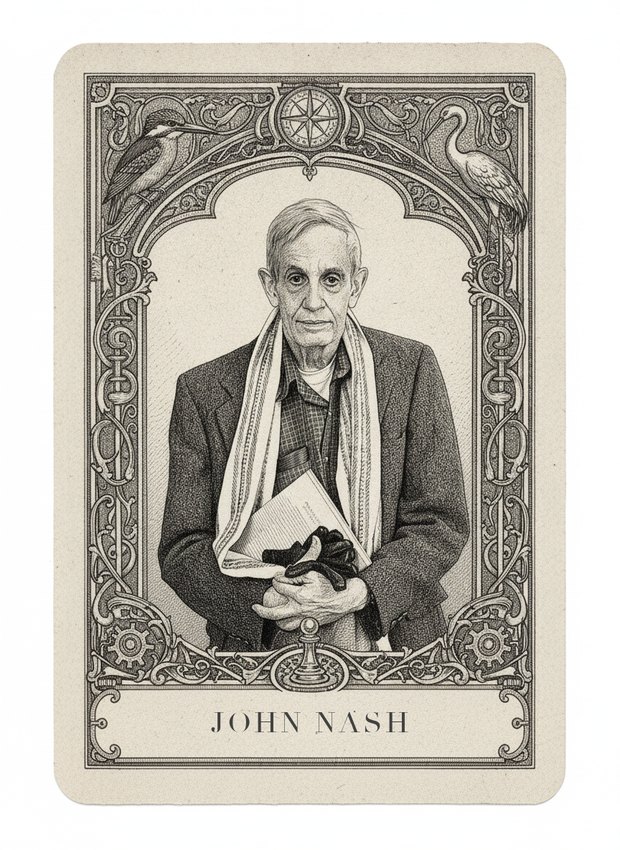
This is Nash's problem in the strict historical sense: his 1950 PNAS note, written at Princeton at exactly the problem's stated moment, proved that every finite non-cooperative game has an equilibrium point, via Kakutani's fixed-point theorem applied to the best-response correspondence; his 1951 Annals paper redid it with Brouwer and named the concept. The 'no firm regrets its choice given the others' characterization is his definition verbatim, and his thesis's mass-action interpretation even anticipated the dynamic question of whether repeated play settles there. Cournot's 1838 oligopoly is the special case his theorem subsumes — three firms setting prices is the canonical application. Honest caveats keep him off 100: existence is not uniqueness, so prediction can be ambiguous among multiple equilibria; and computing equilibria is PPAD-complete (shown 2006), a limit invisible from 1950. Otherwise: maximal fit, by construction.
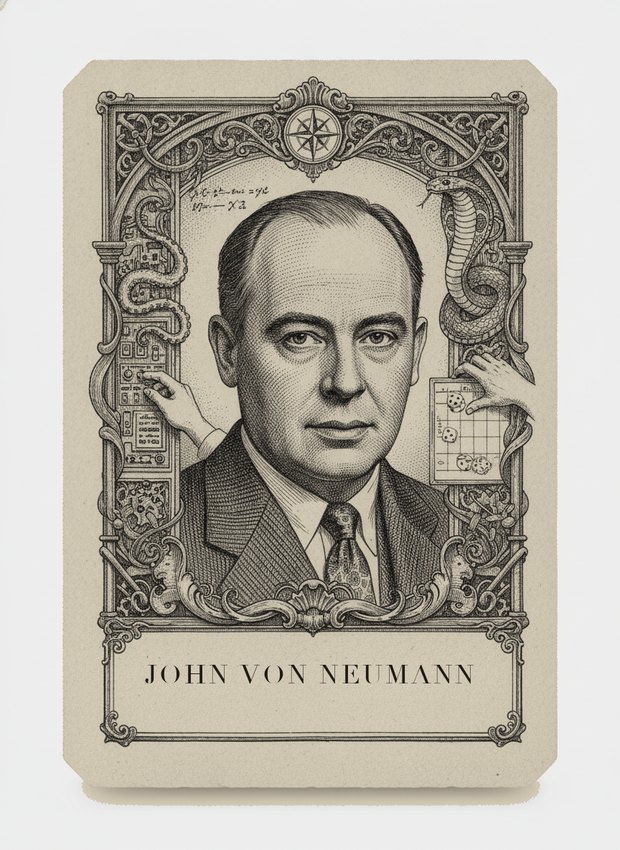
Von Neumann built the discipline this problem lives in: the 1928 minimax theorem proved equilibrium existence for two-person zero-sum games, and Theory of Games and Economic Behavior (1944, with Morgenstern) supplied the entire formal apparatus — expected utility, normal form, mixed strategies — the problem presupposes. His 1937 expanding-economy model even used Brouwer's fixed-point theorem for an economic equilibrium, so the exact mathematical weapon was already in his hands. Yet history records the precise gap: he attacked non-zero-sum games through cooperative theory — coalitions, stable sets — rather than per-player equilibrium, and reportedly dismissed Nash's result as 'just a fixed point theorem.' True — but the fixed point Nash took was the one von Neumann didn't. He possesses every tool and nearly the theorem; the solution concept itself belongs to his junior colleague.
In the mind map
The same ideas, as concepts rather than history — in John's ML knowledge map.
53 figures are scored on this problem. Draw it in a battle to see where you land.