It is the early 1960s, and a puzzle circulating through the mathematics community is sharper than it looks: candidates are interviewed one at a time in random order, each can only be ranked against those already seen, and the decision to hire is immediate and irrevocable — pass on someone and they are gone. Maximize the probability of hiring the single best. The answer has a shape nobody guesses: observe a calibration fraction — 1/e of the sequence — then take the first candidate who beats everyone seen, succeeding 37% of the time, a rate no cleverness improves. Derive it, then map the structure onto the real decisions it models: selling a house, filling a position, committing. Stop too early or too late and the best option is simply lost.
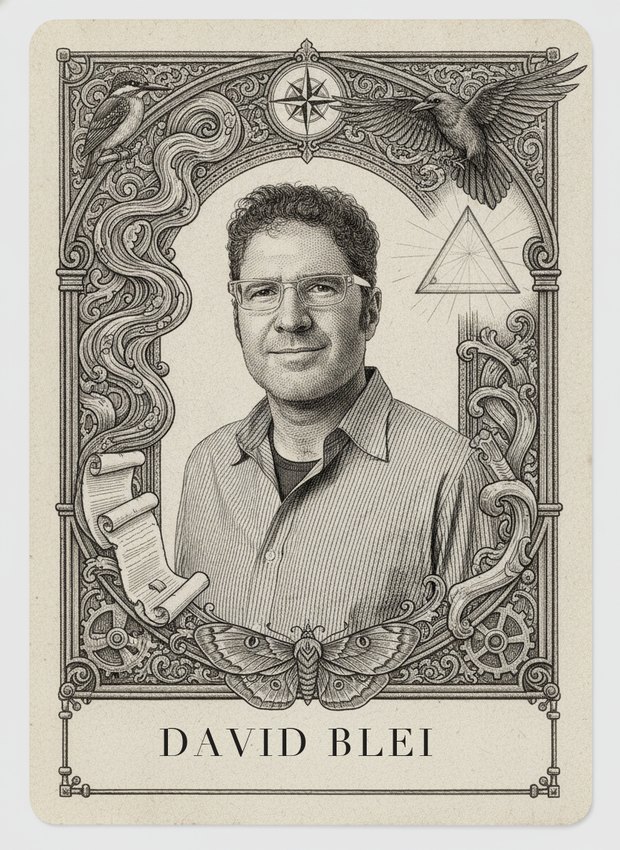
Blei's topic models and variational inference made practical give him genuine technical sophistication with probabilistic modeling and approximate optimization under uncertainty, background relevant in spirit to the probabilistic reasoning this problem's optimal-stopping derivation requires, even though his own major published research targets unsupervised learning of latent structure in text and data rather than classical combinatorial optimal-stopping theory or the secretary problem specifically. His broader Bayesian modeling instincts keep him in a related mathematical neighborhood as a rigorous probabilist. His relevance to this specific 1960s puzzle is general modern probabilistic-modeling competence applied at some distance from the actual derivation this problem's "derive it" instruction demands. A grad student should treat this as general modern probabilistic competence rather than direct engagement with the classical derivation.

Silver's AlphaGo and AlphaZero demonstrated that value-based sequential decision-making methods, distantly related to the recursive reasoning underlying classical optimal-stopping derivations, can solve enormously complex sequential problems through learned rather than analytically derived policies, a different methodological approach from this problem's explicit demand for a closed-form mathematical derivation. His practical engineering of large-scale sequential value estimation is relevant background for the general mathematical territory but not a direct technique. He never worked on the secretary problem or classical optimal stopping theory, so his relevance is a distant modern methodological adjacency rather than any direct contribution to this problem's derivation. His relevance is a distant modern methodological adjacency rather than any direct contribution to this problem derivation.
Battle #97 · 8/10/2026, 11:37:42 AM · this result is deterministic: the same two personas on this problem always resolve the same way.