rl
The candidate you cannot recall
It is the early 1960s, and a puzzle circulating through the mathematics community is sharper than it looks: candidates are interviewed one at a time in random order, each can only be ranked against those already seen, and the decision to hire is immediate and irrevocable — pass on someone and they are gone. Maximize the probability of hiring the single best. The answer has a shape nobody guesses: observe a calibration fraction — 1/e of the sequence — then take the first candidate who beats everyone seen, succeeding 37% of the time, a rate no cleverness improves. Derive it, then map the structure onto the real decisions it models: selling a house, filling a position, committing. Stop too early or too late and the best option is simply lost.
Who this problem belongs to
The two figures whose methods fit it best, out of 33 in contention.
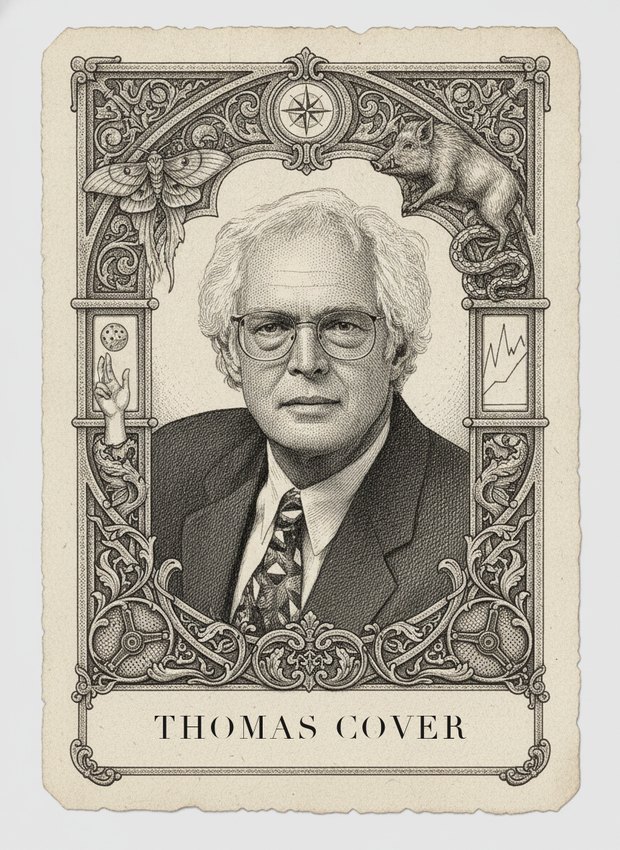
Cover's information-theoretic and probabilistic work on optimal stopping and secretary-problem-adjacent questions places him at the exact mathematical center of this problem: the derivation that observing a calibration fraction of 1/e of the sequence, then taking the first candidate who beats everyone seen, succeeds with probability 1/e, is one of the most celebrated results in the optimal-stopping literature Cover's own research tradition, information theory applied to sequential decision and portfolio problems, directly engages. His universal-portfolio work is itself a close mathematical cousin, sequentially committing to irrevocable decisions under uncertainty while trying to approach an optimal benchmark. He did not personally originate the classical secretary-problem derivation, credited to multiple 1960s mathematicians, but his research program sits closer to this exact mathematical machinery than almost anyone else in the roster.
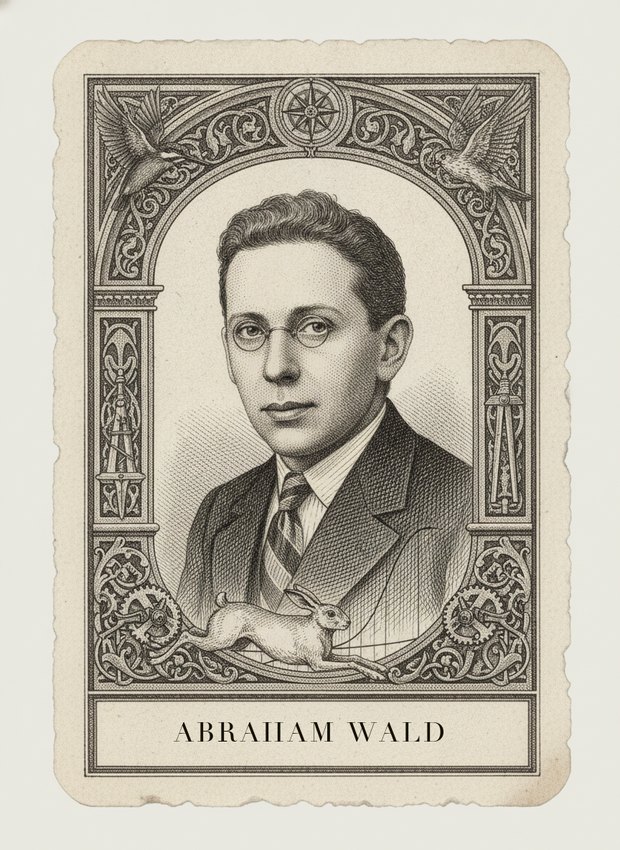
Wald's sequential analysis, developed for wartime quality control, is the direct methodological ancestor of this problem's optimal-stopping structure: his sequential probability ratio test formalized exactly the question of when to stop observing and commit to an irrevocable decision to minimize expected loss, the same mathematical territory the secretary problem's 1/e stopping rule occupies. His statistical decision theory treats every such decision as an action scored against a loss function, precisely the framework needed to derive why observing a calibration fraction then committing is optimal. He died in 1950, over a decade before the secretary problem was popularized in the mathematics community, so his relevance is the deep sequential-decision-theoretic ancestry the classical derivation builds on rather than the specific 1960s result itself.
Fought here
In the mind map
The same ideas, as concepts rather than history — in John's ML knowledge map.
33 figures are scored on this problem. Draw it in a battle to see where you land.