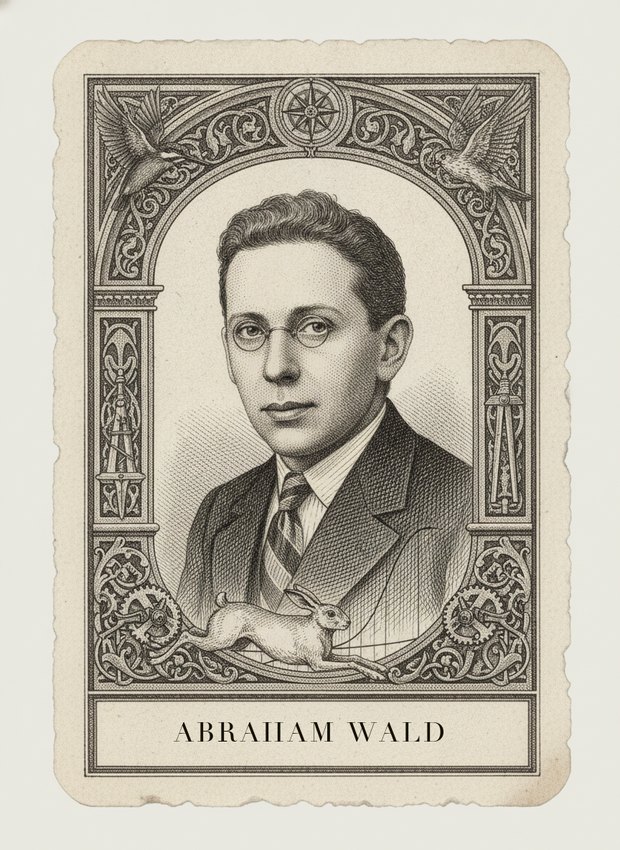
Abraham Wald
Statistical decision theory; sequential analysis; survivorship bias insight
Strongest on
In the mind map
The same ideas, as concepts rather than history — in John's ML knowledge map.
Life and career
Abraham Wald's career was compressed into about fifteen productive years by antisemitism at one end and a plane crash at the other, and in that window he reorganized the foundations of statistics.
He was born in 1902 in Kolozsvár, then in Hungary, now Cluj-Napoca in Romania. His family was Orthodox Jewish, and because he would not attend school on Saturdays he was educated largely at home by his parents and older brother. He entered the University of Cluj and then went to Vienna, where he took his doctorate in 1931 under Karl Menger with a thesis in geometry — a highly abstract result on metric spaces and the axiomatic characterization of geometric structure. Menger considered him outstanding. But Austria in the early 1930s would not give a Jew an academic appointment, and Wald took private work instead: he tutored the economist Karl Schlesinger in mathematics, and through him joined Menger's colloquium and turned to economics.
The economics work from these years is significant in its own right. Wald produced the first rigorous mathematical analysis of the existence and uniqueness of equilibrium in a Walrasian general-equilibrium system, work that is directly ancestral to the Arrow–Debreu results two decades later. He also worked at the Austrian Institute for Business Cycle Research under Oskar Morgenstern on seasonal adjustment of time series.
The Anschluss in 1938 made Austria immediately lethal. Morgenstern, already in the United States, helped arrange a position for Wald with the Cowles Commission, and he emigrated that year, then moved to Columbia University on a fellowship arranged by Harold Hotelling. He stayed at Columbia for the rest of his life, becoming a professor and building its statistics program. Eight members of his family, including his parents and a sister, were killed at Auschwitz.
During the war Wald was the leading figure at Columbia's **Statistical Research Group**, a remarkable concentration of talent — Hotelling, Wallis, Wolfowitz, Milton Friedman, George Stigler — doing applied statistical work for the military: ordnance inspection, quality control, bombing accuracy, aircraft vulnerability. Sequential analysis came out of that work, and so did the survivorship-bias analysis he is popularly known for. His wartime memoranda on aircraft vulnerability addressed the question of where to add armor to bombers given data on the distribution of hits on returning planes, and his contribution was the recognition that the sample is conditioned on survival: the returning aircraft show you where a plane can be hit and still come home. His technical work was a considerably more careful estimation of the probability of downing given a hit in each region than the folk version of the story suggests, but the folk version has the logic right.
After the war he published *Sequential Analysis* (1947) and *Statistical Decision Functions* (1950), the two books that carry his reputation. In December 1950, on a lecture tour of India at the invitation of the Indian government, he and his wife were killed when their plane struck a mountain in the Nilgiris. He was forty-eight.
Key contributions
**Statistical decision theory.** This is the framework contribution, and it is the one that unified the field. Wald's move was to treat every statistical procedure — estimating, testing, predicting, choosing — as a **decision rule** δ mapping observed data to actions, evaluated by a **loss function** L(θ, a) specifying the cost of taking action a when the true state is θ. The **risk function** R(θ, δ) is the expected loss under θ. Estimation and testing stop being separate subjects and become special cases: squared-error loss gives estimation, 0-1 loss on two hypotheses gives testing.
Two criteria for choosing among rules follow. **Minimax**: pick the rule minimizing the worst-case risk over θ — an explicitly adversarial stance, treating nature as an opponent, and Wald connected this directly to von Neumann's game theory, showing that statistical inference is a two-player game against nature. **Bayes rules**: pick the rule minimizing risk averaged over a prior. Wald's **complete class theorems** then establish the deep structural result that the admissible decision rules are essentially the Bayes rules and their limits — meaning that any procedure not expressible as (approximately) Bayes is dominated by one that is. This is one of the most consequential results in the philosophy of statistics: it says that the frequentist criterion of admissibility drives you back to the Bayesian form, which is a large part of why the two traditions can be talked about in one language at all. The concepts of **admissibility** and **dominance** are his.
**Sequential analysis and the SPRT.** Classical testing fixes n in advance. Wald asked why. His **sequential probability ratio test** accumulates the log-likelihood ratio as observations arrive, continues sampling while it lies between two boundaries A and B set from the desired error rates α and β, and stops the instant it crosses either — accepting or rejecting accordingly. His 1947 book derives the boundary approximations, computes the expected sample size using what is now **Wald's identity** (the expectation of a randomly-stopped sum equals the expected stopping time times the mean summand), and demonstrates savings that are often around half the observations required by the best fixed-sample test at the same error rates. With Wolfowitz he proved the SPRT **optimal**: among all tests with the same two error probabilities, none has smaller expected sample size under either hypothesis. The work was classified during the war. Every modern group-sequential clinical trial design, every alpha-spending function, every always-valid p-value and anytime-valid confidence sequence in the current sequential-testing literature descends from this.
**Survivorship bias and selection.** The bomber analysis is a specific instance of a general principle: when the observed sample is generated by a process that conditions on an outcome, naive analysis of the survivors is systematically wrong, and the correction requires modeling the selection. This is the same structure as truncation and censoring in survival analysis, sample-selection bias in econometrics, collider stratification bias in epidemiology, and the missing-not-at-random problem generally.
**Wald test and asymptotics.** The Wald test — comparing an estimate to its hypothesized value, standardized by the estimated information — is one of the three standard asymptotic test constructions alongside the likelihood-ratio and score tests, and appears in the default output of essentially every regression package. He also contributed to errors-in-variables regression and to the theory of nonparametric tolerance intervals.
In battle
Wald's profile is that of a wide-spectrum threat with an unusual signature: mean 51.1, median 49, eighteen problems above 80, twenty-nine above 70, and only sixteen weak. What distinguishes him from Fisher and Neyman is *where* the extra strength sits — his optimization average of 71.5 and RL average of 63.5 across six problems are the highest such numbers in the early-statistics cohort, because decision theory is fundamentally about acting rather than describing.
His dominant problems are almost all his own inventions. "Stopping the sequential test" (99) is the SPRT in its original ordnance-inspection setting; the profile notes that every element of the problem statement is his. "Peeking at the trial" (97) is the modern interim-analysis problem — what happens to your error rates when you look at accumulating data — and it is the SPRT's direct descendant. "The bomber that came home" (98) is his survivorship analysis, literally. "Optimize for the worst case" (96) is minimax, his criterion. "The adaptive dose-finder" (96) is sequential experimentation with a decision rule updating as data arrives. "The ruler that lies a little" (97) is errors-in-variables measurement, where he did direct technical work. "Estimate the tank total" (95) is decision-theoretic estimation with an explicit loss. "Catch the process the moment it drifts" (94) is sequential change-point detection and industrial process control — CUSUM is an SPRT run repeatedly.
The RL strength is the most interesting feature of his sheet and deserves explanation, because it is not chronological. Wald never saw a reinforcement-learning paper. But sequential decision-making under uncertainty with a loss function, an adversarial worst-case criterion, and an explicit stopping rule *is* the structure of bandit problems, regret minimization, and safe exploration. A student who has studied UCB or Thompson sampling is working in Wald's frame with different notation, and the game credits him accordingly. Likewise his games average of 36.0 — higher than any of his statistical contemporaries — reflects the genuine link he drew to von Neumann's minimax theorem.
His weaknesses are computational, symbolic, and infrastructural. "The document that links anywhere" (8) is his floor: hypertext and universal addressing, where the profile allows only thematic kinship and no technical bridge. "Let the machine find the proof" (8) is automated deduction, "The problem all others reduce to" (13) is Cook–Levin and complexity theory, "The picture that isn't there" (8) is image reconstruction, and "Prune the game tree, provably" (10) is alpha-beta — notably, an *adversarial* problem he loses, because the difficulty there is combinatorial search rather than risk under uncertainty. "Classify with 30 labels and 30,000 unlabeled" (14) is semi-supervised learning, which needs assumptions about data geometry rather than a loss function. His classification average is 17.0, perception 14.0, search 14.5, computability 16.0.
The rule for playing him is stated in his own battle identity: he wins when you can write down a loss function and an adversary, and loses when you cannot. Send him at sequential procedures, stopping rules, worst-case guarantees, selection bias, quality control, and adaptive experimentation. Keep him away from anything where the problem is to *find* something in a large discrete space rather than to *decide* something under uncertainty.