optimization
Optimize for the worst case
It is the era when planners learn that optimizing for the expected scenario can be a trap: a plan tuned to average demand can collapse the moment reality lands in the tail. You must commit to decisions now — inventory, capacity, a portfolio — before the uncertain parameters are revealed, and you want a solution that performs well not on average but across the whole range of plausible outcomes, including adversarial ones. Formulate the problem so the optimization hedges against an uncertainty set rather than a single forecast, and keep it tractable. Get it wrong and you produce a brittle plan optimal for a world that never arrives, or hedge away all the value — robust optimization is how decisions get made when the data comes after commitment.
Who this problem belongs to
The two figures whose methods fit it best, out of 71 in contention.
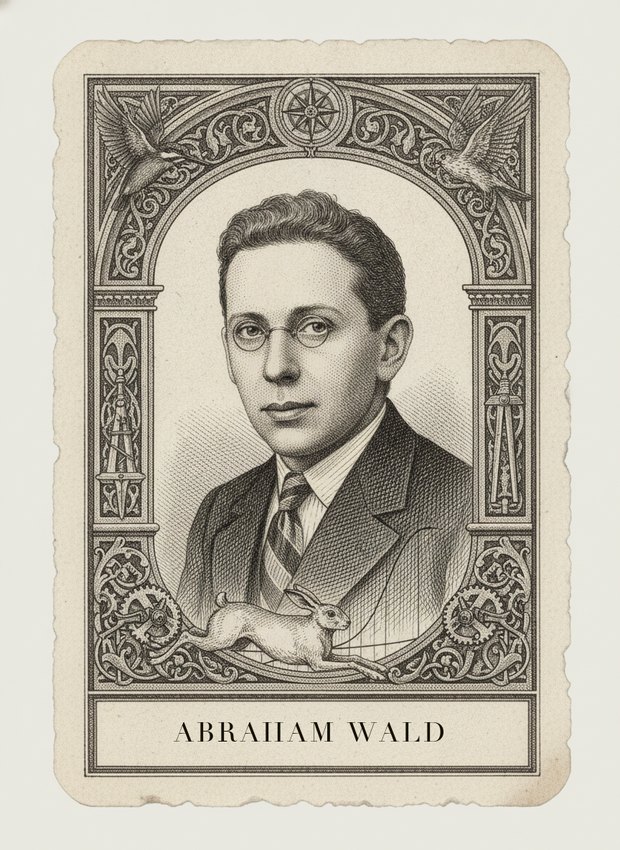
Wald's statistical decision theory, developed during and after his World War II work on sequential analysis and famously including the survivorship-bias insight about where to armor returning bombers, is precisely minimax reasoning: choose the action that performs best against the worst plausible state of the world, not the expected one. His 1950 book 'Statistical Decision Functions' formalized minimax decision rules as the rigorous alternative to Bayesian expected-value reasoning when the analyst distrusts the assumed distribution over outcomes, exactly this problem's premise. He built the mathematical grammar of committing to a decision before uncertainty resolves and evaluating it by its worst case. His score reflects direct, foundational authorship of this problem's entire conceptual framework.
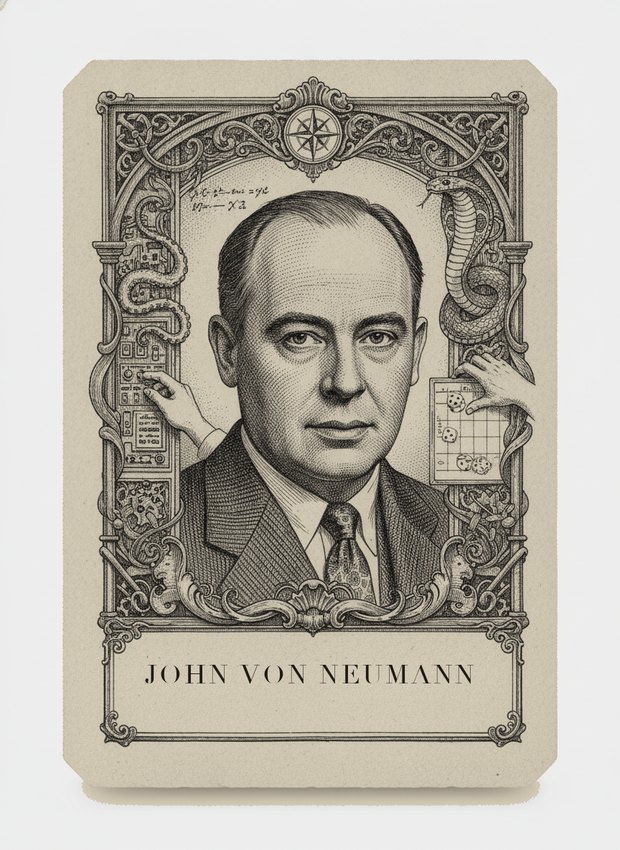
Von Neumann's minimax theorem, proved in 1928 and central to his 1944 book with Morgenstern, is the mathematical bedrock beneath all robust optimization: it guarantees that in a zero-sum game, a strategy optimizing against the worst-case adversarial response exists and can be computed, exactly the logic this problem asks planners to adopt against an uncertain, potentially adversarial future. His game-theoretic framing treats uncertainty as an opponent, precisely the adversarial-uncertainty-set framing the problem specifies. He did not personally develop robust convex optimization's modern machinery, but the minimax principle underlying it is his. His score reflects deep foundational authorship one abstraction layer beneath the modern technique. That foundational standing means the game-theoretic backbone of this entire problem traces to him, even though the modern tractable machinery came later.
Fought here
In the mind map
The same ideas, as concepts rather than history — in John's ML knowledge map.
71 figures are scored on this problem. Draw it in a battle to see where you land.