testing
Stopping the sequential test
It is wartime again, and munitions come off the line to be inspected — but every observation costs money, time, and sometimes a destroyed unit, so testing a fixed large sample is pure waste. Observations arrive one at a time; after each you must choose to accept the lot, reject it, or pay for one more look. Design the rule that decides when to stop with guaranteed error rates on both kinds of mistake, using on average far fewer observations than any fixed-sample test. The stopping rule is the invention. Get it wrong and you either pass defective munitions to the front or scrap good lots at ruinous cost — and the whole point, spending only as much data as the decision requires, is lost.
Who this problem belongs to
The two figures whose methods fit it best, out of 48 in contention.
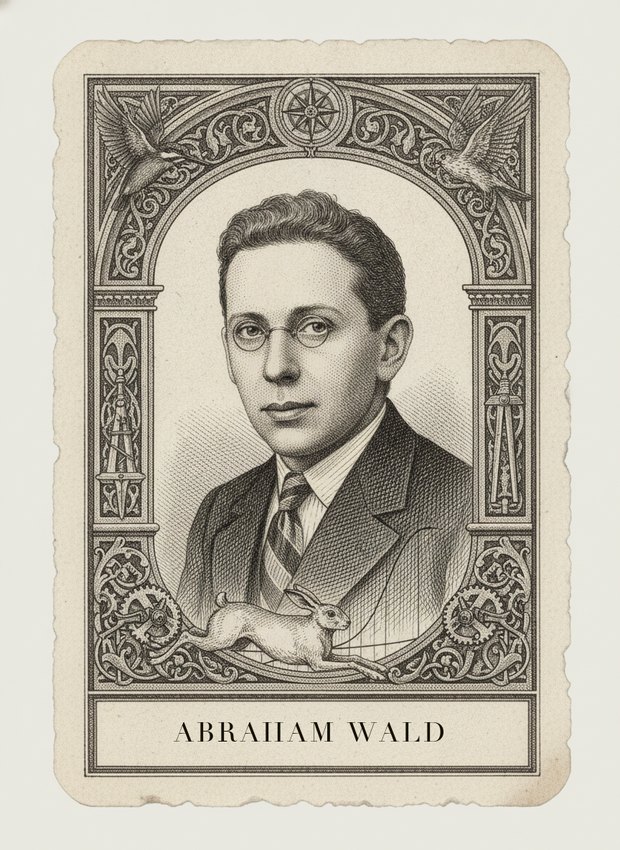
This is Wald's own invention, in its original setting. At Columbia's Statistical Research Group in 1943, working precisely on wartime munitions and ordnance inspection, he devised the sequential probability ratio test: continue sampling while the likelihood ratio stays between two boundaries set directly from the desired error rates alpha and beta, and stop the moment it crosses either. His 1947 book Sequential Analysis derives the boundary approximations A and B from the error constraints, computes expected sample size via what is now Wald's identity, and shows the savings — often half the observations of the best fixed-sample test. With Wolfowitz in 1948 he proved the SPRT optimal: no test with the same error guarantees uses fewer observations on average. Every element of the problem statement is his.
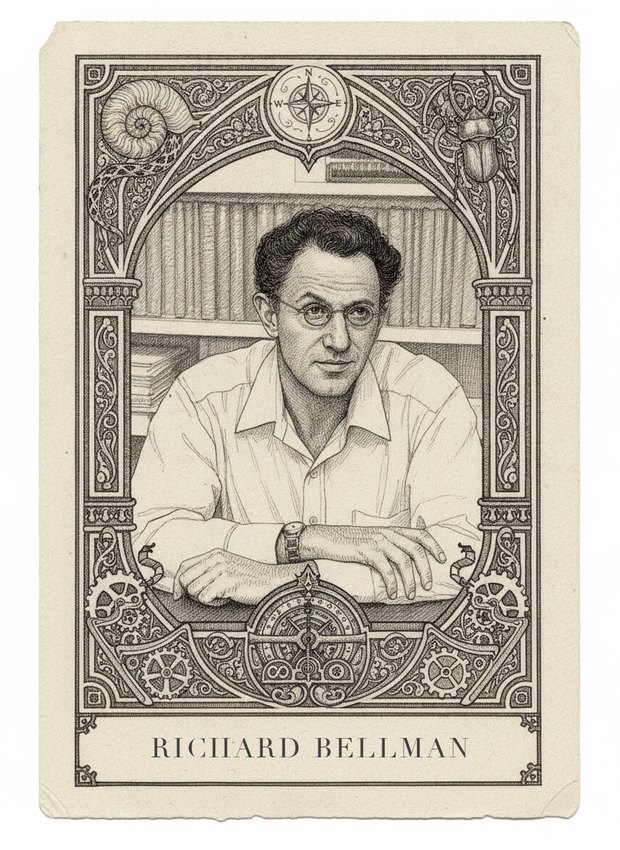
Optimal stopping is a dynamic program, and dynamic programming is Bellman's invention (RAND, early 1950s). His principle of optimality gives the clean structural argument for why the optimal sequential test must be a two-threshold rule: the value function of the continue/accept/reject problem, computed by backward induction on the posterior, forces exactly the SPRT's form — the derivation now standard in every decision-theory text. Arrow, Blackwell, and Girshick's 1949 Bayes-sequential paper and Wald's own later work run on precisely this recursive logic, contemporaneous with Bellman's formalization of it. He arrives five years after the SPRT itself and the error-rate calibration is statisticians' territory rather than his, which is what separates him from Wald. But as the owner of the mathematical principle that explains why the answer is optimal, he is the problem's second-strongest carrier.
In the mind map
The same ideas, as concepts rather than history — in John's ML knowledge map.
48 figures are scored on this problem. Draw it in a battle to see where you land.