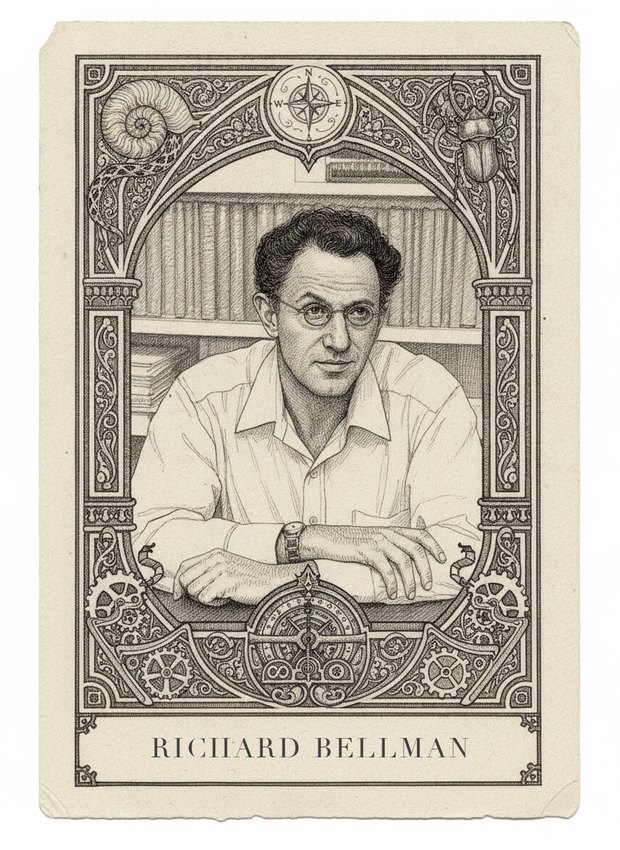
Richard Bellman
Dynamic programming; the curse of dimensionality
Played by Amanda Gill
Strongest on
Battles
Shortest path through the map W Frederick Jelinek
How much can the railway carry? W Andrew Gelman
Catch the process the moment it drifts W John Santerre
The model is five percent of the system
In the mind map
The same ideas, as concepts rather than history — in John's ML knowledge map.
Life and career
Richard Ernest Bellman gave his central idea a deliberately vague name, and by his own account he did it for bureaucratic cover. Working at RAND in the early 1950s under Air Force contract, with a Secretary of Defense who reportedly had a visceral dislike of the words *research* and *mathematics*, Bellman needed a label for multistage decision processes that would survive a budget review. "Programming" meant planning and scheduling, which sounded operational. "Dynamic" sounded impressive and, he noted, was impossible to use in a pejorative sense. The story comes from his own autobiography, *Eye of the Hurricane*, and historians have poked at its details, but it is his telling, and the resulting term has confused generations of students who reasonably expect it to involve a computer program.
He was born in Brooklyn in 1920, the son of a grocer, and grew up in a New York where a bright kid could educate himself in the public library. He went to Brooklyn College, took a master's at Wisconsin, and was drafted into the Army during the war. After the Army Specialized Training Program at Wisconsin he was assigned to Los Alamos, working in the theoretical division on the Manhattan Project — an experience that put him, at twenty-four, in a room with the most formidable mathematicians and physicists of the era.
After the war he went to Princeton for a doctorate, finishing in 1946 under Solomon Lefschetz with a thesis on the stability theory of differential equations. He taught at Princeton and then Stanford, and by his late twenties had a reputation as a pure analyst with a promising career in classical mathematics. He gave it up. He joined RAND in 1952, drawn by problems rather than theorems, and spent the next thirteen years there.
RAND in the 1950s was the ideal environment for what he did next. It was full of people — Dantzig, von Neumann as a consultant, Ford, Fulkerson, Shapley — attacking planning and allocation problems for the Air Force with whatever mathematics could be brought to bear, on computers with a few thousand words of memory. Bellman's problems were *sequential*: not "what is the best allocation," but "what is the best sequence of decisions when each one changes the situation the next one faces." Inventory, equipment replacement, missile guidance, resource scheduling over time. His answer, worked out across the 1950s and published in *Dynamic Programming* (1957), was to stop searching over sequences and start solving backward from the end.
Bellman left RAND in 1965 for the University of Southern California, where he held professorships in mathematics, electrical engineering, and medicine simultaneously, and spent his later career applying dynamic programming and control theory to biomedical problems — drug dosing, cardiology, medical diagnosis. He was extraordinarily prolific by any measure, with hundreds of papers and dozens of books.
In 1973 he was diagnosed with a brain tumor. The surgery removed it but left him with severe and permanent disability — impaired mobility and speech, and years of complications. He kept working. A substantial fraction of his published output came after the operation, produced with the help of colleagues and family, and colleagues' accounts of that period are uniformly about persistence rather than pathos. He received the Norbert Wiener Prize in Applied Mathematics, the von Neumann Theory Prize, and the IEEE Medal of Honor in 1979, the citation naming dynamic programming and the invention of the Bellman equation. He died in 1984.
Key contributions
**The principle of optimality and the Bellman equation.** The principle is a statement about the structure of optimal sequential decisions: an optimal policy has the property that whatever the initial state and initial decision, the remaining decisions must constitute an optimal policy with regard to the state resulting from the first decision. Stated that way it sounds nearly tautological. Its consequence is not.
Define the *value function* $V(s)$ as the best achievable total return starting from state $s$. The principle implies the recursion
$$V(s) = \max_a \Big\{ r(s,a) + \gamma \sum_{s'} P(s' \mid s,a)\, V(s') \Big\}.$$
This is the Bellman equation. What it does is replace an optimization over the entire space of policies — which grows exponentially in horizon — with a fixed-point equation over the state space. Solve for $V$, and the optimal action at any state is whatever attains the max. The computational payoff is that a problem whose naive search cost is $|A|^T$ becomes one whose cost is $T \cdot |S| \cdot |A|$.
Two algorithmic families follow immediately. *Value iteration* applies the Bellman operator repeatedly; because that operator is a $\gamma$-contraction in the sup norm, Banach's fixed-point theorem gives geometric convergence to the unique optimal value function, with a clean error bound at every iteration. *Policy iteration* — developed by Ronald Howard in 1960 — alternates policy evaluation and greedy improvement and converges in finitely many steps.
For anyone working in reinforcement learning, this is the load-bearing structure of the entire field. Q-learning is a stochastic approximation to the Bellman optimality operator applied to state–action values. Temporal-difference learning bootstraps from the Bellman equation's own consistency condition. Fitted value iteration, DQN, actor–critic methods, AlphaZero's value network — all of them are the Bellman recursion with function approximation substituted for the table.
**The Hamilton–Jacobi–Bellman equation.** In continuous time and continuous state, the same principle yields a nonlinear partial differential equation for the value function, $-\partial_t V = \max_a \{ r + \nabla V \cdot f \}$, which is the foundation of optimal control theory alongside Pontryagin's maximum principle. Viscosity-solution theory later supplied the right notion of solution for the cases where $V$ is not differentiable.
**The curse of dimensionality.** Bellman coined the phrase, in *Dynamic Programming* (1957) and again in *Adaptive Control Processes* (1961), as an honest accounting of his own method's limits: the state space of a $d$-dimensional problem discretized at $k$ levels per dimension has $k^d$ states, so exact dynamic programming is feasible only for small $d$. The phrase escaped optimal control entirely and is now the standard name for every high-dimensional pathology — the vanishing of relative distance contrast in nearest-neighbour search, the exponential sample complexity of nonparametric estimation, the emptiness of high-dimensional balls. Crucially, Bellman did not merely diagnose it; with Stuart Dreyfus he experimented with polynomial and quadrature approximations of the cost-to-go function, which makes him the origin of approximate dynamic programming as well as of exact.
**The Bellman–Ford algorithm.** Single-source shortest paths with negative edge weights permitted, by relaxing all edges $|V|-1$ times — dynamic programming over path length. It is slower than Dijkstra but handles negative weights and detects negative cycles, and it is the basis of distance-vector routing protocols.
**Stability theory and other work.** The Bellman–Grönwall inequality, a workhorse tool for bounding solutions of differential and integral equations, comes from his early analysis career. He also worked on invariant imbedding, on branching processes (the Bellman–Harris process), and extensively on the application of control theory to physiology and medicine.
In battle
Bellman is one of the strongest and broadest carriers in this set: 100 problems, mean 48.4, median 44, nineteen dominant cells and twenty-eight at 70 or above, with nineteen at 20 or below. The reason is structural — sequential decision-making appears in an enormous number of guises, and he wrote the equation that governs all of them.
His categories run **games** (83.5), **testing** (81.5), **experimental-design** (79.5 across four), **rl** (67.7 across *eighteen* problems — the single most valuable block on his sheet), **networks** (63.0), and **search** (57.4 across sixteen).
His peak is **P067 — Dynamic programming's curse** at 98, which the matrix describes as asking him to recite his collected works — the principle of optimality, the functional equation, the coined phrase, and the Dreyfus approximation experiments are all his, in the building where he did them. **P068 — When to replace the engine** (97) is the equipment-replacement problem, one of the original RAND applications. **P221 — How much stock to hold** (95) is inventory control under uncertainty, the other canonical DP application. **P278 — All your neighbors are equidistant** (95) is distance concentration in high dimensions — the curse under its other name. **P038 — Decode the hidden path** (92) is the Viterbi algorithm, which is exactly dynamic programming over a trellis. **P208 — The missile and the evader** (92) is pursuit–evasion as a differential game, HJB territory. **P192 — Plan when you cannot see** (90) is partially observed planning, where the belief-state MDP formulation is the standard reduction and rests entirely on his recursion. **P120 — Play the winner** (92) is the multi-armed bandit, where the Gittins index and the Bayesian formulation are both dynamic programs over belief states.
The failure modes divide into two clean classes. First, **systems** at 18.7 across ten problems, with floor cells at **P249 — The shopping cart that must not vanish** (8), **P248 — The machine that overdosed** (9), **P081 — Train across a thousand GPUs** (10), and **P252 — The document that links anywhere** (12, hypertext). Bellman built mathematics for planning, not infrastructure for running software, and every one of those problems is an engineering artifact from decades after his active period.
Second — and more interesting — the *representation learning* failures. **P257 — The meaning of a word is its company** (8, word embeddings) and **P166 — Compress without knowing the source** (10, universal compression) are near the floor, and his **nlp** average is 24.0 with **classification** at 26.0. The matrix's explanation of the word-embedding cell is a precise statement of a trap: one *can* argue that the curse of dimensionality bears loosely on extracting low-dimensional representations from high-dimensional co-occurrence data, and that argument is explicitly rejected as generic mathematical adjacency rather than historical precedent. Bellman's high-dimensional insight is a warning about the size of state spaces, not a method for learning features.
Note also **high-dim** at only 37.0 across eleven problems, which is the sharpest irony on his sheet: the man who named the curse of dimensionality scores mid-range on high-dimensional problems, because the modern responses to that curse — sparsity, regularization, random projection, kernel methods, manifold assumptions, deep representation — were all developed after him and by other people. He identified the disease with unusual clarity and supplied only the first, crudest treatments.
Play Bellman on anything with a horizon: control, planning, scheduling, inventory, bandits, sequential decoding, and every reinforcement-learning problem on the board. Keep him away from anything about representations or infrastructure.