high-dim
All your neighbors are equidistant
It is 1998, and similarity search has hit an invisible wall: a multimedia database indexes images as thousand-dimensional feature vectors, and the nearest-neighbor engine that hummed in ten dimensions returns junk in a thousand. The pathology is geometric, not a bug — as dimension grows, the distance to the nearest point and the farthest point concentrate toward each other, and "nearest" stops meaning anything. Diagnose the concentration precisely: when does nearest-neighbor remain meaningful, what intrinsic low-dimensional structure rescues it, and what do the classical asymptotic guarantees for nearest-neighbor methods actually promise in this regime? Get it wrong and retrieval systems ship confident rankings that are arithmetic noise — recommendations, matches, and forensic "similar faces" drawn from distances that discriminate nothing.
Who this problem belongs to
The two figures whose methods fit it best, out of 58 in contention.
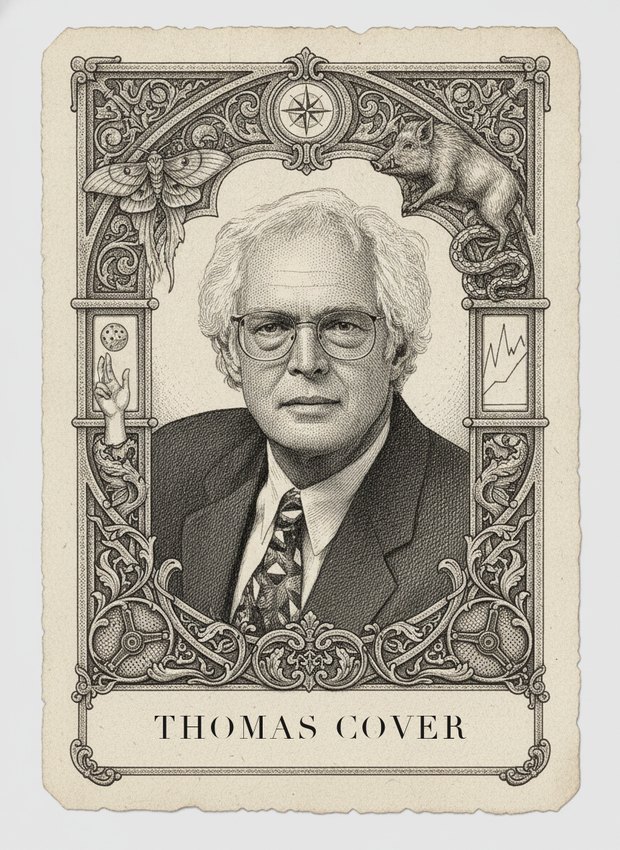
This is Cover's own foundational territory. His 1967 paper with Peter Hart established the classical asymptotic nearest-neighbor error bound, that its error rate is asymptotically at most twice the Bayes-optimal error, precisely the 'classical asymptotic guarantee' the problem asks what it actually promises in high dimensions. His later information-theoretic work on high-dimensional geometry, including results on the concentration of volume near a sphere's surface, gives him the exact mathematical vocabulary for why distances concentrate as dimension grows. He would diagnose immediately that the 1967 guarantee assumes fixed dimension and unboundedly growing sample size, an assumption the thousand-dimensional feature-vector regime violates, and could rigorously state what if anything survives. Dropped into 1998, he is revisiting and correcting the limits of his own founding result.
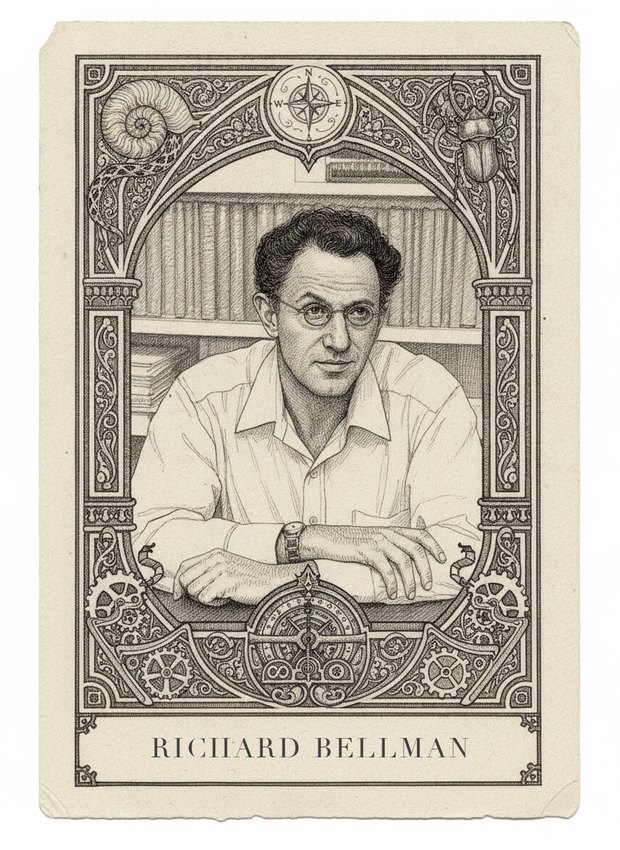
Bellman coined the term 'curse of dimensionality' in his 1957 work on dynamic programming, precisely to describe how the volume of a space, and the sparsity of data within it, grows catastrophically as dimension increases, exactly the pathology this problem diagnoses in nearest-neighbor retrieval. His insight that high-dimensional spaces are mostly empty of nearby points is the conceptual seed of the concentration-of-measure phenomenon the problem asks to be characterized precisely. He would recognize instantly that a retrieval system's confident rankings in a thousand dimensions are built on geometric noise. His gap relative to the strongest carrier is that his own work stated the qualitative curse vividly without the later distance-concentration theorems and intrinsic-dimension theory that make the diagnosis fully rigorous.
In the mind map
The same ideas, as concepts rather than history — in John's ML knowledge map.
58 figures are scored on this problem. Draw it in a battle to see where you land.