games
The missile and the evader
It is 1955 at RAND Corporation, and the games on the blackboard have stopped being parlor games: a pursuer and an evader maneuver continuously in space, and the Air Force wants to know who wins — a homing missile against a jinking bomber, an interceptor against a warhead. Formalize the pursuit as a differential game: strategies are control laws, payoffs accrue continuously, and the solution couples game theory to the calculus of variations, with a surface in state space dividing capture from escape. Compute who wins from where, and the optimal maneuvers for both. Get the boundary wrong and doctrine is built on fantasy — interceptors procured that cannot catch what they chase, or evasion tactics that fly bombers into the capture zone.
Who this problem belongs to
The two figures whose methods fit it best, out of 55 in contention.

Bellman's dynamic programming, formalized while he was at RAND in the 1950s, is precisely the mathematics the problem calls for: coupling game theory to the calculus of variations by treating the pursuit as a sequence of optimal decisions backward from the capture boundary. His work explicitly engaged differential games and pursuit-evasion problems as an extension of optimal control, and RAND in the 1950s was exactly the institutional home where this mathematics was developed for exactly this purpose, missiles chasing bombers, interceptors chasing warheads. His principle of optimality, breaking a continuous multi-stage decision problem into a sequence of simpler ones, underlies how the capture-versus-escape boundary is actually computed. The only reason this falls short of a perfect score is that Rufus Isaacs, working alongside him at RAND, is credited with the differential-game formalism's decisive final synthesis.
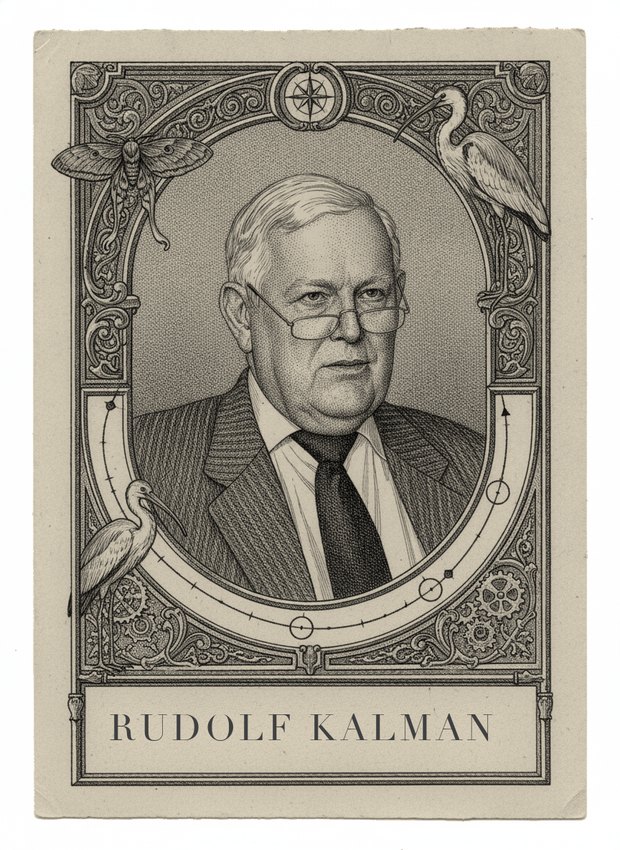
Kalman's 1960 filter for optimal state estimation from noisy measurements, and his broader state-space formulation of control theory, gave engineering the exact mathematical language the pursuit problem needs: representing a missile and an evader's positions, velocities, and uncertainties as evolving state vectors and computing optimal control laws in continuous time. His work on controllability and observability of dynamical systems is directly relevant to determining whether an interceptor can, from a given state, force capture regardless of the evader's maneuvers. Kalman's own famous filter targeted passive, non-adversarial noise processes rather than a rational evading adversary, which is a genuine gap between his most famous result and the specifically game-theoretic pursuit problem, but his state-space control framework is close to indispensable machinery for the paper's continuous-control formalization.
In the mind map
The same ideas, as concepts rather than history — in John's ML knowledge map.
55 figures are scored on this problem. Draw it in a battle to see where you land.