experimental-design
The adaptive dose-finder
It is wartime, and sequential methods are being born under the pressure of not wasting a single observation. Now the setting is a dose-finding trial: patients arrive one at a time, and you must choose each one's dosage using everything the earlier patients taught you — too low wastes the chance to help, too high risks harm. You are balancing two goods that pull apart: the welfare of the patient in front of you against knowledge for the thousands who come after. Design the trial that adapts as results arrive and defend the ethics of every escalation. Get it wrong and you either endanger volunteers chasing information or learn too slowly to help anyone — the sequential structure is what makes the trade-off honest.
Who this problem belongs to
The two figures whose methods fit it best, out of 49 in contention.
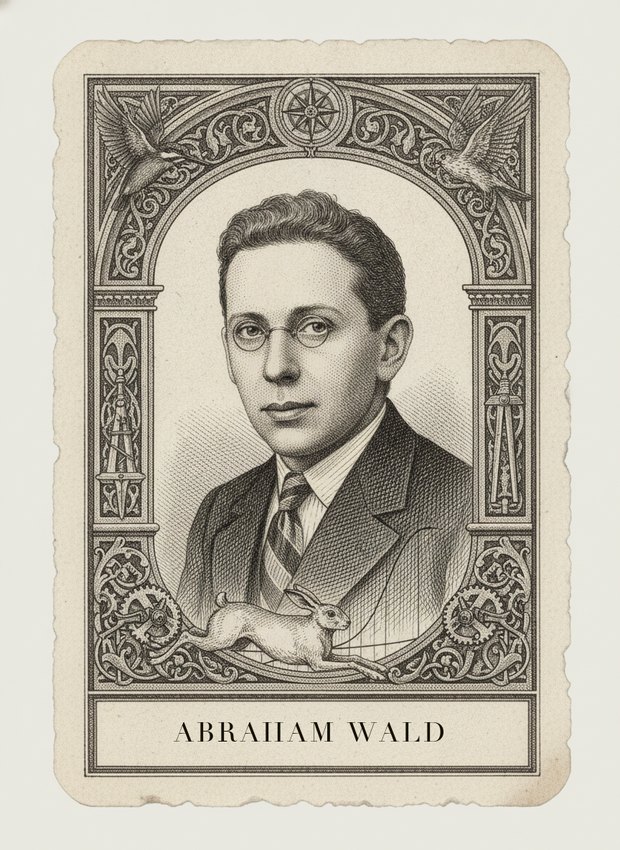
This is Wald's problem almost verbatim. Working for the Statistical Research Group during World War II, he invented sequential analysis precisely to avoid wasting a single observation: his sequential probability ratio test lets you stop, continue, or decide after each incoming data point rather than fixing the sample in advance. That one-at-a-time decision structure is exactly what dose-finding demands. His statistical decision theory (1950) frames the trade-off as a loss function balancing action against information, giving a principled language for escalation rules. What his 1940s toolkit lacks is the modern ethical scaffolding of informed consent and IRB oversight, and continuous covariate-dependent dosing, but the mathematical engine for adapting to accumulating evidence while respecting a stopping rule is his direct invention.
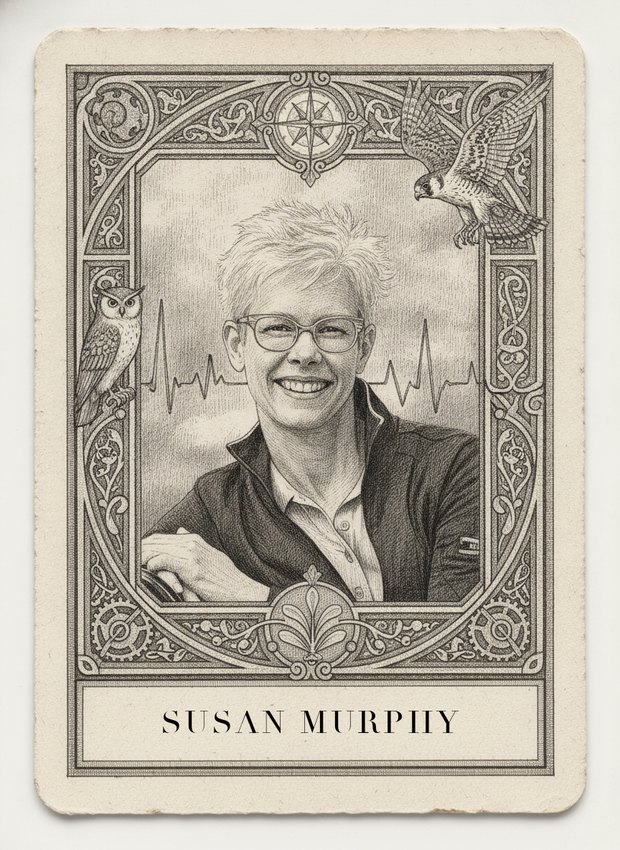
Murphy built her career on exactly this: sequential decision-making for treatment when patients arrive over time. Her work on dynamic treatment regimes and adaptive clinical trials (SMART designs, from the 2000s onward) formalizes how to choose each intervention using everything prior patients revealed, and her micro-randomized trials extend it to per-context adaptation. She explicitly reasons about the welfare-versus-knowledge tension and the statistical guarantees needed to defend each escalation. Dose-finding is a canonical case her methods handle, blending reinforcement learning with rigorous inference. Her only distance from the wartime framing is that her tools assume modern computing and large mobile-health data streams; scaled down to a single dose-escalation trial, her framework applies with almost no translation. Among living carriers she is the strongest fit.
Fought here
In the mind map
The same ideas, as concepts rather than history — in John's ML knowledge map.
49 figures are scored on this problem. Draw it in a battle to see where you land.