regression
The ruler that lies a little
It is the mid-twentieth century, and a regression relating a response to a predictor rests on a quiet fiction: that the predictor is measured perfectly. It is not — the instrument reading it has its own error — and that error does something insidious, biasing the estimated slope systematically toward zero rather than merely adding scatter. Diagnose the attenuation, and estimate the true relationship despite it, either by modeling the measurement error directly or by finding a variable correlated with the true input but not its noise. Get it wrong and a real effect is understated, perhaps into insignificance, and you conclude a genuine driver doesn't matter — errors-in-variables is the trap where more noise doesn't just blur the answer, it moves it in a known, wrong direction.
Who this problem belongs to
The two figures whose methods fit it best, out of 58 in contention.
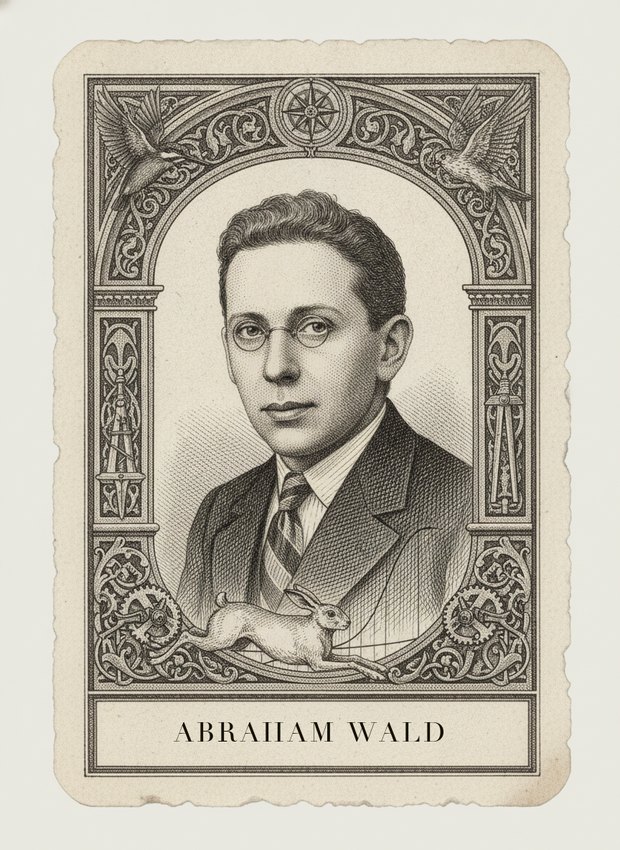
Wald's 1940 paper 'The Fitting of Straight Lines if Both Variables Are Subject to Error,' published in the Annals of Mathematical Statistics, is the direct historical answer to this exact problem. He proved that ordinary least squares, which assumes the predictor is measured without error, produces a slope biased toward zero when it is not, and he built the method-of-grouping estimator, splitting observations into groups by the error-prone variable and using group means to recover a consistent slope, as a practical fix requiring no distributional assumptions about the noise. His wartime survivorship-bias insight shows the same instinct: what you assume is clean can quietly distort every downstream conclusion. No one else on this roster owns the specific diagnosis and the specific fix as completely and as early as Wald does here.
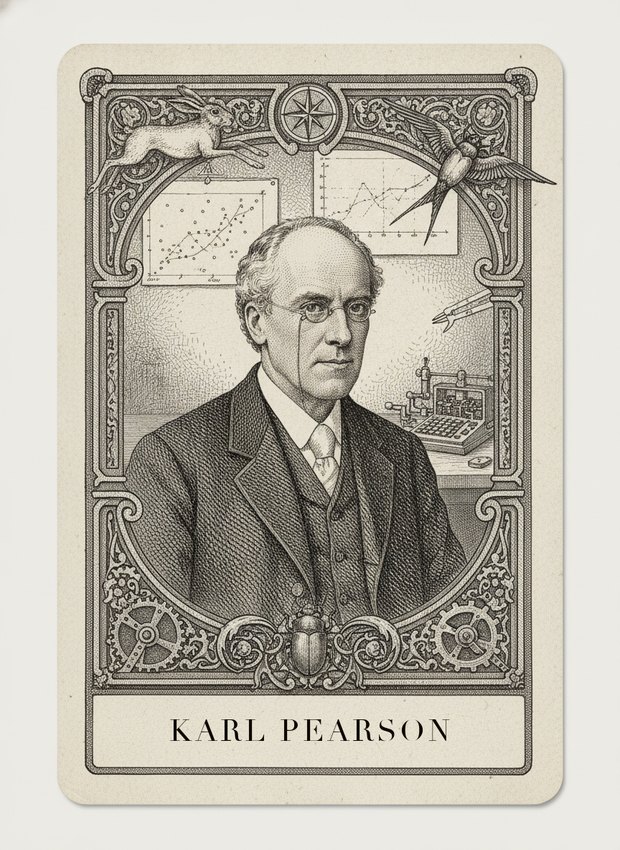
Pearson's 1901 paper 'On Lines and Planes of Closest Fit to Systems of Points in Space' introduced orthogonal regression, later called total least squares, which minimizes perpendicular rather than vertical distance and is the classical geometric answer to errors present in both the predictor and the response. As founder of mathematical statistics at University College London, he understood deeply that ordinary regression's asymmetry between predictor and outcome is a modeling choice, not a law of nature, and that choice matters exactly when the predictor carries measurement error. He predates Wald's specific attenuation proof and instrumental-variable-style fixes, and his orthogonal-regression solution requires knowing the ratio of the two error variances, a real practical limitation the problem's own diagnosis doesn't fully resolve. Still, he built the foundational alternative geometry.
Fought here
In the mind map
The same ideas, as concepts rather than history — in John's ML knowledge map.
58 figures are scored on this problem. Draw it in a battle to see where you land.