It is 1985 at UCLA, and medical expert systems are drowning: encoding diagnosis as thousands of brittle if-then rules has produced systems that contradict themselves the moment evidence arrives in an unexpected order. The real structure is probabilistic — forty diseases, 200 symptoms, tangled dependence — and the full joint distribution has more parameters than there are atoms of patient data. Build a representation where the dependencies are drawn as a graph, diagnosis queries are tractable, and updating on new evidence is principled rather than ad hoc. The prize is a probability calculus machines can actually run; the failure mode is a decade more of expert systems confidently wrong at the bedside, and an AI winter with the word "probability" frozen out of it.
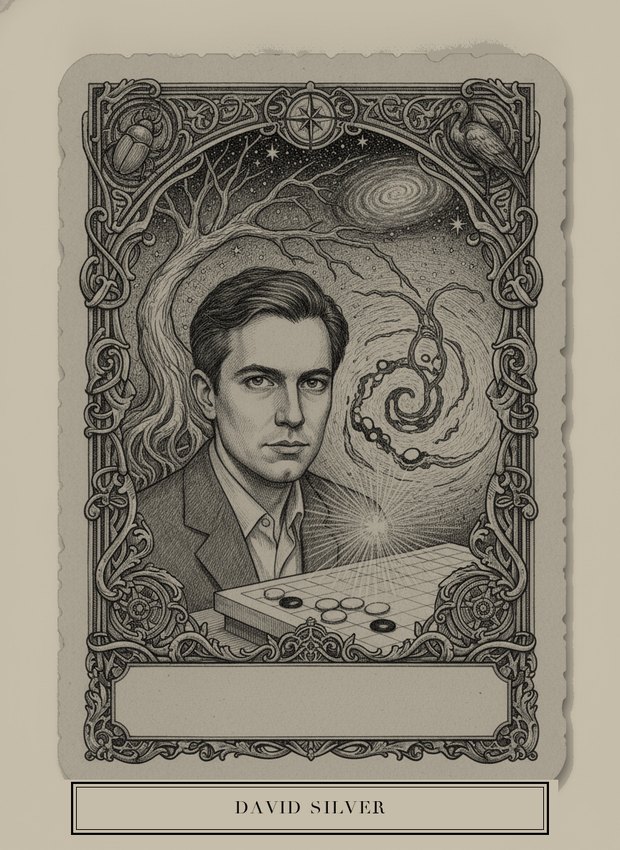
Silver's mastery is sequential decision-making at scale: AlphaGo and AlphaZero combine deep function approximation with Monte Carlo tree search to conquer enormous structured state spaces. Two threads faintly connect to this problem — MCTS is principled propagation of value estimates through a tree, cousin to inference by sampling, and his systems do manage uncertainty over vast combinatorial spaces. But the connection stays faint. His methods presuppose a known simulator (the game rules) and millions of self-play episodes; 1985 medicine offers neither, only thin observational records and a demand for calibrated, inspectable posteriors. Nothing in his corpus involves representing conditional independence, learning generative diagnostic models, or coherent evidence updating in Pearl's sense — and the deep-RL machinery he actually invented requires compute four decades beyond the era. Wrong problem class, wrong data regime, wrong century.
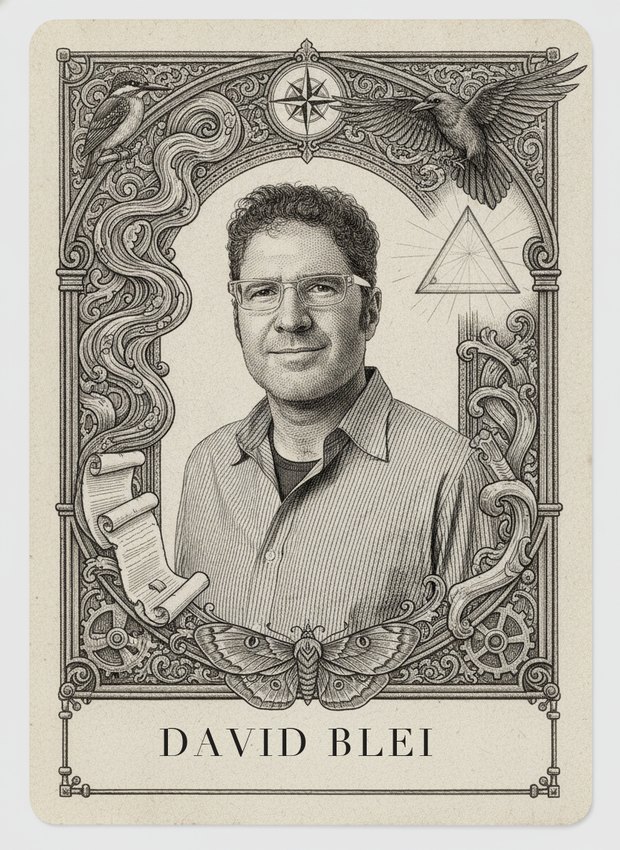
Blei's contribution is making variational inference a practical, almost routine tool for large latent-variable models — latent Dirichlet allocation (2003) being the canonical example of a graphical model with an intractable posterior tamed by optimization. That is directly the second axis of this problem: once diseases and symptoms are drawn as a graph, diagnosis queries require posterior inference the exact algorithms cannot always deliver, and Blei's mean-field machinery, and later stochastic variational inference for massive data, is the modern answer. His plate-notation fluency and model-building taste suit the forty-disease, 200-symptom design task well. What he does not supply is the 1985 conceptual breakthrough itself — the graph-as-independence-map representation predates him and is assumed by everything he built — and medical diagnosis is not his applied home turf the way text and science corpora are.
Battle #96 · 8/10/2026, 11:37:42 AM · this result is deterministic: the same two personas on this problem always resolve the same way.