causality
The web of symptoms
It is 1985 at UCLA, and medical expert systems are drowning: encoding diagnosis as thousands of brittle if-then rules has produced systems that contradict themselves the moment evidence arrives in an unexpected order. The real structure is probabilistic — forty diseases, 200 symptoms, tangled dependence — and the full joint distribution has more parameters than there are atoms of patient data. Build a representation where the dependencies are drawn as a graph, diagnosis queries are tractable, and updating on new evidence is principled rather than ad hoc. The prize is a probability calculus machines can actually run; the failure mode is a decade more of expert systems confidently wrong at the bedside, and an AI winter with the word "probability" frozen out of it.
Who this problem belongs to
The two figures whose methods fit it best, out of 64 in contention.
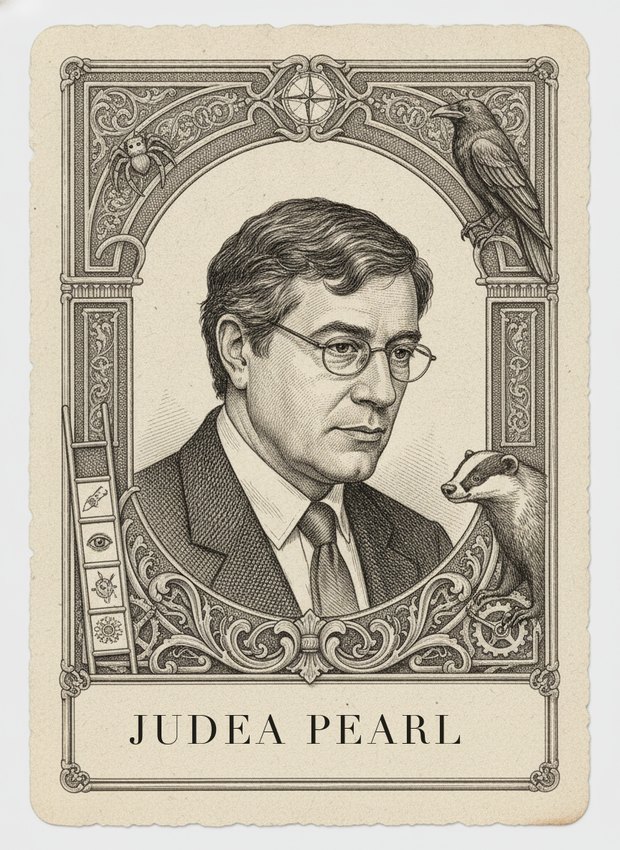
This is not merely Pearl's kind of problem; it is, almost literally, the problem he solved at UCLA in exactly this period. Between 1982 and 1988 he developed belief propagation, the message-passing algorithm for polytrees, and the Bayesian network formalism itself, culminating in Probabilistic Reasoning in Intelligent Systems (1988) — the book that thawed probability out of the AI winter. His central move answers each demand in the prompt: conditional independence drawn as a directed acyclic graph collapses the intractable joint over forty diseases and 200 symptoms into local conditional tables; d-separation makes the independencies readable off the graph; and evidence updates propagate coherently regardless of arrival order, curing exactly the brittleness that plagued rule-based systems like MYCIN. No other figure in the roster matches problem to biography this closely.
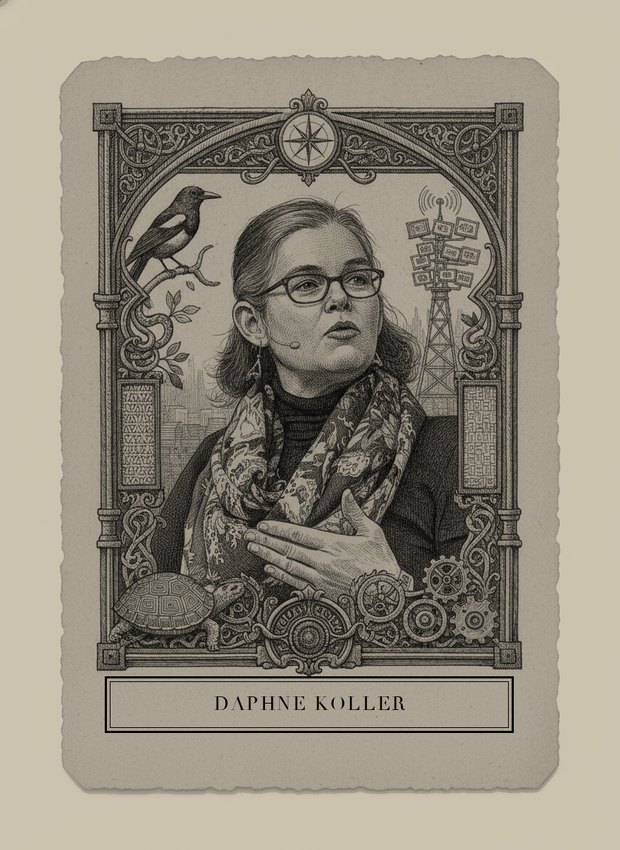
Koller is the second-generation heir to this problem, and her toolkit maps onto it almost completely. Her career from the mid-1990s onward was devoted to probabilistic graphical models — representation, inference, and learning — and her 2009 textbook with Friedman is the definitive engineering manual for exactly the artifact the prompt demands: encoding a forty-disease, 200-symptom joint compactly, choosing between exact junction-tree inference and approximate methods when treewidth explodes, and learning the conditional tables from sparse patient data. Her sustained work applying graphical models to biomedicine means the medical framing is native terrain, not analogy. The only gap is chronological: in 1985 she was a teenager, and her contributions presuppose Pearl's formalism already existing. Given that formalism as a starting point, she executes this build about as well as anyone alive.
Fought here
In the mind map
The same ideas, as concepts rather than history — in John's ML knowledge map.
64 figures are scored on this problem. Draw it in a battle to see where you land.