It is 1985 at UCLA, and medical expert systems are drowning: encoding diagnosis as thousands of brittle if-then rules has produced systems that contradict themselves the moment evidence arrives in an unexpected order. The real structure is probabilistic — forty diseases, 200 symptoms, tangled dependence — and the full joint distribution has more parameters than there are atoms of patient data. Build a representation where the dependencies are drawn as a graph, diagnosis queries are tractable, and updating on new evidence is principled rather than ad hoc. The prize is a probability calculus machines can actually run; the failure mode is a decade more of expert systems confidently wrong at the bedside, and an AI winter with the word "probability" frozen out of it.
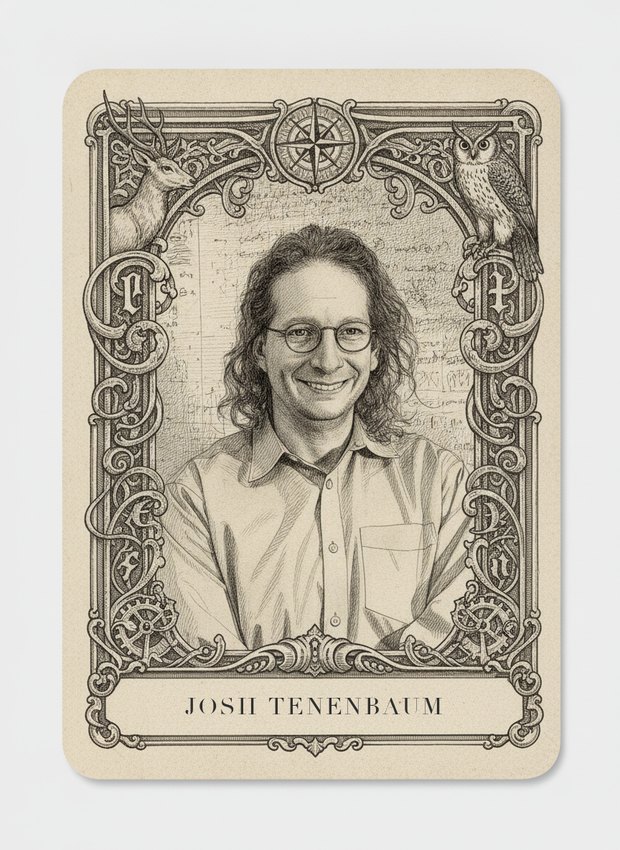
Chose Simulate and invert — right call.
Tenenbaum's program — Bayesian models of cognition, and later probabilistic programs as models of the mind — treats structured probabilistic representation as the language of intelligence itself, which is precisely this problem's thesis against rule-based expert systems. His work on hierarchical Bayesian models, structure learning (discovering the form of dependencies, not just their strengths), and probabilistic programming languages like Church generalizes the Bayes-net idea: a probabilistic program is a graphical model with recursion. Applied to 1985 UCLA, he would frame diagnosis as inference in a generative model of diseases causing symptoms, exactly the right shape. Discounts: his tools presuppose Pearl's formalism and the cheap computation of the 2000s; his validation style is behavioral experiments rather than deployed clinical systems; and inference at 200-symptom scale is where his cognitive-science toolkit thins out.
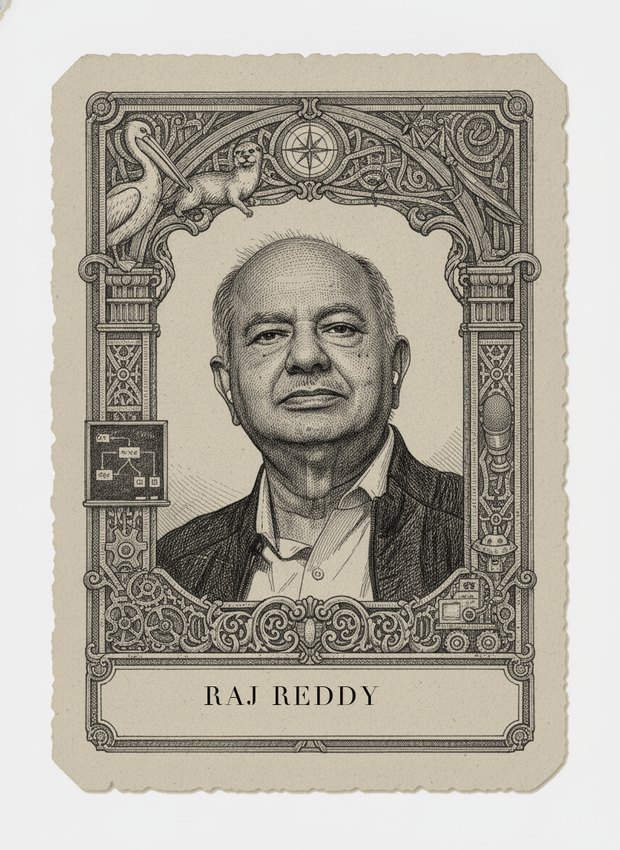
Reddy led the 1970s CMU speech systems — Hearsay-II and Harpy — that wrestled with exactly this problem's shape before its solution existed: combining hundreds of uncertain, mutually dependent evidence sources into a coherent best interpretation. Harpy's integrated network search and Hearsay's blackboard architecture were serious engineering answers to evidence integration, and the speech community he built went on to embrace hidden Markov models, a tractable structured-probability formalism that vindicates the prompt's thesis. He also knows the expert-system era's failure modes as a firsthand AI-establishment insider. The discount is that his own methods were heuristic rather than probabilistically principled — blackboards update opportunistically, not coherently, and are order-sensitive in just the way the prompt indicts — and the HMM revolution in speech was driven by Baker and IBM's Jelinek more than by Reddy himself.
Battle #117 · 8/10/2026, 11:38:43 AM · this result is deterministic: the same two personas on this problem always resolve the same way.