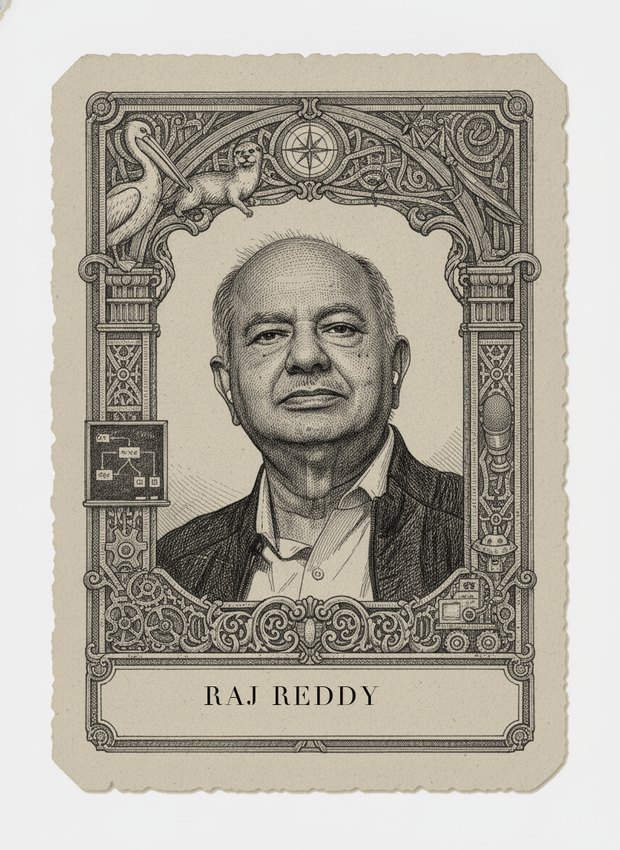
Raj Reddy
Continuous speech recognition; robotics; Turing Award
Played by Christie
Strongest on
Battles
Solve the game, completely L Karl Pearson
Choose the first hundred believers L Josh Tenenbaum
The web of symptoms W Lek-Heng Lim
Solve the game, completely L Lek-Heng Lim
Choose the first hundred believers
In the mind map
The same ideas, as concepts rather than history — in John's ML knowledge map.
Life and career
Dabbala Rajagopal Reddy — Raj Reddy to everyone — was born in 1937 in a village in what is now Andhra Pradesh, and took a first degree in civil engineering at Guindy in Madras before a master's in Australia and a stint working for IBM there. That is an unusual runway into artificial intelligence, and the pivot came at Stanford, where he went for a doctorate and became one of John McCarthy's early graduate students in the department McCarthy was then building. His thesis was on computer recognition of speech, a topic that in the mid-1960s was closer to a dare than a research area: computers had kilobytes of memory, no digital signal processing hardware to speak of, and no statistical framework for sequence modeling.
He taught briefly at Stanford and then moved to Carnegie Mellon in 1969, where he stayed for the rest of his career and became the central institution-builder of American AI's system-building wing. He founded the Robotics Institute in 1979 and served as its first director, creating what remains the largest academic robotics organization in the world; he later served through the 1990s as dean of CMU's School of Computer Science, the first school-level computer science organization of its kind. In 1994 he and Edward Feigenbaum shared the Turing Award for their work on large-scale artificial intelligence systems — the first Turing Award to a person of Indian origin.
The defining episode of his research career was DARPA's Speech Understanding Research program of the 1970s, a five-year, specification-driven effort with a hard target: connected speech, a thousand-word vocabulary, a constrained task domain, an acceptable error rate. Reddy's group at CMU produced two competing systems. Hearsay-II was the intellectually beautiful one — a blackboard architecture in which independent knowledge sources (acoustic, phonetic, lexical, syntactic, semantic) posted and revised hypotheses on a shared data structure, cooperating asynchronously toward an interpretation. Harpy was the brutal one, associated with his student Bruce Lowerre: compile the entire space of legal utterances into one enormous finite-state network and search it with beam-pruned dynamic programming. Harpy met the specification. Hearsay-II did not. Reddy reported that outcome honestly, and his 1976 survey of speech understanding systems remains the primary document for one of AI's most consequential and repeatedly relearned lessons: a large, well-pruned search often beats an architecture that reasons.
His later career widened past research. He advised American science policy, co-chairing the President's Information Technology Advisory Committee in the 1990s, and he devoted enormous energy to education and access in India — helping found information-technology institutions there, championing the Million Book Project's effort to digitize and open the world's literature, and arguing consistently that computing's payoff should reach people with no literacy and no keyboard. He has received the Padma Bhushan and the French Legion of Honour among many other distinctions.
Key contributions
**Continuous speech recognition as an engineering discipline.** Before Reddy's group, speech recognition meant isolated words from a cooperative speaker with pauses between them. The hard problem in connected speech is that word boundaries are not in the signal: acoustics blur across them, and segmentation and recognition have to be solved jointly. Reddy's line of systems — Hearsay-I, Hearsay-II, Harpy, and the Dragon system built by his student James Baker — established the architecture that all subsequent recognizers inherited: a decoding search over a graph of hypotheses, constrained by a language model, scored by an acoustic model, pruned aggressively for tractability. Baker's Dragon work introduced hidden Markov models into the pipeline, the framework that would dominate for thirty years; later, Kai-Fu Lee's Sphinx from the same lab demonstrated speaker-independent, large-vocabulary continuous recognition. Reddy did not personally invent every component, and that is arguably the point: he built the environment where the components could be invented, compared, and honestly evaluated against a specification.
**The blackboard architecture.** Hearsay-II's control structure was a genuine contribution to AI independent of speech. A shared, hierarchically organized hypothesis space; a set of independent knowledge sources, each of which watches for conditions it can act on and posts its results; and a scheduler deciding which opportunity to pursue next. This is opportunistic problem-solving rather than fixed pipeline processing, and it influenced expert systems, sensor fusion, and multi-agent architectures for decades. The honest verdict from the SUR program — that this elegant scheme lost to a compiled search graph — is one of the field's foundational data points about the relative value of knowledge engineering and computation.
**Robotics as an institution and a practice.** Reddy's founding of the Robotics Institute produced the American center of gravity for mobile robots, autonomous navigation, and manipulation. The work that came out of it under his umbrella and his successors — Moravec's mobile-robot navigation, the autonomous land vehicle programs, the vision groups — established the perception-planning-action pipeline as robotics' organizing structure. Reddy's specific technical stamp is the systems view: real robots operating in real environments under real time budgets, where the interesting failures are integration failures.
**Access and scale.** The Million Book Project and his work on technology for low-literacy users are not footnotes to the research career; they follow directly from the same instinct that drove the speech work. If a person cannot type and cannot read, the interface has to be speech, and the content has to already be digitized. He was arguing for that combination decades before it was buildable.
In battle
Reddy's numbers describe a narrow, deep specialist with a very long tail: mean 22.9, median 18, three dominant problems, fifty-eight problems at or below 20. When the problem is his, he is nearly unbeatable; when it is not, he brings almost nothing, and the game is blunt about it.
His summit is "A thousand words, connected speech" (97), which is the DARPA SUR program restated — his own desk, his own two systems, his own honest report of which one won. "Words from waveforms" (90) is the acoustic-to-lexical problem underneath it, and "A recognizer for a language of ten speakers" (90) is the low-resource speech problem, where his era's discipline of getting a working recognizer out of very little data and very little compute is exactly the right instinct. "The robot in the warehouse" (76) draws on the Robotics Institute's whole tradition of integrated perception and navigation. "Decode the hidden path" (68) is HMM decoding — his lab's territory through Baker, though Viterbi and Baum own the mathematics, which is why he places well rather than first. "Sequence the robot's actions" (58) and "Shortest path through the map" (54) are planning and graph search, where he is a competent systems builder among people who proved the theorems.
Note his highest-volume categories: search at 33.5 across fifteen problems and NLP at 37.0 across ten, with perception at 41.8 across nine as his best broad showing. That is a coherent portrait — a builder of large search-based perception systems.
Two kinds of loss. The first is the era-shift loss, and it is the pedagogically important one: "Replace the acoustic model" (55) is where deep neural acoustic models displaced the Gaussian-mixture HMM pipeline his lab perfected. He still scores respectably because he understands what an acoustic model is *for*, but the method that won is not his, and the same dissolution happened to the whole hand-structured pipeline he built — end-to-end sequence models absorbed segmentation, acoustic modeling, pronunciation dictionaries and language modeling into one trained network. A student playing Reddy against modern speech problems should expect exactly this: strong on the problem statement, beaten on the solution.
The second kind is total mismatch with statistics. His floor problems are almost all classical statistical inference: "Why tall fathers have shorter sons" (4) is regression to the mean, "The paradox in the admissions data" (4) is Simpson's paradox, "The therapy the trial reversed" (4) is causal inference from trials, "How high must the dike be?" (4) is extreme-value theory, and "Calculus for a jagged path" (3) is Itô's stochastic calculus. His regression average is 5.5 and his causality average is 12.2 across eighteen problems — a huge block of the board where he is close to worthless. "The posterior at web scale" (5) is the same story in Bayesian clothing. Reddy's career is about making systems work under constraints, not about the validity of an inference, and the matrix scores that distinction without sentiment.