perception
A thousand words, connected speech
It is 1976 at Carnegie Mellon, and DARPA's five-year speech bet is coming due: recognize continuously spoken sentences over a thousand-word vocabulary — no pauses between words, real speakers — under a program many advisors expected to fail. Rival philosophies share the building: a blackboard where knowledge sources argue about hypotheses, and a brute compilation of every legal sentence into one enormous network searched with beam-pruned dynamic programming. Deliver a system that meets the specification, and account honestly for the finding that stings: the elegant reasoning architecture loses to the compiled network that simply searches — a decade before statistics completes the same lesson. Get the accounting wrong and speech research spends its next funding cycle rebuilding the architecture the evidence just buried.
Who this problem belongs to
The two figures whose methods fit it best, out of 58 in contention.
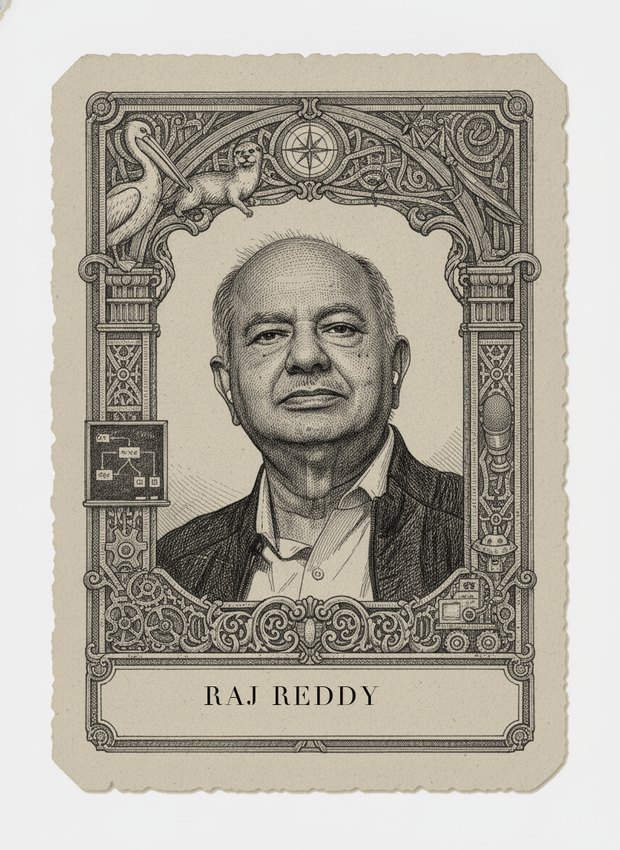
This problem is Reddy's actual desk. He led Carnegie Mellon's effort under DARPA's five-year Speech Understanding Research program, and his students built both rival systems the problem describes: Hearsay-II, a blackboard architecture where independent knowledge sources negotiate over a shared hypothesis space, and Harpy, which compiled every legal sentence of the thousand-word vocabulary into one giant network searched with beam-pruned dynamic programming. Harpy met the program's specification and Hearsay-II did not, a finding Reddy's own group had to report honestly to DARPA even though the elegant multi-expert architecture was in some ways the more intellectually appealing project. His 1976 survey paper on speech understanding systems is the primary source for exactly this problem's "search beats reasoning" accounting. He built both systems and lived the verdict, which is as close to a perfect score as this problem allows.
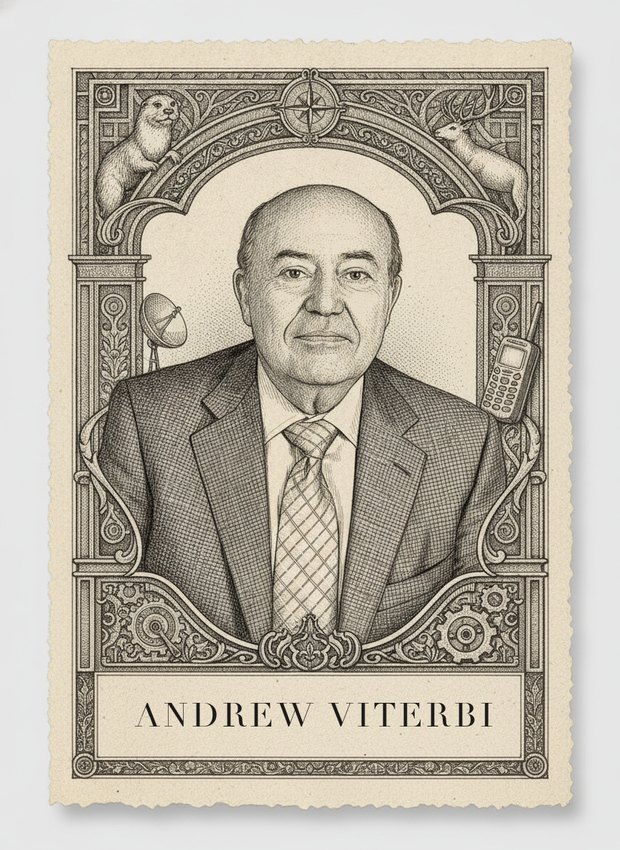
The Viterbi algorithm, published in 1967 for decoding convolutional codes, is the literal computational engine inside Harpy's beam-pruned dynamic-programming search over its compiled sentence network — finding the most probable path through an enormous state space efficiently by discarding low-probability partial hypotheses at each step rather than exploring exhaustively. Harpy's CMU team adapted exactly this kind of dynamic-programming decoding to speech, and the lesson the problem asks to be honestly delivered — that a compiled network searched efficiently beats an elegant reasoning architecture — is fundamentally a victory for Viterbi's algorithmic family over symbolic AI's. He never worked on speech recognition specifically or on the CMU program itself, so translating his coding-theory algorithm into this exact 1976 system is a step CMU's team took rather than Viterbi, keeping this just below a perfect score.
Fought here
In the mind map
The same ideas, as concepts rather than history — in John's ML knowledge map.
58 figures are scored on this problem. Draw it in a battle to see where you land.