It is 2007 at the University of Alberta, and checkers — the game Samuel's program made famous — is about to become the largest game ever solved: not played well, solved, its value proven. Combine forward search from the opening with endgame databases computed backward from every position of ten pieces or fewer — thirty-nine trillion of them — until the proof tree closes and the verdict is certain: perfect play draws. The computation runs for years across many machines; a single corrupted entry poisons the proof. Marshal it, verify it, and defend the word "proof" for a result no human can check by hand. Get it wrong and a decade of compute yields a claim, not a theorem — and the difference is the entire point.
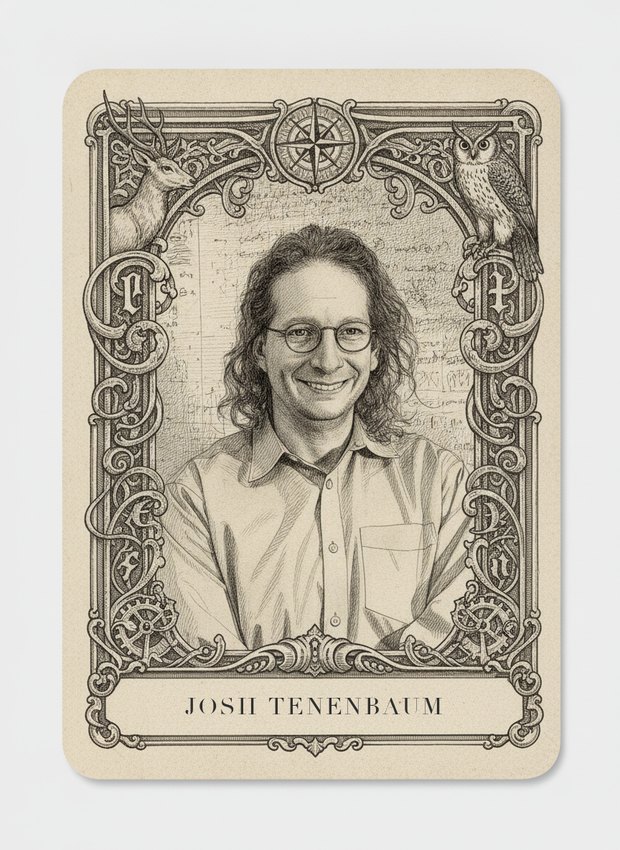
Tenenbaum's probabilistic models of cognition, using Bayesian inference and probabilistic programs to explain how minds learn from sparse evidence, address a fundamentally different problem from Chinook's exhaustive, deterministic retrograde computation of a checkers game's exact value. Nothing in his research on modeling human learning and reasoning engages with game-tree search, endgame databases, or distributed systems verification, and his interest in how people form rich models from limited data runs in nearly the opposite direction from a project whose entire point was replacing any kind of inference or approximation with certified exhaustive computation. Tenenbaum has not published on checkers or combinatorial game-solving, and his relevance to this specific historical achievement is essentially nonexistent beyond broad, distant membership in the field of artificial intelligence.

Reddy's pioneering work on continuous speech recognition and robotics at Carnegie Mellon from the 1970s onward established him as a foundational figure in applied AI systems operating under real-world sensory uncertainty, a different problem entirely from checkers's fully observed, deterministic combinatorial game structure that Chinook exhaustively solved through forward search and retrograde databases. Nothing in Reddy's research addresses game-tree search, retrograde endgame analysis, or distributed correctness verification across many machines, and speech recognition's core challenge -- extracting meaning from noisy acoustic signal -- has no natural application to certifying the exact outcome of a perfect-information board game. His relevance to Chinook's specific 2007 achievement is essentially nonexistent beyond broad, distant membership in the applied artificial intelligence research community.
Battle #158 · 8/10/2026, 11:41:05 AM · this result is deterministic: the same two personas on this problem always resolve the same way.