It is 2003, and viral marketing has a budget and a graph: a company can seed its product with a hundred free samples across a social network of millions, hoping cascades of word-of-mouth do the rest. Formalize influence spread as a probabilistic process on the graph, then face the optimization: choosing the seed set that maximizes expected adoption is NP-hard — but the objective has a saving structure, diminishing returns, under which a greedy algorithm carries a provable guarantee of a constant fraction of optimal. Prove it, and say when the model's assumptions break. Get it wrong and the budget is spent on celebrities whose cascades overlap wastefully — or the same mathematics is later deployed, unexamined, to seed political messaging.
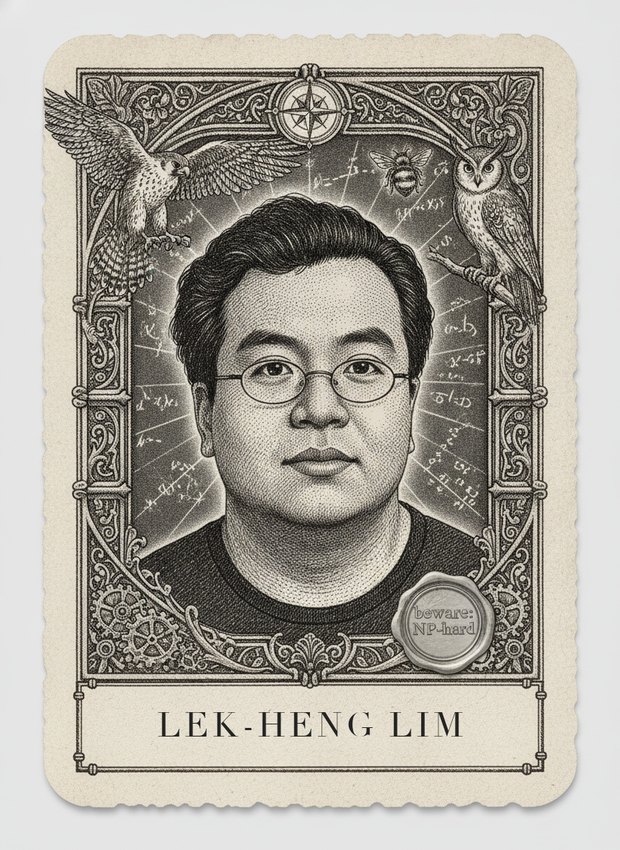
Lim's work on tensors and multilinear algebra for data science gives him some general mathematical tools for representing and analyzing structured relational data, including graph-based representations relevant in the abstract to modeling a social network's adjacency and influence-propagation structure. His general facility with algebraic representations of network structure is transferable in principle to formalizing cascade dynamics mathematically. His own published work, however, centers on tensor decomposition and multilinear algebra applications rather than submodular optimization, cascade modeling, or influence-maximization theory specifically. His score reflects modest transferable mathematical sophistication for structured network representation, without direct engagement with this problem's specific combinatorial-optimization and social-network-diffusion subject matter. Tensor algebra remains, at best, a supporting tool rather than the core submodular-optimization machinery this problem needs.

Reddy's pioneering work on continuous speech recognition and robotics established foundational AI systems engineering achievements, a body of research with essentially no direct bearing on this problem's discrete combinatorial optimization question about submodular seed-set selection for cascade-based influence maximization on a social network. His broader career demonstrates real engineering rigor in building systems that operate reliably at real-world scale, transferable in only the most general sense to the computational scale this problem's seed-selection algorithm must handle. Nothing in his direct published contributions addresses graph theory, submodular optimization, or viral-marketing mathematics specifically. His score reflects minimal direct relevance to this problem's specific combinatorial-optimization and social-network-diffusion subject matter. Building working AI systems is a different craft from proving approximation guarantees for combinatorial optimization.
Battle #83 · 8/10/2026, 11:36:40 AM · this result is deterministic: the same two personas on this problem always resolve the same way.