perception
Words from waveforms
It is 1975 at IBM's Thomas J. Watson Research Center, and the reigning belief is that speech recognition must be built from linguistics: phonetic rules, syntax, expert knowledge layered like geology. The heresy on your desk says otherwise — treat the sentence as a noisy channel, model acoustics and language as probability distributions, train on data, and let perplexity fall where it may. Transcribe continuous speech from audio, and quantify how and why the statistical models of sequence beat the linguistic rules: word-error rate against word-error rate, measured, not argued. DARPA's funding and two decades of research direction ride on which paradigm wins. Every time you fire a linguist, the joke will go, performance goes up — but you must first earn the joke.
Who this problem belongs to
The two figures whose methods fit it best, out of 60 in contention.
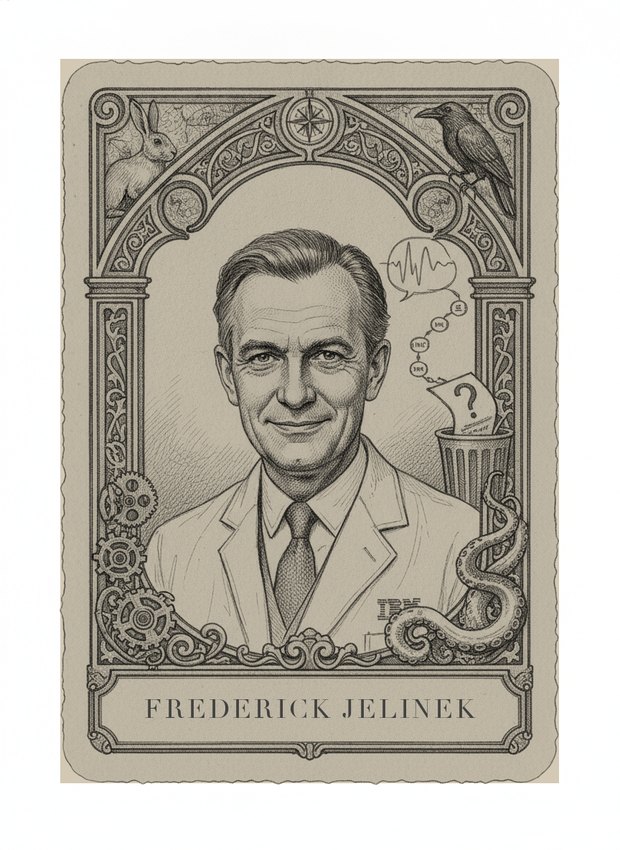
This is his desk, his year, his heresy. At IBM from 1972 Jelinek built the statistical speech group that treated language as a noisy channel: hidden Markov models over phonemes and words, trigram language models, parameters estimated from transcribed corpora rather than hand-written phonetic rules. The line "every time I fire a linguist, performance goes up" is attributed to him precisely because he ran this fight and won it, WER against WER, against Chomskyan and rule-based competitors funded by the same DARPA program. He has the corpora, the Baum-Welch training procedure, and two decades of institutional backing for exactly this claim. No other carrier owns both the method and the historical outcome this completely; this is as close to a perfect match as the roster contains.
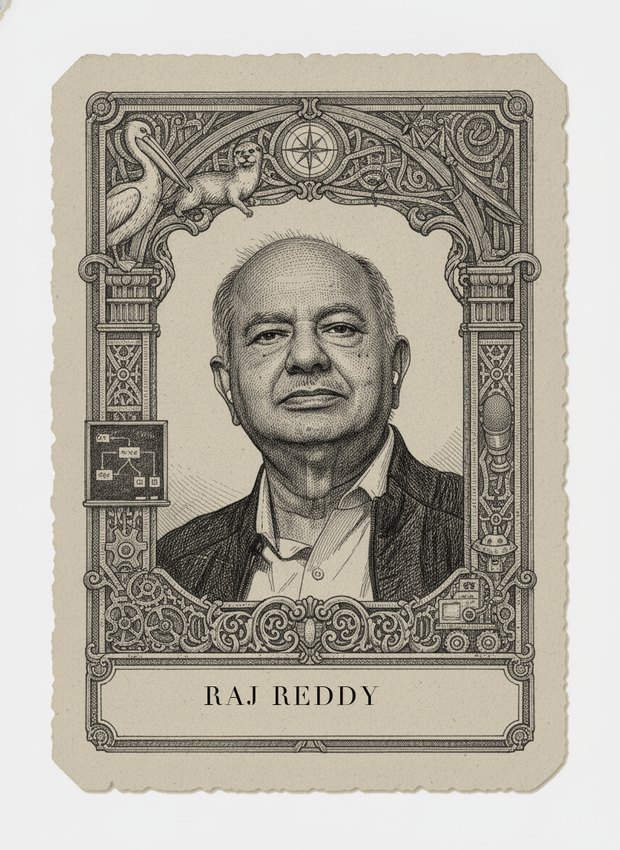
Reddy's Harpy and Hearsay systems at CMU in the 1970s were the other pole of continuous statistical/heuristic-search speech recognition running in real time against exactly this DARPA-funded problem, and his Turing Award citation names continuous speech recognition explicitly. He shares Jelinek's era, funding source, and empirical WER-driven methodology, though his systems leaned more on search and knowledge sources than IBM's purely statistical channel model, so he is a strong second rather than the discoverer of the noisy-channel framing itself. His work still directly demonstrates that data-driven, benchmarked systems beat hand-built linguistic rule systems on this task, which is the entire point being adjudicated here. Even granting the era gap, Reddy's standing on continuous speech recognition; robotics; turing award is close enough to this problem's actual demands that a graduate student would expect a real, defensible showing rather than a token one.
In the mind map
The same ideas, as concepts rather than history — in John's ML knowledge map.
60 figures are scored on this problem. Draw it in a battle to see where you land.