search
The robot in the warehouse
It is the era of working robots on real floors, and a machine must fetch items in a warehouse where the world will not hold still — people cross its path, other robots move, shelves shift — so a plan computed once and executed blindly is worse than useless. Plan the robot's actions to reach its goals, and replan continuously online as the environment changes beneath it, fast enough to keep acting while the world moves. Plan and execution must interleave, not take turns. Get it wrong and the robot either freezes to recompute while obstacles pile up, or barrels ahead on a stale plan into a collision — in a dynamic world, the whole challenge is planning that survives contact with reality, correcting itself faster than reality changes.
Who this problem belongs to
The two figures whose methods fit it best, out of 69 in contention.
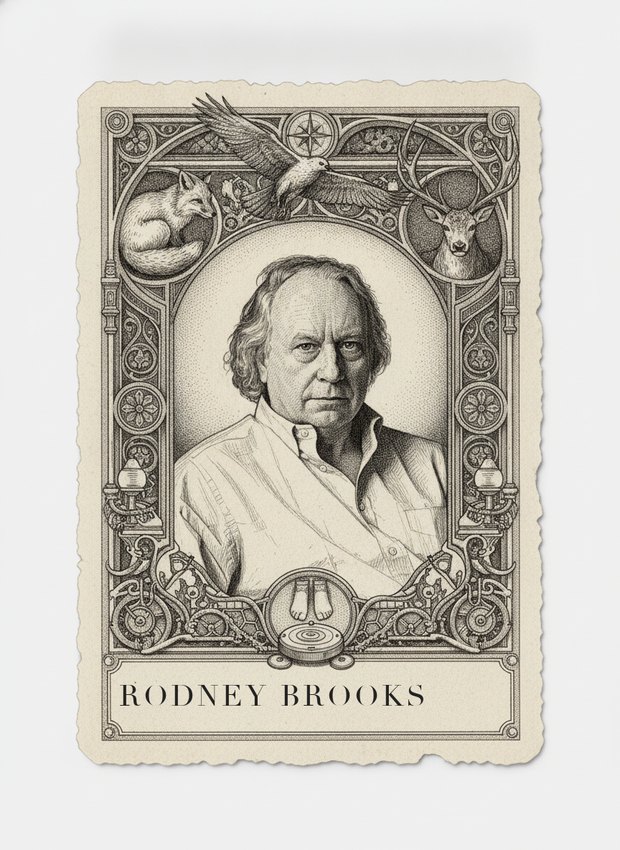
This problem is Brooks's career thesis stated as an exam question. The subsumption architecture (1986) attacked exactly the sense-model-plan-act pipeline whose failure modes — freezing to recompute, executing stale plans — the prompt recites: instead, layered behaviors couple sensing directly to action, run concurrently, and stay perpetually responsive, with 'the world is its own best model' as the operating principle. He proved it in hardware: Genghis and the insect robots walked through mess in real time on tiny processors, iRobot (co-founded 1990) put the philosophy into millions of Roombas, and Rethink's Baxter targeted human-shared industrial floors. Warehouse robotics is, commercially and intellectually, downstream of him. The honest caveat — pure reactivity struggles with long-horizon task sequencing, so fielded systems are hybrids with a deliberative layer he scorned — is the only thing between him and a higher score.
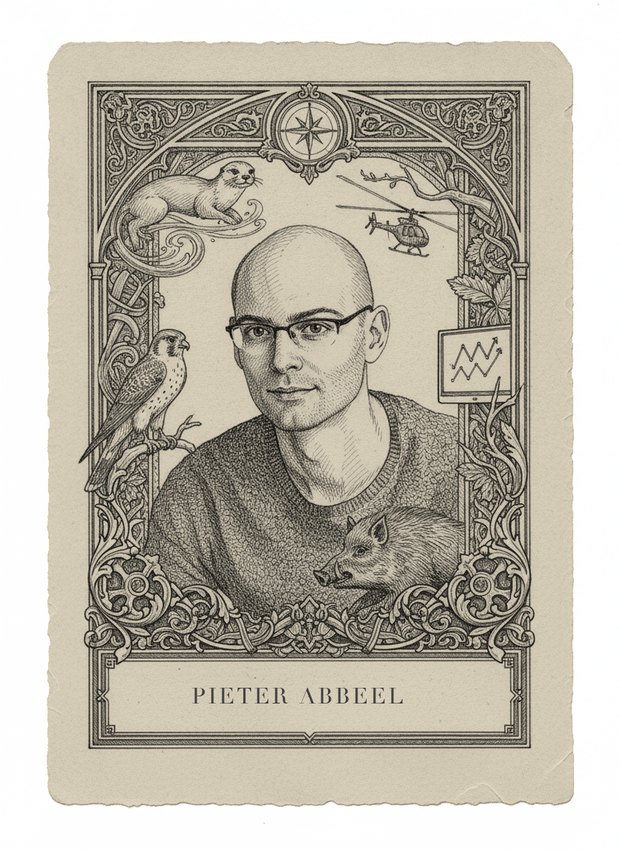
Abbeel is a designated winner and the batch's most direct fit: his career is closing the loop between learned policies and physical robots in unstructured settings. Apprenticeship learning for helicopter aerobatics (2000s, with Ng) put learned control on hardware where stale plans meant crashes; his Berkeley lab's deep-RL manipulation work — grasping, cloth folding by BRETT, guided policy search with Levine — made fetch-and-place in cluttered scenes a signature demo genre; and domain randomization plus sim-to-real transfer, which his group helped establish, is the modern answer to plans surviving contact with reality. Covariant, his company, deployed exactly warehouse pick-and-place. Honest caveats: learned policies remain sample-hungry and safety certification in human-shared aisles is unsolved, and classical replanning (D*-style) predates him. But this problem is his research program stated as prose.
Fought here
In the mind map
The same ideas, as concepts rather than history — in John's ML knowledge map.
69 figures are scored on this problem. Draw it in a battle to see where you land.