It is the era of working robots on real floors, and a machine must fetch items in a warehouse where the world will not hold still — people cross its path, other robots move, shelves shift — so a plan computed once and executed blindly is worse than useless. Plan the robot's actions to reach its goals, and replan continuously online as the environment changes beneath it, fast enough to keep acting while the world moves. Plan and execution must interleave, not take turns. Get it wrong and the robot either freezes to recompute while obstacles pile up, or barrels ahead on a stale plan into a collision — in a dynamic world, the whole challenge is planning that survives contact with reality, correcting itself faster than reality changes.
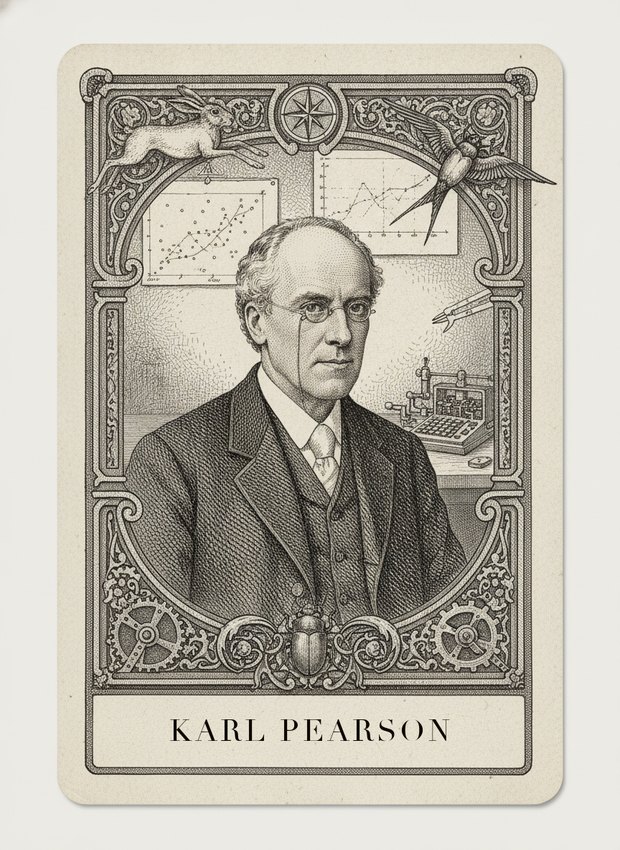
Pearson founded mathematical statistics — correlation, chi-squared, the method of moments, the first statistics department (UCL, 1911) — and his toolkit is population-level curve-fitting on static samples, full stop. The designated floor of this problem, and rightly: every element the warehouse demands is absent from his world. He has no sequential decision theory (Wald's sequential analysis came a decade after his death), no notion of feedback, no computation beyond human computers with mechanical calculators, and a positivist philosophy — describe correlations, do not model hidden causes — that is actively hostile to the state-space modeling a robot's estimator requires. At most, his chi-squared could test whether collision counts differ across aisle layouts, a warehouse-safety memo. The gap between fitting a frequency curve and out-computing a moving world is the century of this whole roster.

Torvalds's Linux is, as deployed fact, the operating system under most modern robots — ROS targets it, warehouse fleets run it — and kernel work he shepherded (preemption, eventually PREEMPT_RT's mainlining) is what lets a control loop hold its latency budget on commodity hardware. Git, his other artifact, versions every robotics codebase on earth. But Torvalds's method is pragmatic systems engineering by massive collaboration, with zero content touching this problem's substance: no planning, no estimation, no control, no learning, and he has been cheerfully explicit that he does plumbing, not applications. The kernel does not know the world exists, let alone that it moves. He shares the infrastructure floor-band with Hopper and van Rossum: indispensable to the solution's deployment, orthogonal to its intellectual content.
Battle #169 · 8/10/2026, 11:41:35 AM · this result is deterministic: the same two personas on this problem always resolve the same way.