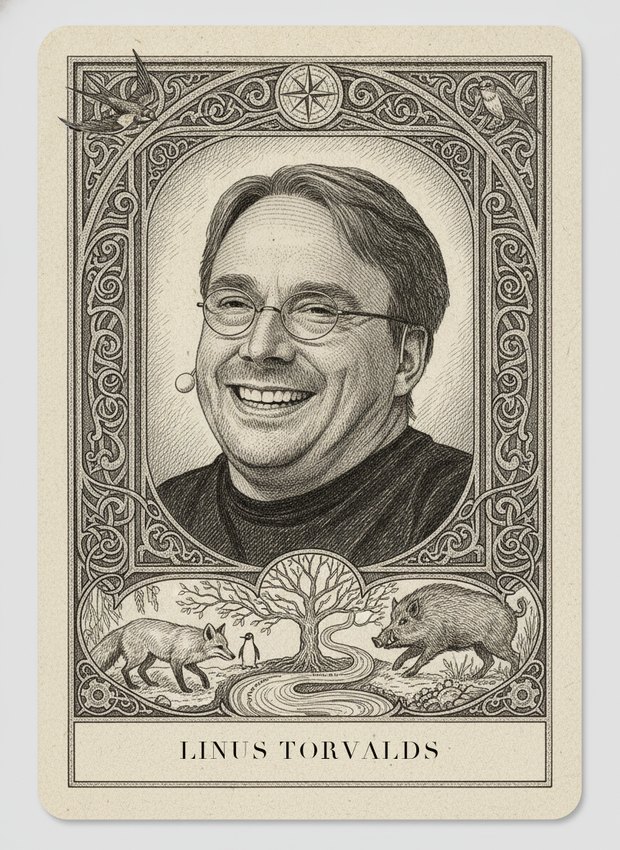
Linus Torvalds
Linux and Git
Played by Chase
Strongest on
Battles
The robot in the warehouse W John Santerre
Color the map, meet the constraints L Risi Kondor
Relax, then round L Risi Kondor
The corner that sparsity loves L Risi Kondor
Correct the corrupted block L Risi Kondor
The certificate of optimality
Life and career
Linus Benedict Torvalds was born in Helsinki in 1969, into a Swedish-speaking Finnish family with a distinctly political cast — his parents were both journalists, active in student radicalism, and he was named after Linus Pauling. His maternal grandfather, a professor of statistics, owned a Commodore VIC-20, and Torvalds started programming on it as a child, moving from BASIC to assembly because BASIC was too slow. He has been consistently uninterested in the political dimension of his family's world and consistently interested in how machines actually work.
He entered the University of Helsinki in 1988, took a year of compulsory military service in the Finnish army, and returned to study computer science. Two things then converged. Andrew Tanenbaum's textbook *Operating Systems: Design and Implementation* came with **MINIX**, a small Unix-like teaching system whose source you could read, and Torvalds bought a 386 PC. Wanting to understand the hardware, he wrote task-switching code that printed alternating characters, then a terminal emulator to dial into the university, then a disk driver and a filesystem so he could download files — and at some point realized he was writing an operating system.
In August 1991 he posted to comp.os.minix: he was doing a free operating system, "just a hobby, won't be big and professional like gnu." It was released under his own license and then, in 1992, relicensed under the **GPL** — a decision he has repeatedly called the best one he ever made, because it guaranteed that companies contributing to Linux could not fork it privately, which made corporate cooperation rational. Combined with the GNU project's userland tools, the result was a complete free Unix-like system. It now runs the majority of the world's servers, all of the top supercomputers, Android phones, embedded devices, and cloud infrastructure of essentially every kind.
The famous **Tanenbaum–Torvalds debate** of 1992 pitted Tanenbaum's microkernel orthodoxy against Torvalds's monolithic kernel, with Tanenbaum declaring Linux obsolete by design. Torvalds's position was pragmatic: monolithic kernels are faster and simpler to get working, and modularity can be achieved by loadable modules and disciplined internal interfaces. Thirty years of Linux deployment is a reasonable empirical verdict, though the theoretical arguments for microkernels never went away.
In 2005 the second act arrived. Linux development had been using BitKeeper, a proprietary distributed version-control system provided free to open-source projects; when that arrangement collapsed, Torvalds stopped kernel work and wrote **Git** over roughly two weeks in April 2005, then handed maintenance to Junio Hamano. Git subsequently took over software development globally.
Torvalds worked at Transmeta in Silicon Valley for several years, then moved to the Linux Foundation, which pays him to work on the kernel full-time. He lives in Oregon. He is well known for extremely blunt code review on the kernel mailing list — abrasive to the point of controversy — and in 2018 stepped back temporarily, publicly acknowledging that his communication had been damaging and committing to change. He returned with a code of conduct in place. He received the Millennium Technology Prize in 2012 and the IEEE Computer Pioneer Award. He has never founded a company or, by his own account, wanted to.
Key contributions
**The Linux kernel and the pragmatic architecture.** Linux is a monolithic kernel with **loadable kernel modules** — the whole thing runs in one address space for speed, but drivers and filesystems can be compiled separately and inserted at runtime. This is the compromise that made the Tanenbaum debate moot in practice. Its more consequential architectural decision is the **stable userspace ABI**: Torvalds enforces, absolutely and famously, that kernel changes must never break userspace programs. Internal kernel APIs, by contrast, are explicitly unstable and change constantly — which forces out-of-tree drivers to be upstreamed and keeps the tree from ossifying. The combination — an immovable external contract and a fluid internal one — is a genuinely interesting engineering position and a large part of why Linux has remained both stable and evolvable for three decades.
Linux is also the source of a great deal of concrete systems technology: the Completely Fair Scheduler, the O(1) and later scheduler designs, cgroups and namespaces (which are what containers and therefore Docker and Kubernetes actually *are*), epoll, the eBPF in-kernel virtual machine for safe programmable tracing and networking, and a device model spanning everything from watches to supercomputers.
**A scaling model for collaboration.** Torvalds's less obvious but arguably equal contribution is organizational. Linux development runs on a **hierarchy of maintainers** — subsystem "lieutenants" who curate patches in their area and send pull requests upward, with Torvalds holding the final merge on the mainline. There is no company, no org chart, and no formal authority; the structure runs on earned trust and technical taste. It has scaled to thousands of contributors from hundreds of competing companies, all of whom cooperate on shared infrastructure while competing in the market — which the GPL makes rational, since defection buys nothing. Eric Raymond's *The Cathedral and the Bazaar* took Linux as its case study for the proposition that open, parallel, high-frequency-release development can outperform closed development, and coined "Linus's Law" (given enough eyeballs, all bugs are shallow) from it.
**Git.** Git's design derives from a small number of hard requirements Torvalds set: distributed (every clone is a full repository with complete history), fast (merging thousands of patches must be cheap), and cryptographically verifiable (history must not be silently alterable). The resulting model is elegantly minimal. Git is a **content-addressable object store**: blobs (file contents), trees (directories), commits (a tree plus parent pointers plus metadata), each stored under the SHA hash of its content. A commit's hash therefore covers its entire ancestry, so the history is a Merkle DAG — tampering anywhere changes every downstream hash. Branches are just movable pointers to commits, which is why branching in Git costs essentially nothing, in contrast to the systems it replaced.
The consequence for practice is that merging became cheap enough to be the default workflow rather than an event to be dreaded. That single property enabled the branch-heavy, pull-request-centered development style that GitHub then productized, and it changed how essentially all software is now written. For a data-science audience the relevance is direct: reproducibility infrastructure, experiment tracking, and collaborative model development all sit on Git.
In battle
Torvalds's computed profile is a textbook one-problem specialist with a very low floor. He carries 100 problems at a mean of **14.5** with a median of **8** — the joint lowest median in this group — and **eighty** problems at or below 20. He has one dominant problem, two strong, and a range from 2 to 99. His only meaningful category is **systems** at 38.7 across eighteen problems; the next is `search` at 15.1, and everything else sits below that.
His 99 is **P082, "Ship it to a hundred contributors."** The game's explanation places it in 1998, when he was coordinating a mailing-list-and-patch workflow across thousands of volunteers with no company and no org chart — the exact crisis the problem describes. His answer combined technical taste about what belongs in the mainline with a trust structure that scales without institutional authority, and when even that broke in 2005 he wrote Git in ten days to make distributed merging cheap enough for the anarchy. The explanation states flatly that no higher score is defensible.
His secondary scores are modest. **P246, "Small tools, loosely joined"** (76) — Unix philosophy — is real but derivative; Thompson's 99 and Ritchie's 96 sit above him, and rightly, since he inherited the design rather than inventing it. **P252, "The document that links anywhere"** (58) and **P076, "Index the entire web"** (52) reflect the fact that Linux is the substrate for both, not that he built either. **P250, "The cluster that iterates"** (50), **P049, "Schedule the moonshot"** (47) — where kernel scheduler experience partially transfers but Hamilton's 92 dominates — **P253, "The model is five percent of the system"** (45), and **P245, "A computer shared by fifty"** (42) round out a shallow tail.
The losses are among the lowest in the set. **P215, "The therapy the trial reversed"** (2) is confounding by indication in the Women's Health Initiative hormone-replacement reversal; **P214, "The paradox in the admissions data"** (2) is Simpson's paradox; **P137, "The same patients, measured again and again"** (2) is repeated-measures design; **P136, "Counting accidents"** (2) is Poisson regression; **P283, "Five hundred stocks, one year of days"** (3) is covariance shrinkage; **P185, "Optimize across the datacenter"** (3) is a notable loss for a systems figure, being a mathematical-optimization problem in systems clothing. His `regression` average is 3.6, `causality` 5.0, `small-sample` 5.0, and `optimization` 7.4 across seventeen problems.
The strategic read: Torvalds is a scalpel with a single edge. When the round is about coordinating large-scale distributed software collaboration — governance, version control, mainlining, the social engineering of open source — he is the best answer on the roster and it is not close. Everywhere else his median of 8 tells the story. His stated identity is exactly right: he wins on pragmatism and distributed collaboration at scale, and loses diplomacy contests, by choice. For a student, the pedagogically useful point is that his best problem is not a *technical* problem at all in the usual sense — it is an organizational-design problem that happens to have a technical artifact (Git) as part of its solution.