search
Schedule the moonshot
It is the 1960s, and a nation has promised to land a man on the moon, which means sequencing ten thousand interdependent engineering tasks across limited crews, hard deadlines, and consequences measured in lives. Some tasks cannot start until others finish; the whole program is only as fast as its longest chain of dependencies. Schedule the work under real constraints, and — critically — make slippage visible early, so a delay buried deep in the network raises an alarm before it silently sinks the launch date. Surface the critical path. Get it wrong and delays compound invisibly until the deadline is lost, crews idle while bottlenecks starve, or corners get cut and people die — at moonshot scale, the schedule itself is a safety system.
Who this problem belongs to
The two figures whose methods fit it best, out of 63 in contention.

Hamilton is the only carrier who was inside the actual moonshot doing the actual thing. As director of Apollo flight software at the MIT Instrumentation Lab, she lived at the mercy of the program's dependency network — software at the end of every chain — and her response was to engineer schedule-safety into the system itself: the AGC's priority-scheduled asynchronous executive, which during the Apollo 11 landing shed low-priority tasks under overload (the 1201/1202 alarms) instead of dying, is 'the schedule is a safety system' implemented in flight. She coined 'software engineering' precisely to force management to treat software as schedulable engineering work, and her later Higher Order Software formalized interface and dependency errors — the silent-slippage class — as preventable by construction. Gap: she is not the OR mathematician; PERT arithmetic came from others. Everything else is lived expertise.
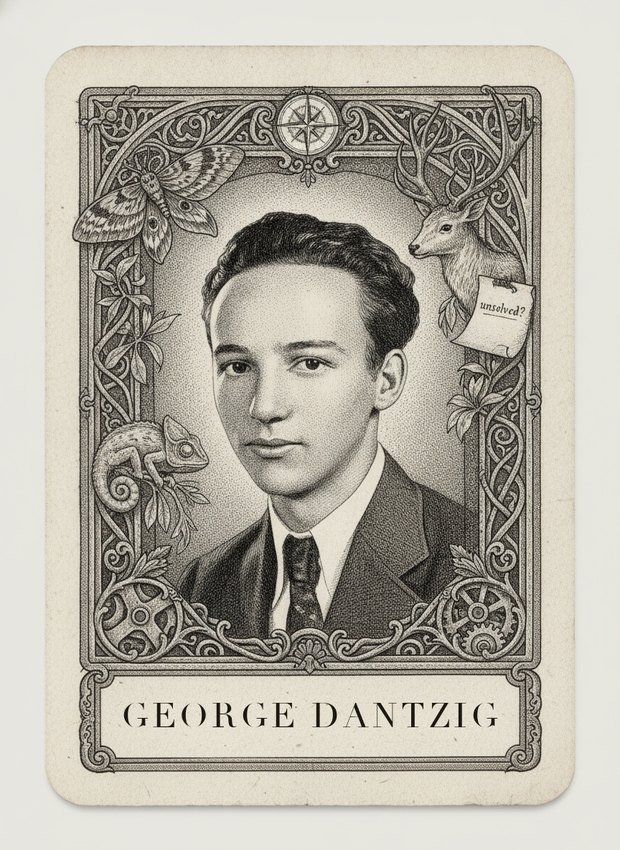
This problem grew up in Dantzig's house. 'Linear programming' is named for military 'programs' — the Air Force planning and scheduling problems he worked on in SCOOP from 1947, where the explicit goal was mechanizing the sequencing of interdependent activities. His simplex method became the computational engine of the operations-research profession that then produced CPM (Kelley and Walker, 1957, explicitly LP-flavored) and PERT (Navy Polaris, 1958); critical-path analysis is expressible directly as a linear program, and resource-leveling extensions land in the LP/network-flow territory he and his students systematized at RAND and Stanford. He had also lived inside a real wartime planning bureaucracy (Air Force combat analysis), so the reporting-and-control side is not foreign. The one honest gap: he built the mathematics of scheduling rather than running a program office himself. Everything else about this problem is his native language.
Fought here
In the mind map
The same ideas, as concepts rather than history — in John's ML knowledge map.
63 figures are scored on this problem. Draw it in a battle to see where you land.