It is the 1960s, and a nation has promised to land a man on the moon, which means sequencing ten thousand interdependent engineering tasks across limited crews, hard deadlines, and consequences measured in lives. Some tasks cannot start until others finish; the whole program is only as fast as its longest chain of dependencies. Schedule the work under real constraints, and — critically — make slippage visible early, so a delay buried deep in the network raises an alarm before it silently sinks the launch date. Surface the critical path. Get it wrong and delays compound invisibly until the deadline is lost, crews idle while bottlenecks starve, or corners get cut and people die — at moonshot scale, the schedule itself is a safety system.

Barber's research — conformal prediction, knockoffs, valid inference after model selection — is about honest uncertainty statements from data, with finite-sample guarantees and minimal assumptions. The scheduling problem offers her methods almost nothing to grip. Conformal prediction needs exchangeable repetitions to calibrate on; a moonshot is a single, unprecedented program, so there is no reference class of prior Apollos from which to build distribution-free intervals on the launch date. The deterministic core — precedence networks, longest paths, resource leveling — is graph optimization entirely outside her field, and the organizational half (reporting hierarchies, early alarms) is management design, not statistics. The generous reading, that a modern program office should want assumption-lean uncertainty on its milestone forecasts rather than PERT's beta-distribution folklore, gestures at her values without invoking any method she has actually built. Near the batch floor.
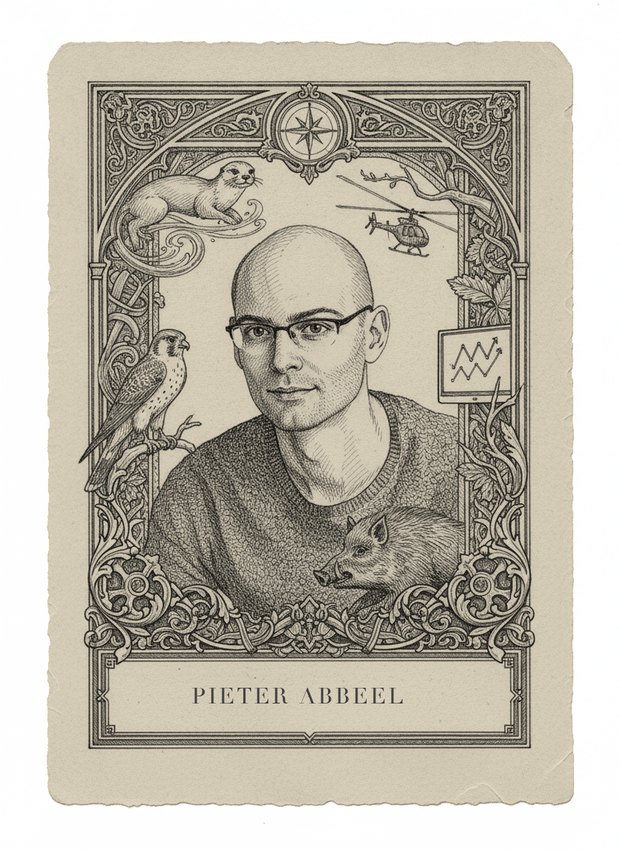
Abbeel's body of work — apprenticeship learning with Ng, deep RL for robotic manipulation, meta-learning — is about acquiring control policies from demonstrations and massive trial, usually in simulation. The moonshot offers none of his preconditions: no expert demonstrations of prior moonshots to imitate, no simulator faithful enough to train against, and a single unrepeatable episode where exploration is forbidden because failure kills crews. The problem's actual solution — an exact longest-path computation plus organizational reporting — needs no learning at all, and its hard variants (resource-constrained scheduling) are attacked with integer programming, not policy gradients. His genuine strengths transfer only weakly: he co-founded and helps run real robotics companies, so he has touched engineering coordination, and task-and-motion planning shares precedence vocabulary. But nothing he is known for produces this deliverable. Low, above only the pure pattern-learners.
Battle #91 · 8/10/2026, 11:37:04 AM · this result is deterministic: the same two personas on this problem always resolve the same way.