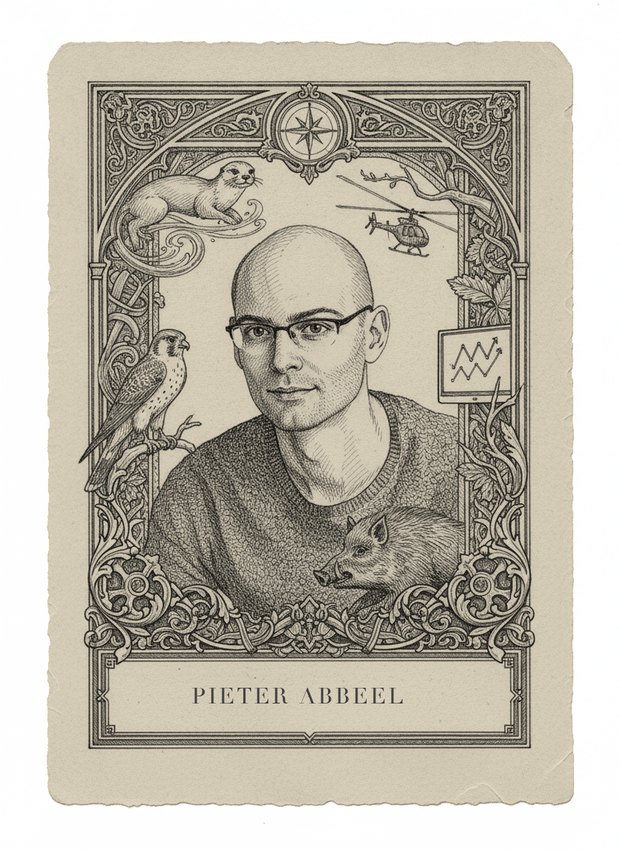
Pieter Abbeel
Robot learning; deep RL for manipulation
Played by Nura
Strongest on
Battles
Prove the descent L Raquel Urtasun
The sticker that erases the stop sign W Rina Foygel Barber
Schedule the moonshot L David Blei
When the predictors move together L David Blei
Index the entire web
In the mind map
The same ideas, as concepts rather than history — in John's ML knowledge map.
Life and career
In the mid-2000s, a radio-controlled helicopter at Stanford flew a sequence of aerobatic maneuvers — loops, rolls, sustained inverted flight, a tail-in funnel — under fully autonomous control. Nobody had written a controller for those maneuvers. The system had watched a human expert pilot fly them, inferred what the pilot was implicitly optimizing, and then flown better than the demonstrations it learned from. Pieter Abbeel was the graduate student behind that work, and it is a good summary of the question he has pursued ever since: how does a machine acquire physical skill when the trials are expensive, dangerous, and few?
Abbeel grew up in Belgium and studied electrical engineering at KU Leuven before coming to Stanford for a doctorate with Andrew Ng, finishing in 2008. He joined the Berkeley EECS faculty immediately afterward and has been there since, directing the Robot Learning Lab and serving as a co-director of the Berkeley AI Research lab. Berkeley in the 2010s became, largely through his lab and Sergey Levine's, the center of gravity for deep reinforcement learning applied to physical robots, and the roster of researchers who passed through — Chelsea Finn, John Schulman, Sergey Levine, and many others — is one of the more remarkable mentorship records in modern AI.
He has also been unusually entrepreneurial. He co-founded Gradescope, a grading platform built on handwriting recognition that spread across university teaching, later acquired. He spent time as a research scientist at OpenAI during its early period. In 2017 he co-founded the company now known as Covariant, applying deep reinforcement learning and imitation learning to warehouse robots that must pick unfamiliar objects out of cluttered bins — an enormously commercially significant problem precisely because the item distribution is open-ended and no hand-engineered grasp planner covers it. He received the ACM Prize in Computing in 2021 for his contributions to robot learning, and he hosts a podcast that has become one of the field's better public interfaces.
The constant across all of it is the physical world's stubbornness. Simulated agents can take a billion steps; a robot arm takes maybe a few thousand before something wears out or breaks. Abbeel's research program is, in a sense, a sustained assault on that sample-complexity gap from every available direction — demonstrations, trajectory optimization, meta-learning, simulation transfer, better policy gradients.
Key contributions
**Apprenticeship learning and inverse reinforcement learning.** With Ng, Abbeel formalized the setting where you have expert demonstrations but no reward function. Rather than cloning the expert's actions directly — which fails because small errors compound and drive the agent into states the expert never visited — their approach infers the reward. Assuming the reward is linear in known features, the key object is the vector of *feature expectations* accumulated under a policy. If your policy matches the expert's feature expectations, then it performs at least as well as the expert under *any* reward linear in those features. The algorithm iteratively finds the reward that most separates the expert from the current policy, solves for the optimal policy under it, and repeats — a max-margin construction with convergence guarantees. The helicopter aerobatics work applied this at a level of physical difficulty nobody had reached.
**End-to-end visuomotor policies.** In 2015, Abbeel's group with Sergey Levine published training of deep neural network policies that map camera pixels directly to motor torques, learning manipulation tasks on a real two-armed robot. The technical enabler was **guided policy search**: instead of asking the network to discover good behavior by blind exploration, run a trajectory optimizer (an iterative LQG-style method) on the physical system to produce locally optimal trajectories, then train the network in a supervised fashion to reproduce them, with a constraint keeping the two in agreement. This reduced real-hardware trials from millions to hundreds, and it demonstrated that perception and control could be learned jointly rather than as separate modules.
**Trust region policy optimization.** With John Schulman and colleagues, Abbeel co-authored TRPO, which addresses the fundamental instability of policy gradient methods: a step that is too large can collapse the policy irrecoverably, because the data distribution itself depends on the policy. TRPO maximizes a surrogate objective subject to a constraint on the KL divergence between the old and new policies, giving a principled trust region in *policy space* rather than parameter space, with a monotonic improvement guarantee under the theoretical version. Together with generalized advantage estimation — a $\lambda$-weighted scheme trading bias against variance in the advantage estimate — it made continuous-control deep RL reliable enough to build on, and it is the direct ancestor of the proximal methods used everywhere today.
**Meta-learning.** MAML, with Chelsea Finn and Sergey Levine, is elegant enough to state in a sentence: find an initialization from which one or a few gradient steps on a new task yields good performance, by explicitly differentiating through those inner gradient steps during meta-training. It is model-agnostic — applicable to any architecture trained by gradient descent — and it reframed few-shot learning as an optimization problem about *where you start*.
**Exploration, transfer, and generative modeling.** His group produced work on intrinsically motivated exploration driven by information gain about the environment's dynamics, on domain randomization for transferring simulation-trained policies to real hardware by randomizing textures, lighting, and physics so the real world looks like one more variation, and — in a direction that surprised many — on denoising diffusion probabilistic models, the formulation that underlies modern image generation.
**Deformable object manipulation.** The towel-folding robot that briefly made his lab famous solved a genuinely hard perception problem: cloth has no fixed shape, so the system had to detect graspable corners from geometry alone and execute a sequence of manipulations that progressively reduce configuration uncertainty.
In battle
Abbeel carries 101 problems at a mean of 28.3 and a median of 20, with 51 problems at or below 20 — the profile of a deep specialist. His dominant categories are `rl` at 59.6 across eighteen problems and `games` at 52.7, and everything worth playing him for lies in that band.
**P066, "The robot learns to grasp"** (97) is set in his own building. Sample-efficient deep RL for physical manipulation, with real-hardware trial counts held to the hundreds by trajectory optimization supplying supervision, is not adjacent to his research program — it is the program, at exactly the right date and place. **P223, "Ascend the policy itself"** (97) is TRPO: the trust-region policy gradient with its KL constraint and monotonic improvement argument, which he co-authored. Those two are his knockout cards.
**P047, "The robot in the warehouse"** (90) is Covariant's exact commercial problem — picking unfamiliar items from cluttered bins, where the open-ended object distribution defeats hand-engineered planning. **P231, "Ride the winds, stay on station"** (85) is RL for control of a physical vehicle in an uncertain environment, where his continuous-control toolkit applies directly even though the specific system was built elsewhere. **P207, "Sixty actions a second, no full view"** (83) rewards his deep RL expertise on a real-time, partially observed domain. **P229, "The room with no reward"** (78) is exploration under sparse reward, where his group's information-gain-driven exploration work is directly on point.
The mid-band is classical control problems where he is strong but historically downstream: **P226, "Which elevator answers the call"** (65) and **P065, "Balance the broomstick"** (64) are RL benchmarks whose original solutions predate him by decades. He knows exactly how to solve them; he did not solve them first, and the game scores accordingly.
His losses are remarkably consistent, and they reveal something a student should notice: Abbeel is weak on *computer systems*, despite being an engineer who ships hardware. His `systems` average is 10.9 across eighteen problems. **P245, "A computer shared by fifty"** (6) is time-sharing, **P249, "The shopping cart that must not vanish"** (6) is distributed availability and conflict resolution, **P247, "What happened first?"** (5) is distributed clocks and causal ordering, **P246, "Small tools, loosely joined"** (5) is the Unix design philosophy, and **P244, "The compiler that beats the coder"** (5) is optimizing compilation. These belong to a systems tradition that runs entirely parallel to machine learning, and proximity to computers is not proximity to that tradition.
His other floor is anything textual or classically statistical. **P263, "Who wrote the disputed papers?"** (5) — small-sample Bayesian authorship attribution — is his weakest documented card, and his `nlp` average of 7.5, `information` of 9.5, and `testing` of 8.7 mark territory he has never entered. `perception` at 25.4 across nineteen problems may look low for a roboticist, but it is accurate: he consumes vision rather than advancing it, and the game credits the people who built the perception methods.
The heuristic: play Abbeel on anything involving an agent acting in the physical world, learning from demonstration, or optimizing a policy. Bench him on infrastructure, text, and inference from small samples.