It is 1950 at Bell Labs, and the computers of the day corrupt bits often enough that a long unattended calculation is regularly ruined — and worse, the machine doesn't even know it erred. Design a code that can correct any single-bit error (and detect two) in a sixty-four-bit block with minimal added redundancy, and that a 1950s relay-and-tube machine can actually compute. The overhead must be small and the arithmetic simple enough for the hardware of the era. Get it wrong and either every long computation stays hostage to silent flips, or your redundancy is so bloated the machine spends its life on parity instead of work — self-correcting codes are what let unreliable hardware do reliable arithmetic, and the constraint is doing it in period-realistic logic.
Chose The stable-contract split — wrong. The content-addressed history was the one that fit.
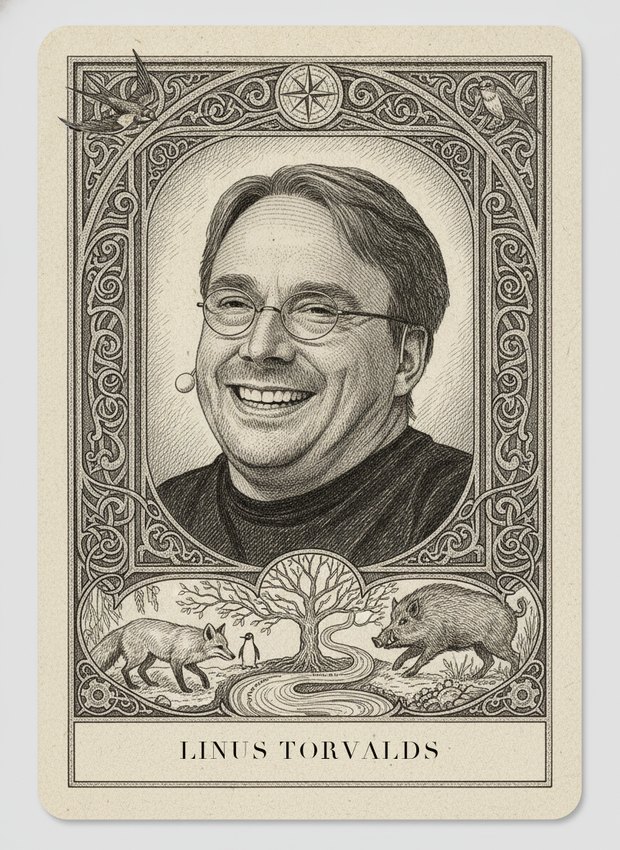
Torvalds is a consumer, not a producer, of coding theory — but an unusually serious consumer. Git's integrity rests on content hashing (SHA-1, chosen 2005) for corruption detection; Linux's storage and filesystem stack integrates CRCs and, via md/RAID code he shepherded, parity and Reed-Solomon-style erasure recovery; he has strong engineering opinions about ECC memory and has publicly campaigned for it. So the problem's purpose — computations that survive silent bit flips — is a lived concern of his professional life. What is missing is everything constructive: he did not design these codes, works four decades past tube hardware, and his skill is systems integration in C, not GF(2) algebra. Given the 1950 problem he would find and correctly deploy Hamming's answer, which is precisely a 33, not an 80.

Kondor's toolkit is algebra applied to computation — group representations, harmonic analysis on finite groups, equivariant networks — and algebraic coding theory is genuinely cognate mathematics: Hamming codes are linear subspaces of F2^n, their automorphisms form groups, and Reed-Muller codes connect directly to Fourier analysis on the Boolean cube that his generation of learning theorists uses daily. He can read and reconstruct the 1950 construction with real fluency, arguably more algebraic fluency than most ML researchers alive. But the applicability is structural kinship, not practice: his publications concern kernels and neural architectures, not codes; his computational world is GPUs and floating point, seventy years from tube logic; and nothing in his record involves communication or storage reliability. A mathematically well-armed tourist in a neighboring department.
Battle #78 · 8/10/2026, 11:36:30 AM · this result is deterministic: the same two personas on this problem always resolve the same way.