systems
The document that links anywhere
It is 1990 at CERN, and thousands of physicists are drowning in their own information: results scattered across incompatible machines, formats, and sites, with each lab's documentation system an island. The proposal on your desk is deliberately, almost embarrassingly simple — a universal address for any document anywhere, a protocol to fetch it, and a format whose links can point across the world with no central registry, no permission, and no guarantee the target still exists. The genius and the scandal are the same property: links may break, and the system works anyway. Get the design wrong — require registration, central coordination, or guaranteed integrity — and the network stays a set of walled gardens; get it right and it swallows human knowledge within a decade.
Who this problem belongs to
The two figures whose methods fit it best, out of 44 in contention.
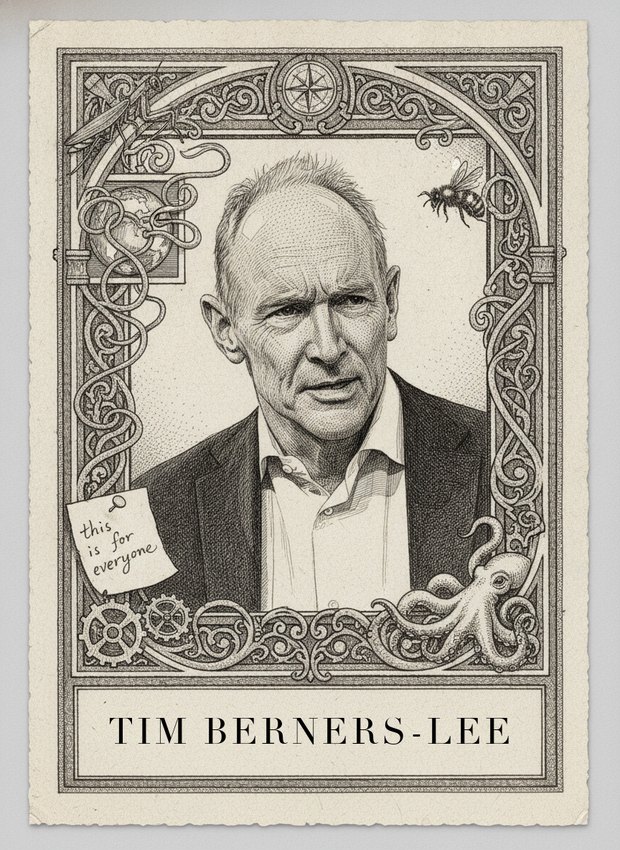
This is not a hypothetical for Berners-Lee; it is literally his desk in March 1990, watching CERN physicists drown in incompatible documentation systems across labs that could not talk to each other. His answer was the World Wide Web: a URI scheme giving any resource a universal address, HTTP as the fetch protocol, and HTML with hyperlinks that could point anywhere with no central registry, no permission required, and no guarantee the target still existed — the deliberate worse-is-better tradeoff this problem names as both genius and scandal. He built the first browser and server himself on a NeXT machine to prove the design worked before anyone else believed in it. No other figure in this roster, or in the history of computing, is more directly the author of this exact answer. Score: maximal, by definition.
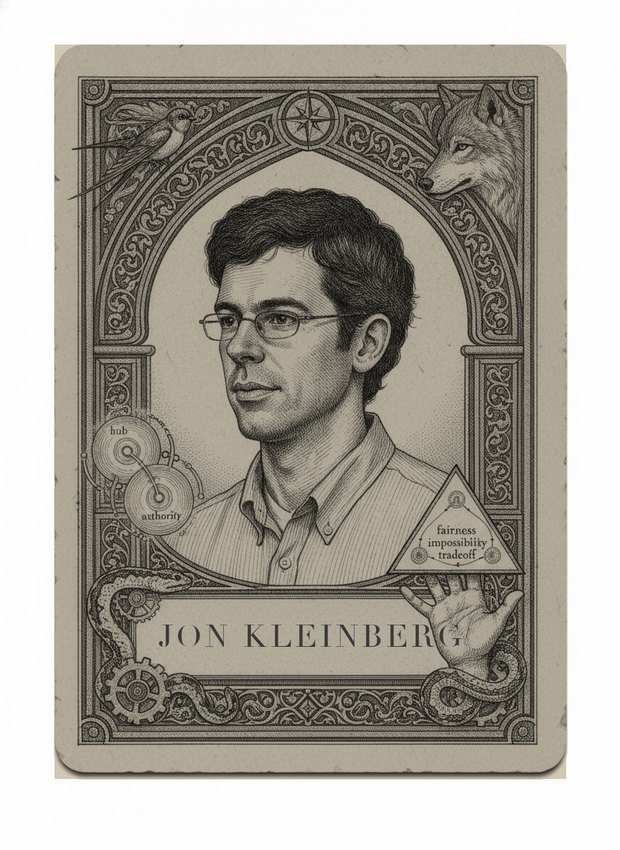
Kleinberg's 1998 HITS algorithm treated the web's link structure itself as a signal — pages that many good hubs point to are authorities, and pages that point to many authorities are hubs — formalizing exactly the property this problem's design created: a network whose value comes from links nobody centrally curated. His later work on navigability in small-world networks explained why a decentralized, unregistered system of links could still be searched efficiently despite no global index, addressing the practical worry any skeptic in 1990 would have raised about a registry-free web. He arrived eight years after Berners-Lee's original design, analyzing rather than building the protocol, which is why he scores below Berners-Lee himself. But no one on this roster understood the mathematics of what an unregulated link graph actually does better than Kleinberg.
44 figures are scored on this problem. Draw it in a battle to see where you land.