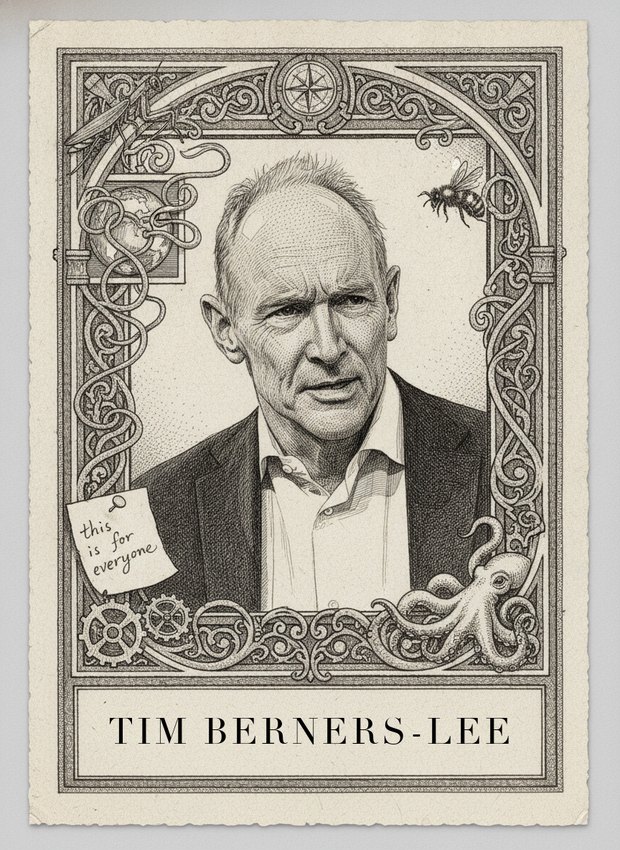
Tim Berners-Lee
The World Wide Web
Strongest on
In the mind map
The same ideas, as concepts rather than history — in John's ML knowledge map.
Life and career
Timothy John Berners-Lee was born in London in 1955 to two mathematicians who had both worked on the Ferranti Mark 1, one of the earliest commercial computers. Computing was dinner-table conversation. He read physics at Queen's College, Oxford, graduating in 1976 — a choice he has described as a compromise between mathematics and electronics, and one that gave him a physicist's habit of asking what the simplest system consistent with the observations would be.
He worked in industry for several years, including at Plessey and at Image Computer Systems, before taking a contract position at **CERN**, the European particle physics laboratory near Geneva, in 1980. CERN is an unusual institution: thousands of physicists from hundreds of universities, arriving and leaving on rotating schedules, each bringing their own machines, document formats, and conventions. Nothing was standardized and nothing stayed put. During that first stint Berners-Lee wrote a personal program called **ENQUIRE**, a hypertext notebook in which entries linked to one another, as an aid to remembering how people, projects, and machines at CERN related. It was never released, but it contained the germ of the idea.
He returned to CERN as a fellow in 1984, and in March 1989 wrote a proposal to his manager Mike Sendall titled "Information Management: A Proposal." Sendall's response, written on the cover, was "vague, but exciting" — one of the few genuinely famous marginal notes in engineering history. The proposal argued that CERN's documentation problem could be solved by a distributed hypertext system in which any document could link to any other without central coordination.
Over 1990 he built it, working on a NeXT cube workstation, with Robert Cailliau as an early collaborator and advocate. By the end of that year he had the three specifications — **URI**, **HTTP**, **HTML** — plus the first web server (info.cern.ch) and the first browser, which was also an editor and was called WorldWideWeb. The first website went live in 1991. In 1993 CERN, at Berners-Lee's urging, placed the web's underlying technology in the public domain, royalty-free. This decision is arguably as consequential as the technical design; competing hypertext systems of the era, including Gopher, faltered partly over licensing uncertainty.
In 1994 he moved to MIT and founded the **World Wide Web Consortium (W3C)**, which he directed for decades, steering standards development through the browser wars and beyond. He has held a professorship at MIT and at Oxford. He was knighted in 2004, received the ACM Turing Award in 2016 for inventing the World Wide Web, the first web browser, and the protocols and algorithms allowing the Web to scale, and was honored during the 2012 London Olympics opening ceremony, where he tweeted "This is for everyone."
His later work has been substantially about the web's failures. He founded the World Wide Web Foundation to push for universal access, articulated a "Contract for the Web," and has been an outspoken critic of centralization, surveillance advertising, and the concentration of personal data in a few platforms. His **Solid** project attempts a structural remedy: give each user a personal data store — a "pod" — that applications access with permission, decoupling data from services. Whether Solid succeeds is an open question; the honesty of the diagnosis is not.
Key contributions
**The three specifications, and why they were designed to be weak.** The web's technical content is remarkably thin, and that thinness was the point.
A **URI** (originally URL) gives any resource on any machine a universal address, combining a scheme, a host, and a path. There is no central registry of documents, only the existing DNS. **HTTP** is a stateless request-response protocol: a client asks for a resource by URI, a server returns it with a status code and headers, and the connection carries no memory of what came before. **HTML** is a simple markup language whose critical feature is the anchor element — a link that points at an arbitrary URI.
The decisive design choice, and the one most instructive for graduate students, is that **links are one-way and unvalidated**. Earlier hypertext research systems — Nelson's Xanadu, and many academic systems — maintained bidirectional links and referential integrity: the system guaranteed a link's target existed. This is a better property. It is also why those systems required central coordination and never scaled. Berners-Lee's web lets you link to anything, with no permission from the target, no notification to it, and no guarantee it still exists. The result is the 404 error — a permanent, visible admission of failure baked into the protocol — and it is precisely what allowed the web to grow without anyone's approval. It is the canonical "worse is better" trade in system design.
The **statelessness** of HTTP has the same character. A stateless protocol cannot support sessions natively, which is why cookies were bolted on and why the entire apparatus of web tracking exists. But statelessness meant servers could be simple, load could be spread across machines trivially, and caching could work at every layer. The web's scaling properties are a direct consequence of the protocol declining to remember anything.
**Standards as an institution.** Founding the W3C was a distinct contribution from inventing the technology. During the 1990s browser wars, competing vendors had strong incentives to fragment HTML into proprietary dialects, and to a significant degree they tried. The W3C process — open specification, multiple independent implementations, formal recommendation — is much of the reason a single interoperable web survived. The specification-and-consensus model it established has been widely copied.
**The Semantic Web and linked data.** Berners-Lee's long-running second project is the argument that the web should carry machine-readable *meaning*, not just human-readable documents. RDF represents facts as subject-predicate-object triples with URIs as identifiers; OWL adds ontology and inference; SPARQL queries the resulting graphs. The full vision — a global reasoning-capable knowledge graph — has not arrived, and the reasons are instructive: ontology alignment is genuinely hard, incentives to publish clean structured data are weak, and statistical language models turned out to extract meaning from unstructured text well enough that the structured layer looked optional. But the influence is real. Schema.org markup, knowledge graphs at every major search engine, and the linked-data infrastructure behind Wikidata all descend from this line of work.
In battle
Berners-Lee's computed profile is the most extreme in this entire set of sixteen, and possibly on the roster. He carries 100 problems at a mean of **12.4** with a median of **8**. Eighty-three of them score at or below 20. He has exactly one dominant problem and one strong problem — which are the same problem. His range is 1 to 100.
That 100 is **P252, "The document that links anywhere."** The game's explanation calls it maximal by definition: this is his desk at CERN in March 1990, and the problem statement names the exact trade-off he made — a URI scheme with universal addressing, HTTP as fetch protocol, and links that point anywhere with no central registry, no permission required, and no guarantee the target still exists. He built the first browser and server himself to prove it worked.
Below that, the drop is immediate and total. His next-best score is **P082, "Ship it to a hundred contributors"** (55), reflecting open collaboration and the W3C's standards process. **P077, "The rank of every page"** (48) is PageRank — he made the object PageRank operates on but did not invent link analysis; Brin and Page did. **P079, "The language for the job"** (45) covers HTML as a designed notation. **P246, "Small tools, loosely joined"** (44) is Unix composability, where he sits far behind Thompson and Ritchie. **P076, "Index the entire web"** (42) is web-scale search, again his substrate but not his method. **P271, "Robust to failure, fragile to attack"** (42) is network resilience, where the web's scale-free link topology is the canonical example — though the analysis is Barabási's, not his. **P297, "The ad the algorithm never showed you"** (35) is his highest score in the fairness category, reflecting genuine engagement with algorithmic accountability and the web's advertising economy in his later advocacy.
His category card confirms the picture: `fairness` 30.0 (only two problems), `systems` 28.7 across eighteen, `networks` 18.5, and then nothing above 16. His `regression` average is 2.5, `classification` 5.0, `rl` 5.0, `causality` 5.5.
The losses are as low as the matrix goes. **P114, "Eleven factors, twelve runs"** (1) — fractional factorial screening design — is a 1 out of 100, the floor of this batch. **P137, "The same patients, measured again and again"** (2) is repeated-measures analysis; **P182, "The corner that sparsity loves"** (2) is the lasso; **P183, "Cool it slowly"** (2) is simulated annealing; **P184, "Fill in the hidden variables"** (2) is EM; **P211, "Roll the dice at Los Alamos"** (2) is Monte Carlo simulation.
The strategic read is stark and worth stating plainly for pedagogy: Berners-Lee is the roster's purest one-problem fighter. He owns a single problem absolutely, and he owns it because he is the sole author of the answer. Everywhere else he is at or near the bottom of the field. His stated battle identity captures both halves — he wins on open universal linking of knowledge, and he loses control of what the web became. Field him only when you know the round is about the web itself.