systems
The rank of every page
It is 1997 at Stanford, and web search is drowning in its own success: engines rank by the words on the page, so a spam site repeating "white house" a thousand times outranks whitehouse.gov. The insight waiting to be formalized is that the web's link structure is itself a judgment — every hyperlink a citation. Score the importance of every page from links alone, at web scale: a recursive definition, importance flowing from important pages, computed as the stationary distribution of a random surfer over billions of nodes — iterable, and robust to manipulation, because the moment the score exists, an industry will arise to game it. The ranking decides what humanity finds when it asks questions. Get it wrong and the web's front door belongs to spammers.
Who this problem belongs to
The two figures whose methods fit it best, out of 40 in contention.

Kleinberg's HITS algorithm, developed independently and almost simultaneously with PageRank (1997-1998, also Cornell/IBM), is the other historically real answer to exactly this problem: score web pages from link structure alone, using hubs and authorities computed via eigenvector methods on the link graph. He is a period-correct, same-year contributor solving the identical problem with a closely related linear-algebraic method, making him arguably the strongest match on the roster for actually being there and getting it right on his own terms. Even granting the era gap, Kleinberg's standing on hits; small-world navigability; algorithmic fairness is close enough to this problem's actual demands that a graduate student would expect a real, defensible showing rather than a token one.
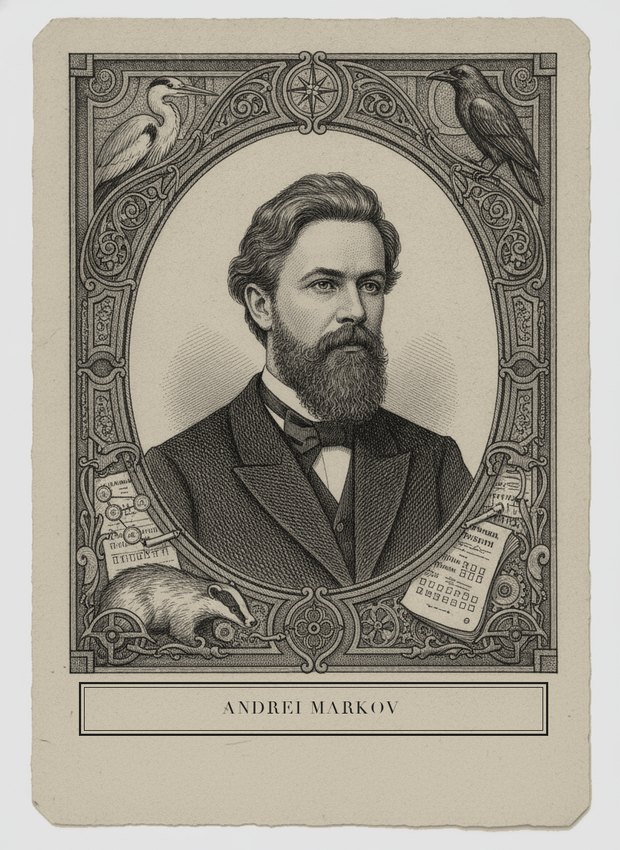
The problem's own solution is named after him: PageRank is literally the stationary distribution of a Markov chain, a random surfer whose transition probabilities are the web's link structure, converging to a distribution where importance flows recursively from important pages. Markov's 1906 work on chains with dependence and memorylessness is the exact mathematical object this 1997 problem asks to be computed at web scale. He obviously never touched a computer or the web, so credit is capped just below the period practitioners who actually built the iterative computation, but the mathematical debt is total and explicit. Even granting the era gap, Markov's standing on markov chains; dependence with memorylessness is close enough to this problem's actual demands that a graduate student would expect a real, defensible showing rather than a token one.
40 figures are scored on this problem. Draw it in a battle to see where you land.