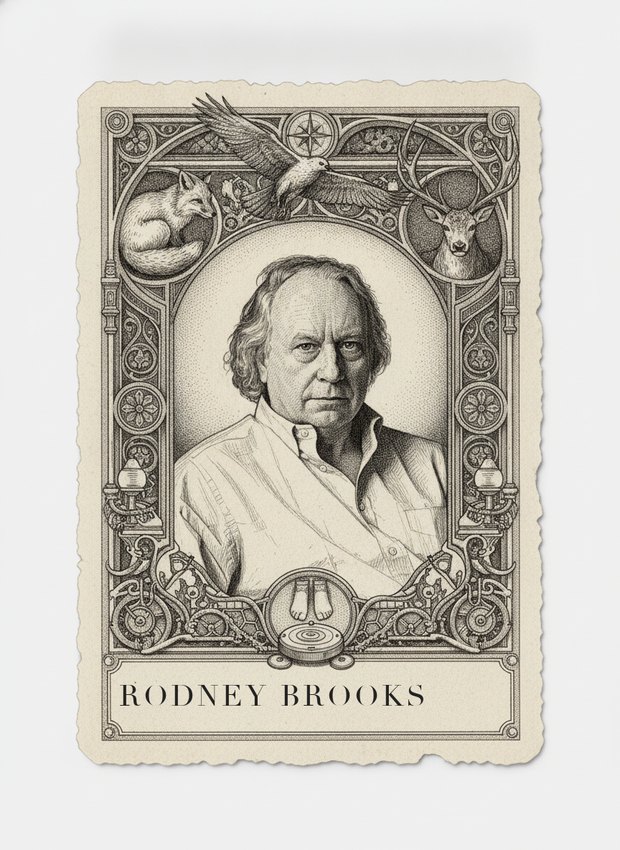
Rodney Brooks
Behavior-based robotics; 'elephants don't play chess'
Strongest on
Life and career
Rodney Brooks grew up in Adelaide, South Australia, building computers out of whatever he could find, and arrived at Stanford for a doctorate at the end of the 1970s — the height of the model-based vision era. His thesis work, on the ACRONYM system with Thomas Binford, was as symbolic as it gets: represent objects as generalized cylinders, reason about how they project into images, and match the model against the picture by constraint propagation. It is worth knowing that Brooks began there, because the man who spent the 1980s attacking representation-heavy AI had first built a representation-heavy system and watched it strain.
He joined MIT in the early 1980s and stayed for a quarter century, eventually directing the AI Laboratory and then, after its merger, CSAIL. What he did there in the mid-1980s was one of the sharpest breaks in the field's history. The prevailing architecture for a mobile robot was sense–model–plan–act: build a world model from sensors, plan a route through it, execute the plan. In practice such robots spent minutes computing and then executed stale plans into a world that had moved. Brooks proposed throwing out the model. His subsumption architecture organized a robot as layers of simple behaviors, each coupling sensing directly to action, running concurrently, with higher layers able to suppress or subsume the outputs of lower ones. There was no central representation and no plan — just competence built up in strata, each of which worked on its own. The slogan attached to it, "the world is its own best model," meant something operationally precise: don't maintain an internal map you have to keep synchronized with reality when you can simply look again.
He proved it in hardware, which is why it stuck. Allen, Herbert, Genghis, Attila and their relatives were small, cheap, insect-like machines that walked over rubble in real time on processors with almost no memory. His polemical papers of the period — "Elephants Don't Play Chess" and "Intelligence Without Representation" among them — argued that the field had inverted the difficulty ordering: chess had been done, and a robot that could move through an unstructured room like an insect had not, so perhaps mobility and perception were the hard, foundational parts of intelligence and abstract reasoning was a late, thin veneer. In the 1990s his lab turned this toward humanoids and social robots, with Cog and with Cynthia Breazeal's Kismet, on the thesis that human-like intelligence needs a human-like body and a developmental social context.
Then he did the thing academics usually do not: he built the companies. iRobot, co-founded in 1990, spent a decade on military and exploration robots before shipping the Roomba in 2002 and selling tens of millions of them — the first genuinely mass-market robot, and about as direct a vindication of cheap reactive competence as one could ask for. Rethink Robotics, founded later, built Baxter and Sawyer: force-compliant industrial arms with expressive faces, safe to work beside humans and trainable by physical demonstration rather than programming. Rethink did not survive commercially, which Brooks has discussed publicly and unsentimentally. He went on to co-found another robotics company and has become one of the field's most useful public skeptics, posting dated, falsifiable predictions about self-driving cars, robotics and AI timelines and then scoring himself against them.
Key contributions
**The subsumption architecture.** The technical content is a design discipline, not an algorithm. Decompose the system by *task-achieving behavior* rather than by functional module. A layer is a small finite-state machine wired between particular sensors and particular actuators — avoid obstacles, wander, explore, map — with fixed, tight loop timing. Layers run in parallel and are added incrementally; a higher layer influences a lower one only by suppressing its inputs or inhibiting its outputs, so lower layers keep working if higher ones fail or are removed. The payoff is robustness and responsiveness: there is no central bottleneck to fall behind reality, no fragile world model to become inconsistent, and graceful degradation is structural rather than engineered. The costs are equally real and Brooks was clear about them: the behaviors interact in ways that are hard to predict or verify, there is no natural place to put a long-horizon goal, and the architecture does not compose upward past a certain complexity.
**Behavior-based robotics as a research program.** Beyond the specific architecture, Brooks established a methodological claim that reoriented the field: intelligence should be studied in situated, embodied systems acting in unmodified environments, on the actual timescale of the world, rather than in simulated micro-worlds with clean symbolic inputs. "Physical grounding" as a hypothesis — that symbols must ultimately be grounded in sensorimotor interaction to mean anything — connects his work to a much older philosophical argument, and gave robotics a reason to treat real hardware and real messes as scientifically necessary rather than as engineering overhead.
**Practical robots at scale.** The Roomba is a serious technical artifact disguised as an appliance: essentially no map, no expensive sensing, randomized and reactive coverage strategies, and a bill of materials cheap enough to sell to households. It works because the environment is doing the bookkeeping. PackBot took the same ruggedness philosophy into bomb disposal and disaster response. Baxter's contribution was series-elastic actuation and compliance in an industrial arm: making the machine intrinsically safe to be near, rather than caging it.
**Honest public forecasting.** His long-running practice of publishing specific, dated predictions about robotics and AI, and then grading them, is a genuine contribution to a field with a chronic hype problem — and it is closely connected to his research stance, which has always been that competence in the physical world is much harder and slower to arrive than benchmark performance suggests.
In battle
Brooks has the most extreme profile in this group and the game does not flatter him: mean 19.8, median 15, seventy of a hundred problems at or below 20, and only two problems above 80. He is a single-domain carrier, and the domain is embodied real-time robotics.
"The robot in the warehouse" (96) is his career thesis restated as an exam question. The brief describes precisely the failure modes subsumption was built against — a robot freezing to recompute, executing a plan the world has already invalidated — and Brooks's answer is layered reactive behaviors that never stop being responsive, proven in hardware and then in millions of shipped units. The only thing keeping him below the ceiling is the honest caveat that real fielded warehouse systems are hybrids with a deliberative planning layer he spent a decade arguing against. "The robot learns to grasp" (83) rewards the same embodied instinct: compliance, contact, and trying things in the real world rather than solving for grasp poses in a model.
After that it drops fast, and the pattern of the middle band is instructive. "A hundred robots, no collisions" (68) is multi-agent coordination, where decentralized reactive behavior genuinely helps but the guarantees come from elsewhere. "Act on what you cannot see" (55) is partial observability — a POMDP problem, and Brooks's response to hidden state is to sense again rather than to maintain a belief distribution, which is a real answer but not the one the problem is asking for. "Depth for a robot on Mars" (55) and "Balance the broomstick" (45) put him in territory owned by the geometric-vision and control-theory people. "Sequence the robot's actions" (45) is exactly where his architecture is weakest by design: long-horizon task sequencing needs the deliberative layer he removed.
His category numbers confirm the narrowness — search 32.2 and RL 27.9 are his best, perception 22.1, and everything else in the teens or single digits. The systems average of 14.1 across eighteen problems is the surprising one: he is a legendary systems builder, but the game's systems problems are about databases, distributed infrastructure and software architecture rather than robots.
The floor is where the pedagogy is. "Why least squares, exactly?" (4), "Just look at the neighbors" (4), "Twenty thousand tests at once" (5), "How much stock to hold" (4), "The candidate you cannot recall" (4, the secretary problem), "The certificate of optimality" (5). These are estimation, statistics, and closed-form optimal decision rules derived in advance from probabilistic first principles — the exact intellectual posture Brooks built a career rejecting. He has no statistical toolkit, no optimization theory, and a stated philosophical objection to computing an optimal action before acting. Against any problem that says *derive the provably best rule*, he is worth almost nothing, and the reason is not ignorance but doctrine. That makes him one of the most illuminating cards in the deck: he shows a student exactly how much of AI's territory a single powerful idea can own, and exactly how sharp its boundary is.