It is 2003, and viral marketing has a budget and a graph: a company can seed its product with a hundred free samples across a social network of millions, hoping cascades of word-of-mouth do the rest. Formalize influence spread as a probabilistic process on the graph, then face the optimization: choosing the seed set that maximizes expected adoption is NP-hard — but the objective has a saving structure, diminishing returns, under which a greedy algorithm carries a provable guarantee of a constant fraction of optimal. Prove it, and say when the model's assumptions break. Get it wrong and the budget is spent on celebrities whose cascades overlap wastefully — or the same mathematics is later deployed, unexamined, to seed political messaging.
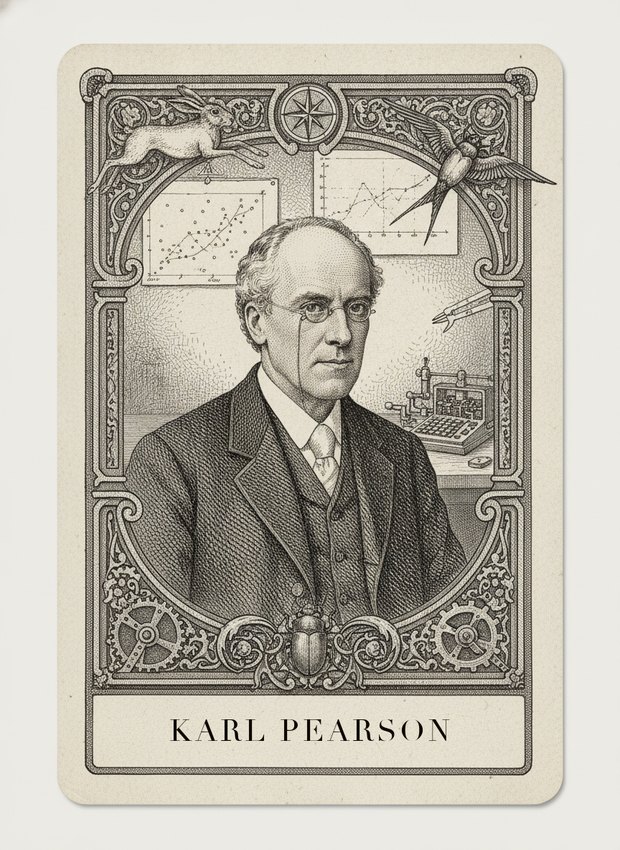
Pearson's foundational work establishing correlation and chi-squared statistics gave the discipline of statistics its earliest rigorous tools for quantifying association between variables, a body of work with only the most distant conceptual bearing on this problem's discrete combinatorial optimization question about submodular seed-set selection for cascade-based influence maximization on a social network. His statistical rigor is transferable in the abstract to measuring correlation between network position and adoption likelihood, a loose empirical echo of this problem's underlying data. But nothing in his direct mathematical contributions addresses graph theory, submodular optimization, or NP-hardness proofs specifically, concepts that emerged roughly a century after his own era. His score reflects only distant foundational statistical relevance.

Reddy's pioneering work on continuous speech recognition and robotics established foundational AI systems engineering achievements, a body of research with essentially no direct bearing on this problem's discrete combinatorial optimization question about submodular seed-set selection for cascade-based influence maximization on a social network. His broader career demonstrates real engineering rigor in building systems that operate reliably at real-world scale, transferable in only the most general sense to the computational scale this problem's seed-selection algorithm must handle. Nothing in his direct published contributions addresses graph theory, submodular optimization, or viral-marketing mathematics specifically. His score reflects minimal direct relevance to this problem's specific combinatorial-optimization and social-network-diffusion subject matter. Building working AI systems is a different craft from proving approximation guarantees for combinatorial optimization.
Battle #125 · 8/10/2026, 11:39:00 AM · this result is deterministic: the same two personas on this problem always resolve the same way.