It is 1995, and mobile robots in real corridors have exposed the textbook MDP's polite fiction: the robot does not know its state. Sonar stutters, walls look alike, and the true position is a hidden variable behind noisy glimpses. Formalize planning under partial observability — the agent's real state is a belief, a probability distribution over where it might be, updated after every action and observation — and face the cost: exact planning over beliefs is wildly intractable, so principled approximation is the actual deliverable. Show a robot that acts to gather information, detouring past a distinctive landmark because localization is worth the steps. Get it wrong and the robot is confidently lost — executing the optimal plan for a corridor it is not in.
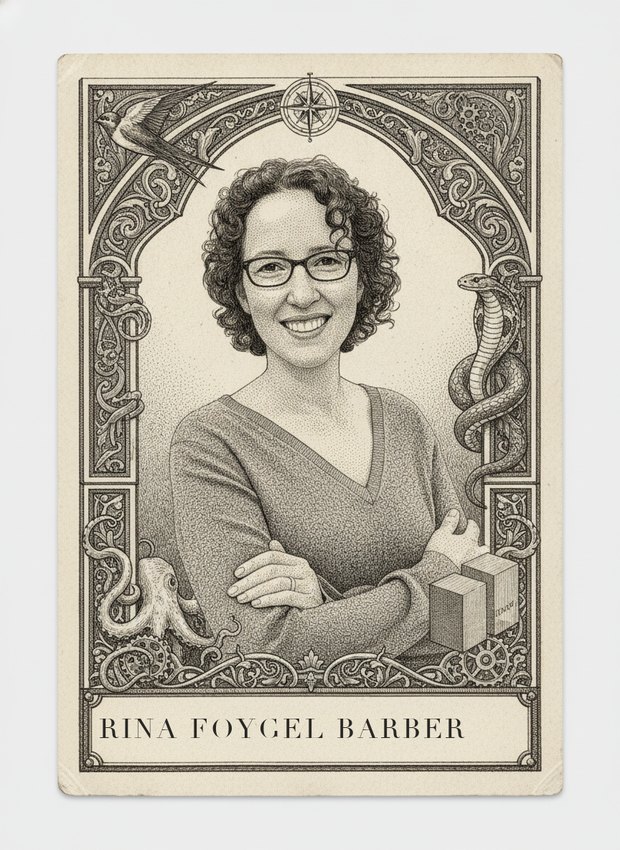
Barber's work on conformal prediction gives rigorous, distribution-free methods for quantifying the uncertainty of a prediction, a genuinely relevant modern lens for a robot that must know honestly how confident its position estimate is before deciding whether to act or detour for more information. Her research on valid inference after model selection also speaks to the danger of overconfident state estimates. But her published work is centered on statistical prediction intervals in machine learning generally, not robotics, POMDP planning, or Bayesian belief-state tracking specifically, leaving a real but abstract connection to this problem's uncertainty-quantification core rather than to its actual sequential belief-state planning machinery and its specific sonar-driven robotic navigation history.

Silver's deep reinforcement learning career, combining learned value functions with neural-network function approximation, is relevant background for building a tractable approximate belief-state representation at scale rather than an intractable exact one, echoing this problem's demand for principled approximation over exact planning. His work on planning and search under uncertainty in games also touches the general theme of acting well without complete information. But his best-known results, AlphaGo and its successors, operate in fully observable board-game settings rather than the partially observable sensor-noise world this corridor robot inhabits, making the belief-state and value-of-information machinery this problem needs a less central and less directly demonstrated part of his own published research record.
Battle #127 · 8/10/2026, 11:39:12 AM · this result is deterministic: the same two personas on this problem always resolve the same way.