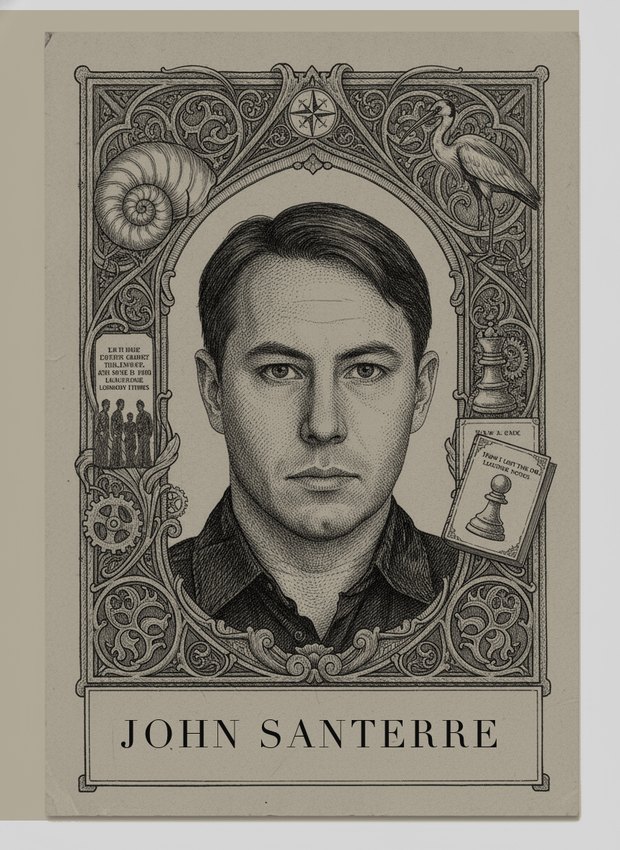
John Santerre
The professor. Brings AI to companies; teaches it at Berkeley; loses to every specialist on their own turf
Played by John
Strongest on
Battles
Drive through the intersection L Terence Tao
Program chess before the computer exists W Michael Mahoney
The memory that completes the pattern W Bernhard Scholkopf
The same patients, measured again and again W David Blei
The adaptive dose-finder W Rina Foygel Barber
Counting yeast in the pitching square L Yann LeCun
Predict, or explain? L Alec Radford
Cut the image into things L David Silver
The eight field plots L David Blei
The gradient that vanishes L Linus Torvalds
Color the map, meet the constraints L Josh Tenenbaum
The pump on Broad Street L Carlos Guestrin
Replace the acoustic model W Judea Pearl
Program chess before the computer exists L Rediet Abebe
Peeking at the trial L Ashish Vaswani
Compress without knowing the source W Florence Nightingale
One test or twenty? W Andrei Markov
Compress without knowing the source W Jurgen Schmidhuber
The million-parameter valley W Richard Karp
The million-parameter valley L Tom Mitchell
Teach the machine checkers L Robert Nowak
Drive through the intersection L Timnit Gebru
Concepts from three examples L Paul Erdos
Trust without recomputing L Andrew Gelman
When you can't randomize
In the mind map
The same ideas, as concepts rather than history — in John's ML knowledge map.
Life and career
Every other figure on this board earned their coin by inventing something. This one earned it by printing the coins.
John Santerre is the professor running this event, and his presence in a roster of Gauss, Turing, and Fisher is a joke he is telling at his own expense. It is also, in a small way, the point. The path that brought him here did not run through a mathematics department.
He started in the humanities — a double major in English and Film at Middlebury College, with stints at UEA, NYU, and UNH along the way. What followed was not graduate school but a camera. He worked as a photojournalist, which is a profession organized entirely around a single question: what is actually happening here, and how do you show it to someone who wasn't in the room? He would later describe the move from photojournalism into machine learning as less of a career change than it looks. Both are about extracting structure from a mess of unlabeled reality and making the result legible to someone else.
The formal turn came at the University of Chicago, where he completed an MS and then a PhD in computer science, working on machine learning under Rick Stevens. His dissertation, *Machine Learning for the Genotype-to-Phenotype Problem*, sat at the intersection of large-scale ML and genomics — specifically the problem of predicting antimicrobial resistance from bacterial genomes, work carried out alongside years at Argonne National Laboratory. Before Chicago there had been a period at Carnegie Mellon's Human-Computer Interaction Institute as a visiting scholar. The résumé reads as a series of lateral moves that only make sense in retrospect.
What came after is a career built more on range than on depth in any single lane. He was Chief Data Scientist at Triggr Health, a venture-backed health startup. He spent four years at SAP, rising from senior to principal data scientist with a research fellowship in the Technology Office's New Ventures group. At Silicon Valley Bank he served as Director of Data Science and then founded the bank's AI Lab, building the team from zero to sixteen people in under six months — an effort deliberately structured for diversity along three separate axes at once: experience level, from undergraduates through PhDs; function, spanning cybersecurity, data science, and business; and demographics, with a team that was consistently more than half women and, for much of its life, more than half Black. He has worked with DeepLearning.AI, advised NASA Goddard on machine learning for planetary science — computer vision applied to Europa, Titan, and Mars — and holds a US patent from that work. He currently serves as CTO of a deep-tech startup and runs Free Focus, a nonprofit providing technology services to other nonprofits.
He has taught at Syracuse, at SMU as lead adjunct professor, and since 2021 at UC Berkeley's School of Information, where he teaches applied machine learning in the MIDS program. He is dysgraphic, and open about it — openly enough that he has spoken to faculty on the subject and served as an ombudsman for learning disabilities. That openness is not incidental to how he teaches. A person who processes written information unusually builds alternate scaffolding by necessity, and then discovers that the scaffolding helps students who don't fit the default mold either.
Key contributions
His published record is real but modest by the standards of this roster — a few hundred citations across antimicrobial-resistance genomics, planetary science with NASA, applied health machine learning, and a long tail of papers co-authored with students. None of it is the kind of contribution that wins a battle against Fisher on experimental design or Shannon on channel capacity.
His actual contribution is of a different type, and it is worth naming precisely because the game has no scoring category for it.
He connects students to the professional world. He has organized industry field trips at every physical immersion he has attended, including taking students to NASA. He has brought his students to meet Andrew Ng. He brings outside speakers into his classroom, and outside investors into immersion events. He runs a Discord server where more than a thousand of his former students have gathered, and for roughly six years he ran weekly talks there — unpaid, uncredited, entirely outside any job description. He has repeatedly hired his own former students into real roles at real companies, which is the most concrete evidence a teacher can offer that the credential meant something.
And he builds things. He built a tool to read across the entire NeurIPS corpus and demoed it to his class, on the theory that watching a practitioner cope with a field that outpaces any syllabus is itself a lesson. He designed a full course on business engineering with large language models — Berkeley declined to adopt it, citing overlap with existing offerings, and he still thinks the argument is right: a data science master's should be producing people who can build businesses, not only people who can build models.
He also built this game. The roster, the three hundred problems, the fifteen thousand scored matchups arguing about whose methods actually apply to what — that is his work, undertaken so that a room full of graduate students might argue about the history of their own field over drinks.
In battle
He loses. Every time. To everyone.
This is not modesty or a scoring artifact. It is written into the rules. Every other persona on this board has a score floor of 1 on every problem they carry. John Santerre scores exactly 0 on all of them. There is no problem in the pool he wins, no opponent he beats, no tie he survives. The arithmetic is deterministic and there is no appeal.
The justification texts are where the joke lives. On the traveling salesman problem, he arrives having taught NP-completeness at Berkeley and drawn the SAT reduction on many whiteboards, only to find that the room contains Cook and Karp themselves, which makes his role roughly that of a docent explaining a painting while the artists reach past him for the brush. On the recovery of Ceres, he can lecture with feeling about Gauss's 1801 triumph and then produces a beautiful whiteboard derivation containing one sign error, pointing the telescopes at the wrong node — a mistake any of his own students would catch, several of whom are also on this roster.
That is the pedagogy, and it is deliberate. The generalist who has taught all of this material, who can explain every method on the board and place each one in its historical moment, still loses to every specialist on their own turf. Breadth is genuinely useful — it is how you know which problem is worth solving, which is not a small thing — but it is not the same as having done the work. Knowing the history of a field and having made history in it are different achievements, and this game keeps score of only one of them.
There is one more thing worth noticing. Thirty-five of the personas on this board are marked because he added them personally and has a story about each — a collaborator, a teacher, a friend, someone whose paper changed how he thought. He is on the board too, at the bottom, having built the whole thing so that his students could meet the people he admires.
Losing every battle is, on reflection, a reasonable price for that.