It is 2011 at MIT, and the gap is embarrassing: state-of-the-art learning systems need thousands of labeled examples to recognize a category, while a three-year-old down the hall at the daycare sees three examples of a new word — "that's a wug, there's another wug" — and generalizes correctly, immediately, including to cases she has never seen. Model this one-shot concept learning as Bayesian program induction: structured priors over how concepts are built, likelihoods that explain why three examples suffice, inference that lands where the child lands. The stakes run in both directions — a computational account of human concept learning for cognitive science, and an existence proof that data-hungry statistics is not the only path, which the deep-learning era badly needs to hear.
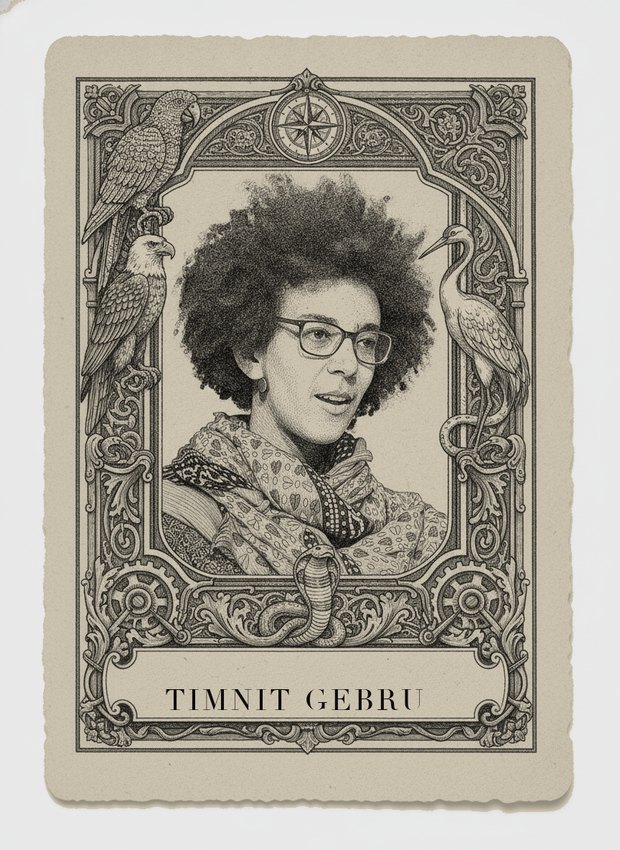
Chose The scale-skepticism critique — right call.
Gebru's contributions — datasheets for datasets, model cards (with Mitchell), the Stochastic Parrots critique (2021), and founding DAIR — constitute the era's most influential accounting of what large-scale data actually contains and costs. Her critique is genuinely adjacent to this problem's motivation: Stochastic Parrots argues that scale-first language models manipulate form without grounded understanding, harmonizing with the claim that data-hungry statistics misses what the three-year-old has. But adjacency of critique is not applicability of method. Her tools are documentation standards, audit methodology, and sociotechnical analysis — none of which constructs structured priors, runs posterior inference, or models children's generalization. Her computer-vision work (Fei-Fei's lab) was itself large-data. She would sharpen the problem's indictment of the paradigm and contribute no machinery toward its proposed solution.
The professor has taught Bayesian concept learning at Berkeley — drawn the hierarchical-prior diagrams, assigned the Tenenbaum papers, told the wug story to three cohorts with genuine enthusiasm. But teaching the size principle is not deriving it, and somewhere between the lecture slides and the daycare, the details went missing. Ask him to actually specify a prior over programs and he produces something a three-year-old would falsify in one utterance; his posterior collapses faster than his office hours attendance after the midterm. In a room containing Bayes himself, Kolmogorov's complexity theory, and Tenenbaum's actual models, the man who explains other people's breakthroughs for a living discovers his true prior: certainty that the specialists win on their own turf, updated by no evidence whatsoever, because none is needed.
Battle #28 · 8/9/2026, 6:20:06 PM · this result is deterministic: the same two personas on this problem always resolve the same way.