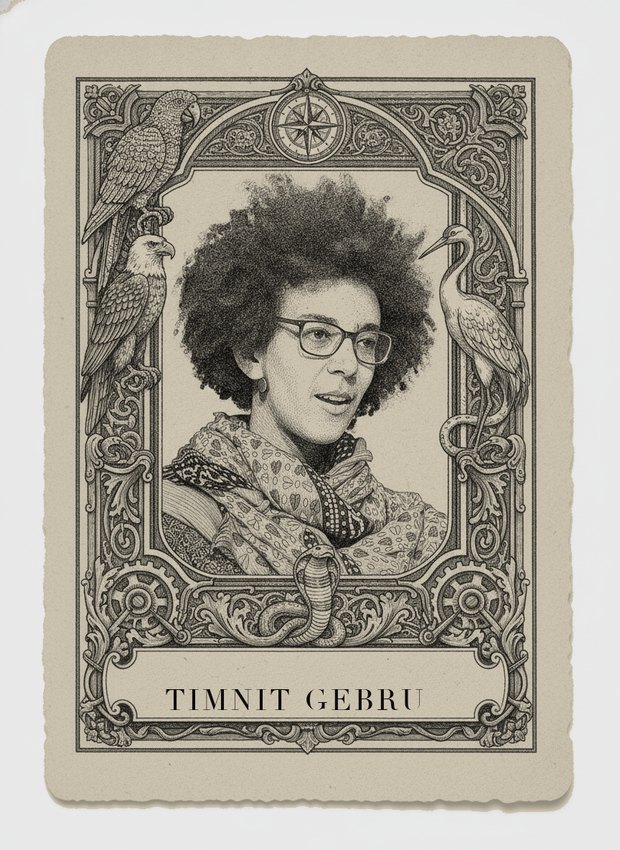
Timnit Gebru
Datasheets and model cards; Stochastic Parrots; founder of DAIR
Played by Sid
Strongest on
Battles
In the mind map
The same ideas, as concepts rather than history — in John's ML knowledge map.
Life and career
The through-line of Timnit Gebru's career is a refusal to accept that a system's failures are somebody else's department. Born in Addis Ababa in 1983 to an Eritrean family, she left Ethiopia as a teenager during the Ethiopian–Eritrean war, spent time in Europe, and eventually arrived in the United States as a refugee, finishing high school in the Boston area. She went to Stanford for electrical engineering, taking a bachelor's and a master's there, and then spent several years at Apple working on hardware and signal processing — circuit-level, ship-it engineering, a long way from the ethics literature she is now identified with.
She returned to Stanford for a PhD in the computer vision group under Fei-Fei Li, and the dissertation work is worth knowing because it explains everything that came after. Gebru assembled a pipeline that detected and classified cars in tens of millions of Google Street View images across hundreds of American cities, and then asked what the resulting distribution of vehicles predicted about the neighborhoods they were parked in — income, education, voting patterns. The result, published in PNAS in 2017, was a demonstration that computer vision at scale is a *social measurement instrument*, whether or not its builders intend it to be. Once you have built a machine that infers demographics from street furniture, the question of who gets measured, by whom, and with what error rate stops being philosophical.
After the PhD she joined Microsoft Research's FATE group (Fairness, Accountability, Transparency, and Ethics) in New York as a postdoc. That is where the Gender Shades work happened: with Joy Buolamwini, an audit of commercial face-analysis APIs that disaggregated accuracy by skin tone and gender and found error rates that were near-zero for lighter-skinned men and dramatically worse for darker-skinned women. The 2018 paper is one of the most consequential empirical results in the field, not because the method is exotic — it is a carefully constructed benchmark and a stratified error analysis — but because nobody had bothered. Aggregate accuracy had hidden a failure mode that only appeared when you cut the data along the axis that mattered to the people being misclassified.
Also in 2017, with Rediet Abebe, she co-founded Black in AI, which has done more than any diversity statement to change who is physically present at NeurIPS.
She moved to Google, where she co-led the Ethical AI team with Margaret Mitchell. In December 2020 she departed the company in a rupture that became one of the most widely covered episodes in the recent history of the field. The proximate cause was an internal dispute over a paper — "On the Dangers of Stochastic Parrots," written with Emily Bender, Angelina McMillan-Major, and a co-author writing under a pseudonym — which Google asked her to retract or remove her name from. The characterization of what followed is genuinely disputed: Google has described it as a resignation, Gebru says she was fired. Both accounts are on the public record; the internal details are not, and readers should treat the framing as contested rather than settled. What is not disputed is the aftermath: thousands of researchers signed letters, the paper appeared at FAccT 2021 anyway, and Mitchell also left Google shortly afterward.
In December 2021 Gebru founded DAIR, the Distributed AI Research Institute — an independent, non-corporate research organization explicitly designed so that the work does not require the permission of a company whose products it might criticize. The institute's structure is the argument: distributed, community-rooted, funded outside the big labs. Having twice found that institutional shelter comes with an editor, she built a place that doesn't.
Key contributions
**Disaggregated evaluation.** The methodological core of Gender Shades is not a new algorithm but a new evaluation discipline. Report accuracy conditioned on the subgroups the system will be deployed across, and construct a benchmark that is balanced enough to make those conditional estimates statistically meaningful. Graduate students should recognize the statistical point immediately: a marginal error rate is an expectation over a population distribution, and if the deployment population differs from the benchmark population — or if the loss is borne unevenly across strata — the marginal is uninformative about the harm. The paper's contribution was to build the stratified benchmark (constructed with attention to skin-tone labeling rather than inferred race) and to make the disaggregated table the reportable object.
**Datasheets for Datasets (2018).** Gebru led this paper, with Jamie Morgenstern, Briana Vecchione, Jennifer Wortman Vaughan, Hanna Wallach, Hal Daumé III, and Kate Crawford. The analogy is to electronic components: no engineer would design with a capacitor that shipped without a datasheet specifying operating range, tolerance, and failure conditions, yet ML datasets circulated with no such document. The proposal is a structured questionnaire covering motivation, composition, collection process, preprocessing, intended uses, distribution, and maintenance — who is in the data, how they got there, whether they consented, what the known gaps are. It is a documentation standard, not a technique, and its influence is visible in the fact that dataset cards are now normal practice at major repositories.
**Model Cards for Model Reporting (2019).** Led by Margaret Mitchell with Gebru and others, this extends the same logic downstream to the trained artifact. A model card states intended use and out-of-scope use, the evaluation data, and — critically — performance disaggregated across relevant demographic and environmental groups, plus known ethical considerations and limitations. The pairing is the point: a datasheet describes the input distribution, a model card describes conditional performance over it, and together they let a downstream deployer reason about whether their population is inside the model's tested envelope.
**Stochastic Parrots (2021).** Co-authored with Bender and McMillan-Major, this is the paper that named the central worry about large language models before scaling had run its course. Its arguments — that undocumented web-scale corpora encode the views of the overrepresented, that fluent text generation without grounding produces plausible-sounding falsehoods, that environmental and financial costs concentrate capability in a few labs, and that benchmark performance is not comprehension — have aged into the field's standard vocabulary. "Stochastic parrot" is now a term of art, invoked as often by people who disagree with it as by people who don't.
In battle
Gebru is one of the sharpest specialists in the game. Across 100 problems her mean is 31.5 with a median of 22, but that average conceals a hard split: eleven problems where she is dominant (80+) and forty-nine where she scores 20 or below. She wins enormous or she doesn't show up.
Her two live categories are **NLP** (87.0 average, her strongest by a wide margin) and **fairness** (72.0, over fifteen problems — the deepest bench she has). Everything else sits below 50. Her signature cell is **P100 — Document the model** at 99, and the matrix's own explanation is unsentimental about why: this problem asks for exactly the disclosure regime that datasheets and model cards proposed, so the translation distance from her real work to the problem statement is essentially zero. **P266 — What is in the training data?** (98) is the datasheet question posed directly. **P292 — Arrested by a false match** (99) and **P099 — The score that decides parole** (91) are the deployment consequences of undisaggregated evaluation in criminal-justice settings — face recognition error concentrated on the population least able to contest it, and risk scores whose calibration hides a differential error profile. **P262 — Fluent, confident, and wrong** (93) is Stochastic Parrots as a battle card. **P294 — The model memorized the secrets** (90) and **P289 — The variable you removed is still there** (88) test whether you understand that removing a protected attribute does not remove it from a correlated feature set — a point her documentation work makes structurally. **P265 — A recognizer for a language of ten speakers** (88) reflects her long-standing insistence that low-resource languages and communities are not edge cases.
The losses are total and they are all of one kind. She scores 5.5 in **games**, 7.0 in **regression**, 8.5 in **computability**, and in the mid-teens across **optimization**, **testing**, and **information**. She collapses on **P211 — Roll the dice at Los Alamos** (2), **P216 — Calculus for a jagged path** (3), **P212 — Sample from the impossible posterior** (4), **P283 — Five hundred stocks, one year of days** (4), **P217 — How high must the dike be?** (5), and **P200 — Beat the world champion** (5). These are mid-century computational statistics, stochastic calculus, MCMC, covariance estimation, extreme-value theory, and adversarial search. There is no bridge from a dataset documentation standard to variance reduction in neutron transport, and the matrix does not invent one.
The pedagogically interesting number is her **causality** score: 19.2 across eighteen problems, which surprises students who expect a fairness researcher to be strong on confounding. The game's causality problems are mostly identification problems — instruments, do-calculus, potential outcomes — and Gebru's method is auditing and disclosure, not structural estimation. Her answer to a biased system is *show me the data and the disaggregated errors*, which is a devastating move on P289 and useless on an instrumental-variables question. Play her where the fight is about what a system hides; keep her away from anything that requires an estimator.