It is 2021 in San Francisco, and the standard vision recipe has a hidden invoice: every new task begins with a curated labeled dataset, so recognition is forever gated on annotation budgets and frozen category lists. The alternative uses supervision nobody had to buy — four hundred million image-text pairs scraped from the web — and trains two encoders to agree: image and caption pulled together, mismatched pairs pushed apart. The test is the radical part: classify standard benchmarks zero-shot, by asking which caption fits, matching supervised baselines without seeing one training label. Then audit what web-scale text smuggles in — its stereotypes ship with its supervision. Get it right and vision uncouples from the labeled dataset; the category list becomes a sentence anyone can rewrite.

Erdos's probabilistic method and his vast body of combinatorics results established powerful techniques for proving that structures with certain properties must exist by showing a random construction has positive probability of possessing them, a mathematical toolkit with no direct bearing on this problem's engineering of a contrastive vision-language model from web-scraped data. There is no meaningful technical bridge between his combinatorial existence proofs and training transformer-based image and text encoders. His relevance to this specific deep-learning problem is essentially nonexistent beyond both belonging to the broad mathematical sciences that indirectly underpin all of computing in different, largely unconnected ways. The absence of any technical bridge here is itself a useful reminder that not every mathematical giant transfers to every modern problem.
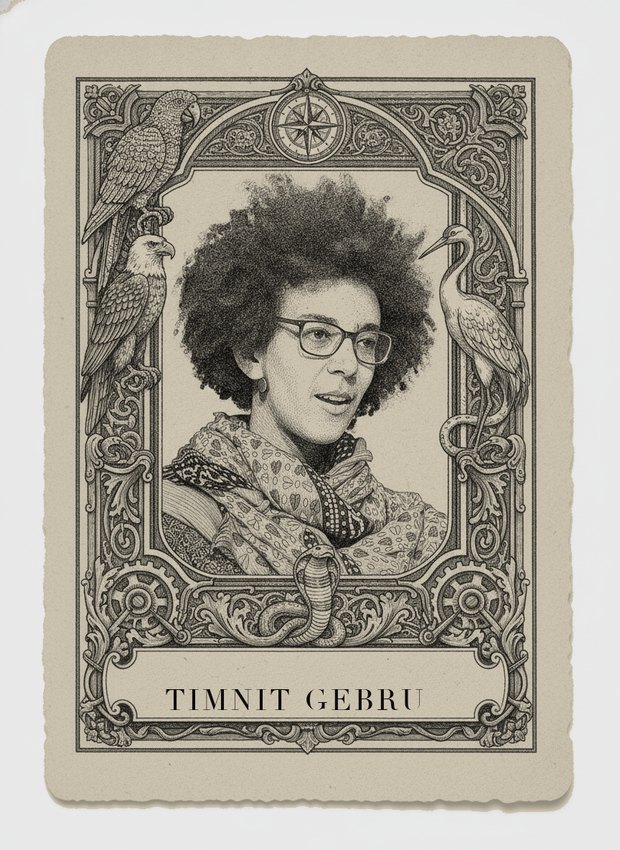
Gebru's research on datasheets for datasets and her co-authored 'Stochastic Parrots' paper directly anticipate this problem's second half: auditing what stereotypes and biases web-scale training data smuggles into a model's supervision. Her argument that models trained on uncurated internet text and images inherit and amplify the internet's demographic and cultural biases is precisely the caution this problem's 'audit what web-scale text smuggles in' demands, and CLIP's own paper openly acknowledges exactly these failure modes in its limitations section. She did not build CLIP or design its contrastive objective herself, and her focus is documentation, accountability, and critique rather than the underlying representation-learning architecture, so her relevance is the problem's essential ethical half rather than its technical core.
Battle #30 · 8/9/2026, 6:20:32 PM · this result is deterministic: the same two personas on this problem always resolve the same way.