It is the era when statistics is becoming an industrial process, and a colleague bursts in celebrating a p=0.03 — the one significant result out of twenty tests he ran. You must break the news gently and then repair the analysis: twenty independent looks at pure noise will hand you a 'significant' finding about two-thirds of the time, and his one survivor is very likely a mirage. Design the correction that controls the family-wide error rate without throwing away the power to detect effects that are genuinely there. Get it wrong and either the literature fills with false discoveries no one can replicate, or your correction is so brutal that real effects are dismissed — the multiplicity is the trap and the cure both.
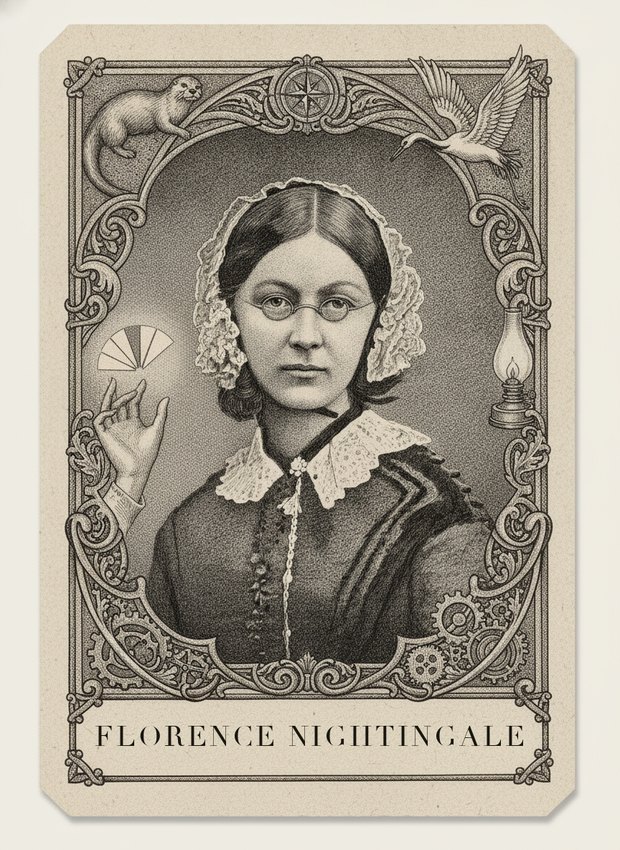
Chose Comparable rates, not raw counts — wrong. Statistics as a governing instrument was the one that fit.
Nightingale's statistics were descriptive and rhetorical — her polar-area diagrams of Crimean mortality (1858) turned counts into policy by making the preventable-death signal impossible to ignore — and she practiced in the 1850s-1870s, decades before p-values, error rates, or any inferential testing existed to be multiplied. She therefore has no machinery for the requested correction. What she does carry is the vignette's stakes: she understood better than almost anyone that statistics feeding institutional decisions must be right, campaigned for uniform hospital data collection precisely so conclusions would not rest on selective or incomparable figures, and her instinct for how evidence misleads administrators is sharp. She could deliver the bad news persuasively and lobby for systemic reform of the colleague's practice; the mathematics of family-wise error control lies entirely outside her era.

The professor surveys the room and realizes his predicament: he has spent a career teaching graduate students that the best-of-twenty p-value is a mirage — and now he must perform the correction in front of Tukey, who named the problem; Neyman, who invented the error rate being controlled; and Efron, who solved its industrial-scale successor before lunch. His lecture slides on Bonferroni are, he now recalls, essentially a summary of what half these people did first. He could gamely propose Benjamini-Hochberg, but Barber and Candès, who improved on it with knockoffs, are sitting right there taking notes out of politeness. Teaching the history of a method, it turns out, confers no advantage when the history shows up in person. Zero — the syllabus concedes to its own bibliography.
Battle #37 · 8/9/2026, 7:04:20 PM · this result is deterministic: the same two personas on this problem always resolve the same way.