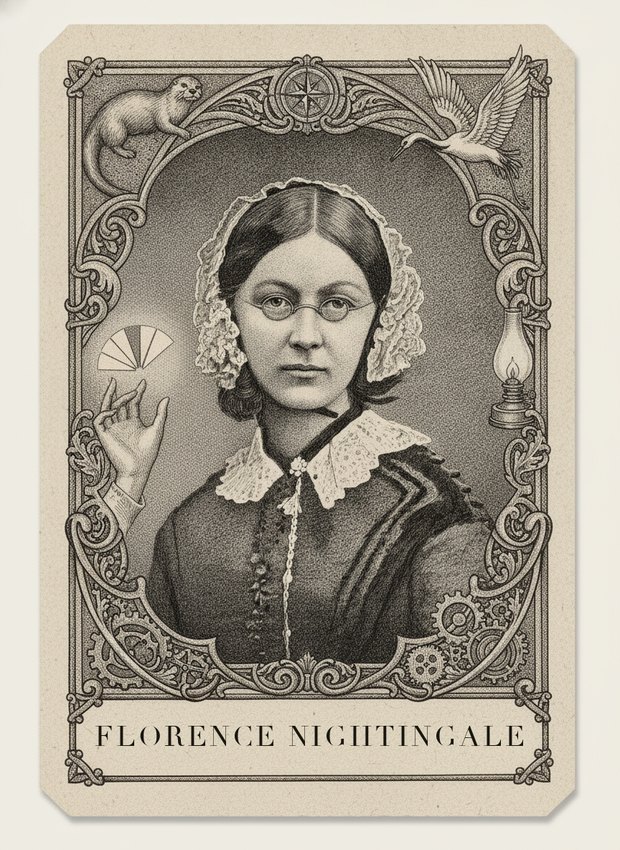
Florence Nightingale
Statistical graphics that changed public health policy
Played by Pri
Strongest on
Battles
In the mind map
The same ideas, as concepts rather than history — in John's ML knowledge map.
Life and career
The lamp is the wrong image. Florence Nightingale spent two years in the Crimea and fifty-four years afterward, and almost all of the work that changed anything was done in the second period, from a sickbed in London, using arithmetic.
She was born in 1820 in Florence, to wealthy, well-connected English parents on an extended continental tour — hence the name. Her father educated both daughters himself in a curriculum that included Greek, Latin, history, philosophy, and mathematics, which was unusual, and Nightingale pushed for more mathematical instruction than the family thought seemly. Her announced intention to become a nurse, made in her twenties, was a scandal in her class: nursing at the time was disreputable work for poor women. She fought her family over it for years, refused a long-standing suitor, trained at a Protestant institution at Kaiserswerth in Germany, and by 1853 was superintendent of a women's hospital in London.
In 1854 Britain went to war with Russia and *The Times* began publishing dispatches about the state of the British military hospitals. Nightingale, through her connection to Sidney Herbert, the Secretary at War, was sent to Scutari, near Constantinople, with a party of thirty-eight nurses. What she found was a barracks hospital sitting on defective sewers with contaminated water, overwhelmed and filthy, where soldiers were dying at a catastrophic rate — and dying overwhelmingly of typhus, cholera, and dysentery rather than of their wounds. She organized, supplied, and administered, and she also did something less visible and ultimately more consequential: she kept records. Meticulously. Cause of death, by month, for the whole force.
She came home in 1856 a national celebrity and almost immediately fell into a chronic illness — most likely brucellosis contracted in the Crimea — that left her largely housebound for the rest of her long life. From that room she conducted a campaign. She secured a Royal Commission on the health of the Army, wrote an enormous confidential report analyzing the mortality data, and, with the statistician William Farr as collaborator and the reformer Sidney Herbert as her instrument in government, pushed sanitary reform through an unwilling War Office. She went on to work on hospital design, on the health of the army in India, on nursing as a trained profession — the Nightingale School at St Thomas's opened in 1860 — and on the introduction of uniform hospital statistics.
The statistical establishment recognized what she was. She was elected the first female member of the Royal Statistical Society in 1858 and later made an honorary member of the American Statistical Association. She was also, it should be said, wrong about mechanism: she was a committed sanitarian who largely held to the miasma theory of disease, and her reforms worked because clean water, drainage, ventilation, and space happen to defeat waterborne and louse-borne pathogens regardless of why you think they do. She died in 1910, aged ninety.
Key contributions
Nightingale's contribution is not a theorem, and pretending otherwise does her a disservice. It is a method for making data *act*, and it has three parts worth separating.
**Comparable rates rather than raw counts.** Her Crimean analysis expressed mortality as an annual rate per thousand of average force strength, by cause, by month. This is denominators, standardization, and cause-of-death classification — the basic apparatus of epidemiology, applied at a time when official statistics were largely tallies. The finding was stark: preventable disease killed several times as many British soldiers as wounds did, and at the peak the death rate in the Scutari hospital was such that the army was destroying itself faster than the Russians could. She later made the equally pointed peacetime comparison: mortality among soldiers in barracks in England exceeded that of civilian men of the same ages living in the same towns. Being a soldier in peacetime was, statistically, a dangerous occupation, and the cause was the barracks.
**The polar-area diagram.** The "rose" or coxcomb — published in her 1858 *Notes on Matters Affecting the Health, Efficiency, and Hospital Administration of the British Army* and in a subsequent pamphlet — divides the year into twelve angular sectors, one per month, with area proportional to deaths, and shades each wedge by cause: preventable disease, wounds, other. Two such diagrams side by side, before and after the sanitary commission's intervention, make the argument in a single glance. Modern visualization critics correctly note that polar area encoding is not the most perceptually efficient choice available, and that a simple stacked bar or line chart would read more accurately. That criticism misses the design problem she was solving. Her audience was cabinet ministers and Members of Parliament who would not read a table, and the diagram's job was to be unignorable rather than to be optimally decodable. It worked. It is one of the earliest and clearest demonstrations that presentation is part of inference's job, not a decoration on top of it.
**Statistics as a governing instrument.** Nightingale's deeper argument, which she made in explicitly theological terms, was that regularities in social data reveal law-like structure that administrators are obligated to act on — that once you know the barracks mortality rate, leaving it alone is a choice. She pushed for uniform hospital statistics so that institutions could be compared, an idea that ran into exactly the objections it still runs into (institutions differ in case mix, and comparison invites gaming). She lobbied, unsuccessfully, for a chair of applied statistics at Oxford, and she pressed for statistical training for administrators. The line from her work to modern evidence-based policy, hospital outcome reporting, and public health surveillance is direct.
What she did not have: any theory of inference, no significance testing, no formal treatment of sampling variability, no notion of confounding as a technical problem, and no correct theory of disease transmission. Her work is descriptive statistics deployed with unusual force.
In battle
Nightingale's profile is that of a specialist with one very sharp peak and a long flat plain: mean 20.3, median 15, exactly one problem above 70, and sixty-five at or below 20. What she carries is a distinctive and coherent competence that the roster's theoreticians mostly lack.
Her dominant problem is "The pump on Broad Street" at 88 — John Snow's cholera investigation, and the closest kin to her own work on the roster. She and Snow were contemporaries fighting the same sanitary-reform battle against the same institutional resistance, and her method (turn overwhelming mortality data into an argument no official can ignore, cause by cause, place by place) is precisely the move the cholera map performs. She is held below a perfect score for two honest reasons: she did not investigate the Soho outbreak, and her own theoretical commitments leaned toward miasma rather than the waterborne transmission Snow was demonstrating. Below that, her strengths are all *applied and institutional*. "Thirty percent chance of rain" (60) is forecast communication and calibration — how to present a probabilistic quantity so a non-expert acts correctly on it, which is her career in one problem. "The hierarchy of hospitals" (57) is multilevel modeling of institutional outcomes, literally the comparative hospital statistics she campaigned for. "When you can't randomize" (55) is observational causal inference in a policy setting. "The bomber that came home" (55) is Wald's survivorship-bias problem, where her instinct about who is missing from the denominator earns real credit. "The proxy that rationed care" (48) and "The census under a privacy budget" (45) are modern algorithmic-fairness and official-statistics problems, and her fairness average of 38.4 is her single best category — she is the roster member most attuned to what happens when a statistic becomes an instrument of institutional power.
Her losses divide cleanly into two kinds. The first is **formal statistical theory**: "Eleven factors, twelve runs" (4) is fractional factorial design, a Fisher/Plackett-Burman construction requiring combinatorial design theory she had no access to; her experimental-design average of 21.4 across sixteen problems is respectable only because those problems often reward practical judgment. Anything demanding a sampling distribution, a design matrix, or an efficiency argument leaves her behind. The second is **anything mathematical or computational with no policy stakes**: "The message no eavesdropper can read" (4), "Fill in the hidden variables" (4), "Search deep on a shoestring of memory" (4), "Calculus for a jagged path" (4) — cryptography, EM, memory-bounded search, and stochastic calculus. Her floor is "The pixel you cannot see" (3), adversarial examples in deep networks, where the profile is blunt that there is no pathway at all. Her optimization average of 4.5, NLP at 5.5, and search at 6.0 confirm the shape.
The pedagogy here is worth naming. Nightingale is the roster's clearest case that *statistical work is not only inference*. She loses to almost everyone on method and beats nearly all of them on the question of whether the number changes what anyone does. Play her when the problem involves institutions, mortality, policy persuasion, unequal outcomes, or communicating uncertainty to people who will act on it. Do not play her on theory, computation, or anything where the difficulty is mathematical rather than human.