causality
The pump on Broad Street
It is September 1854 in Soho, London, and cholera is killing a neighborhood — five hundred dead in ten days — while official science blames miasma, the bad air of the poor. A physician is mapping deaths house by house, and the cluster around the Broad Street pump is unmistakable to him and invisible to the Board of Health. Make the case: from the map, from the brewery workers who drank beer and lived, from the distant widow who had pump water delivered and died, assemble an argument that the water is the cause — decades before germ theory can say why. The natural experiments are the evidence. Get it wrong and the handle stays on the pump, and the next outbreak follows the same water.
Who this problem belongs to
The two figures whose methods fit it best, out of 58 in contention.
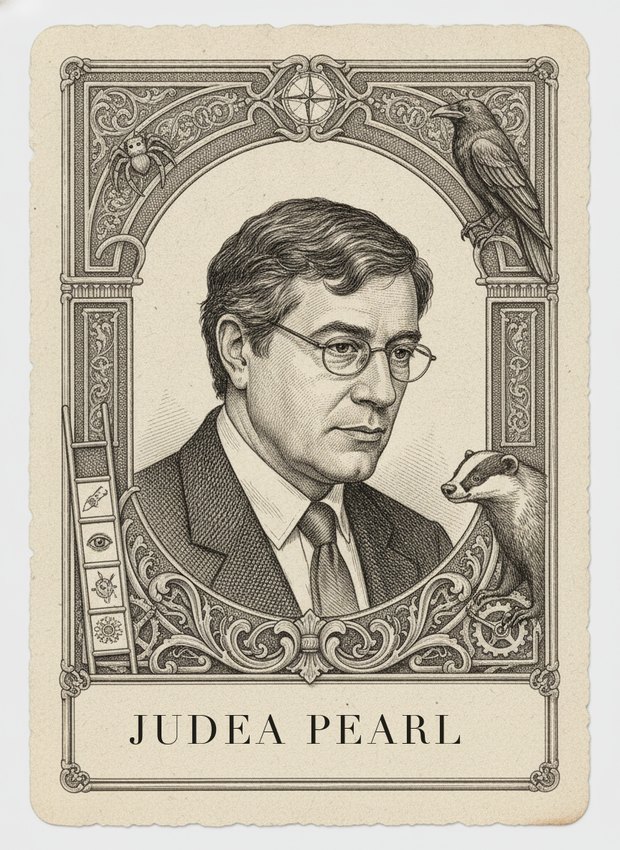
Pearl's causal revolution, formalized decades after Snow through do-calculus and structural causal models, gives rigorous mathematical vocabulary to exactly the reasoning Snow performed by instinct in 1854: distinguishing correlation from causation using natural experiments, the brewery workers who drank beer and lived, the distant widow whose piped-in pump water killed her, as quasi-controlled comparisons. Pearl explicitly cites Snow's cholera map as a canonical historical example of causal reasoning from observational data before formal theory existed to justify it, treating it as a proof that rigorous causal inference does not require randomization, only the right natural comparisons and the courage to draw conclusions from them. Pearl did not live through or analyze the 1854 outbreak himself, and his formal apparatus postdates Snow by over a century, which is the only reason this falls short of a perfect score.
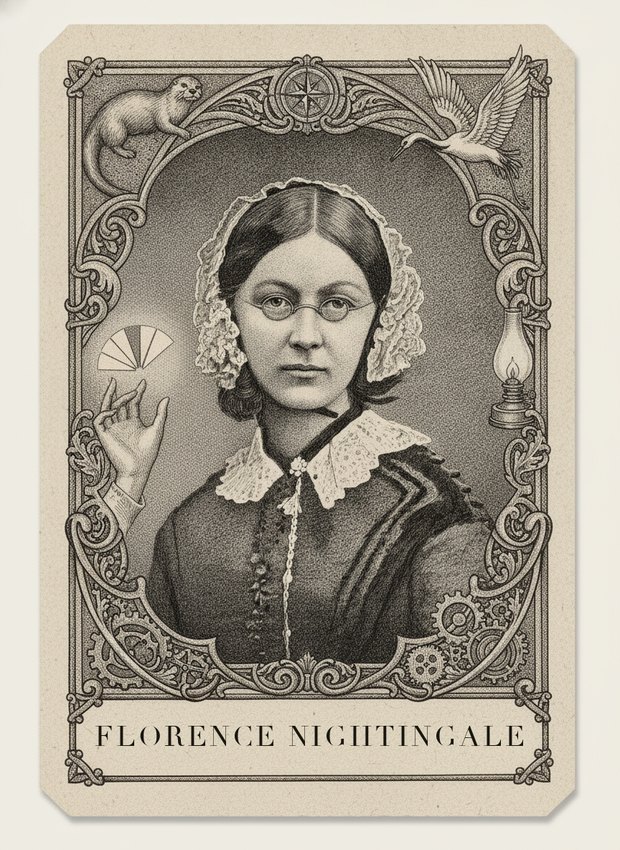
Nightingale's statistical graphics, especially her 1858 rose diagram showing that far more Crimean War soldiers died of preventable disease than of battle wounds, changed British public health policy through exactly the kind of visual, house-by-house, cause-by-cause argument Snow needed to make about the Broad Street pump. She was a direct contemporary of Snow working the same sanitary-reform battle against the miasma theory the Board of Health clung to, and her method, turn overwhelming mortality data into an argument no official can ignore, is precisely the rhetorical and statistical move the cholera map performs. Nightingale did not investigate the Soho outbreak herself, and her own early theoretical commitments leaned toward miasma rather than the waterborne theory Snow was proving, keeping this just below a perfect score despite the extremely close kinship in method and moment.
Fought here
In the mind map
The same ideas, as concepts rather than history — in John's ML knowledge map.
58 figures are scored on this problem. Draw it in a battle to see where you land.