It is 1977, and a maddening gap sits between theory and practice: the entropy bound tells you how few bits a source needs only if you already know its statistics — and in the real world of arbitrary files, you never do. Build a compressor that needs no model handed to it, that learns the structure of the data as it reads, and provably approaches the true entropy rate for any stationary source without being told what that source is. The method must be one pass, adaptive, and simple enough for modest hardware. Get it wrong and compression stays a bespoke craft, a different scheme for text and images and code — instead, this universal idea becomes the engine inside nearly every general-purpose compressor the world uses.
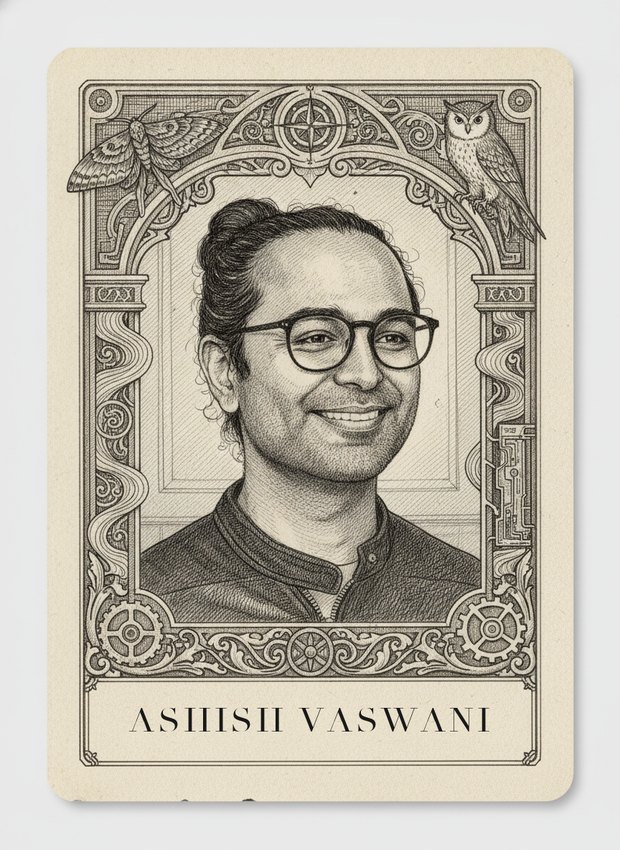
Vaswani's co-authorship of the 2017 transformer architecture built a sequence model that, like this problem's compressor, learns structure from data without being handed an explicit statistical model in advance, adapting its predictions purely from exposure to the sequence. This gives his work a genuine thematic kinship with universal compression's core insight that learning-as-you-go can approach optimal prediction without prior knowledge. But his actual contribution operates through gradient-based deep learning on massive datasets, a fundamentally different mathematical and computational regime from the 1977 problem's demand for a simple, one-pass, hardware-modest adaptive dictionary construction, leaving a real but era-displaced and technically distinct connection. His actual contribution belongs to a much later, differently constructed chapter of adaptive sequence modeling.
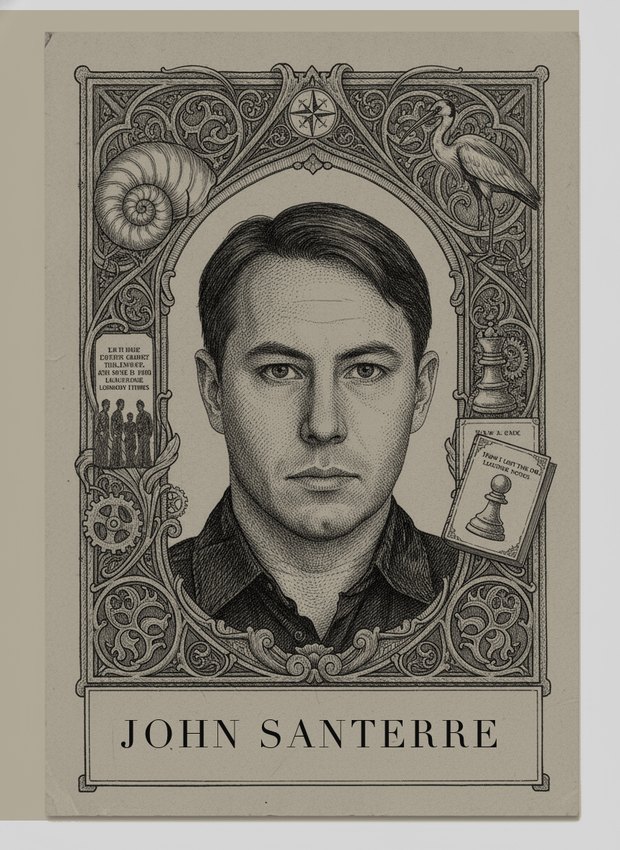
The professor attempts to explain why a compressor with no prior knowledge of the source can still, provably, approach the entropy rate, and gets tangled trying to distinguish LZ77 from LZ78 on the whiteboard while a student politely points out he has swapped which one uses a sliding window. Jacob Ziv, four seats away in this thought experiment, is not impressed. John's own filing system for lecture notes has achieved zero compression of any kind across fifteen years and several thousand redundant PDFs, which he insists is 'a deliberate lossless archival strategy.' It is not. It is entropy, uncompressed and unbounded, spread across a desktop that no algorithm, universal or otherwise, could ever meaningfully organize.
Battle #45 · 8/9/2026, 8:36:50 PM · this result is deterministic: the same two personas on this problem always resolve the same way.