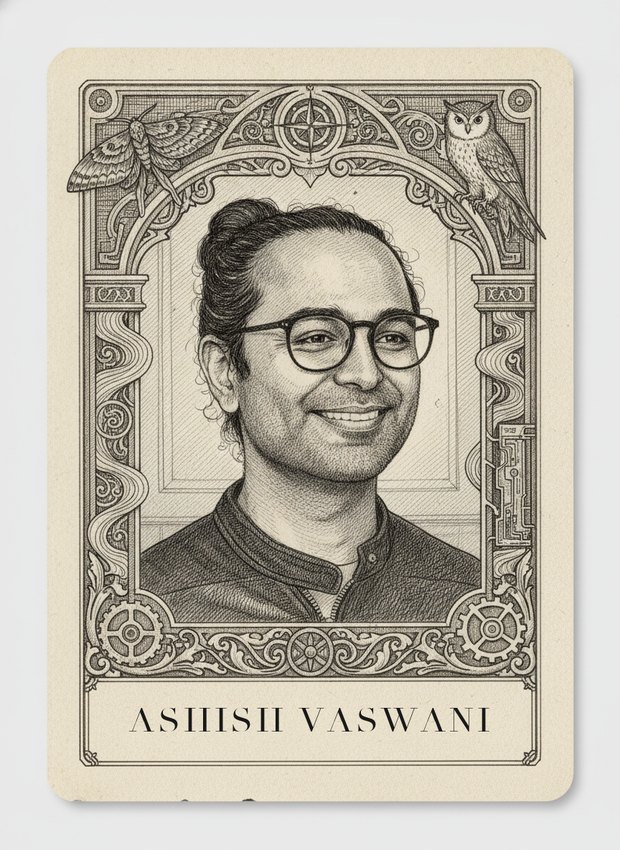
Ashish Vaswani
'Attention is all you need': the transformer
Played by Lawrence Jordan
Strongest on
Battles
Depth for a robot on Mars L Aaron Clauset
Who wrote the disputed papers? L Aaron Clauset
Why tall fathers have shorter sons W Aaron Clauset
XOR L Aaron Clauset
Which examples deserve labels? W Aaron Clauset
The tilted scan L Aaron Clauset
The corner that sparsity loves L Rediet Abebe
Randomize the villages, not the people L Judea Pearl
When 0.9 must mean ninety percent L Rediet Abebe
A thousand categories W John Santerre
Compress without knowing the source
In the mind map
The same ideas, as concepts rather than history — in John's ML knowledge map.
Life and career
Few researchers are as thoroughly identified with a single paper as Ashish Vaswani, and fewer still have that paper turn out to be the architecture of an entire technological era. He came up through statistical natural language processing at a time when the field's center of gravity was still phrase-based machine translation — enormous engineered pipelines of word alignment models, phrase tables, reordering models, and a separate language model, all tuned against BLEU by hand. His doctoral work was done at the University of Southern California, in the orbit of its Information Sciences Institute, one of the great American centers of machine translation research, and his early publications sit exactly on the seam where that tradition began giving way. A 2013 paper with colleagues at USC on decoding with large neural language models is characteristic: it did not throw out the statistical MT machinery, it showed that a neural language model integrated into the decoder was worth a real quality gain. That is the posture of someone who learned the old system well enough to know precisely which piece to replace.
He joined Google Brain, and the environment there in the mid-2010s mattered enormously to what followed. Google had just deployed neural machine translation in production; the sequence-to-sequence-with-attention framework of Sutskever, Vinyals, Le, Bahdanau, Cho and Bengio was the state of the art; and the practical bottleneck was no longer accuracy but training time, because recurrence forced the computation of a sentence to proceed one token at a time and no amount of parallel hardware could shorten a sequential dependency chain.
In 2017 Vaswani and seven colleagues at Google — Noam Shazeer, Niki Parmar, Jakob Uszkoreit, Llion Jones, Aidan Gomez, Łukasz Kaiser, and Illia Polosukhin — published "Attention Is All You Need." It is important to say clearly that this was a collaborative paper with an explicit equal-contribution note; Vaswani is first author and led the effort, not its sole author, and the individual pieces came from different people around the table. What they produced together was a sequence model with no recurrence and no convolution at all, built entirely out of attention and feedforward layers.
The paper's reception is now hard to reconstruct because the outcome seems inevitable. It was presented as a machine translation result. Within five years the same architecture, essentially unmodified in its core, was running language models, protein structure prediction, image generation, speech recognition, code synthesis, and reinforcement-learning policies. Vaswani continued at Google on transformer follow-ons — extending self-attention to images, and contributing to the Tensor2Tensor library that made the architecture easy for others to pick up, which is a substantial and underrated part of why it spread so fast.
He later left Google to co-found Adept AI Labs with Niki Parmar and David Luan, working on models that take actions in software rather than only emitting text, and subsequently co-founded Essential AI with Parmar. Both moves fit a pattern in this generation of researchers: the people who built the architecture left the company that owned it to build companies of their own.
Key contributions
**The transformer.** Worth explaining properly, because a graduate student who knows the equations does not always know what each piece was *for*.
Start with the problem. An RNN encoder processes token $t$ only after token $t-1$, so training on a length-$n$ sequence has an $O(n)$ chain of sequential operations that cannot be parallelized, and the path length between two distant tokens — the number of steps a gradient must traverse to connect them — is also $O(n)$. Both facts are bad: the first caps throughput, the second makes long-range dependencies hard to learn.
Scaled dot-product attention replaces both. Project every token into a query, a key, and a value. Compute $\mathrm{softmax}(QK^\top/\sqrt{d_k})V$. Every position now reads directly from every other position in a *single* operation. The path length between any two tokens is $O(1)$, and the whole layer is one large matrix multiplication — precisely the shape modern accelerators are built for. The $\sqrt{d_k}$ scaling is not decoration: without it, dot products of high-dimensional vectors have variance growing with $d_k$, pushing the softmax into saturated regions where gradients vanish.
Multi-head attention runs several attention functions in parallel over lower-dimensional projections and concatenates them, which lets different heads specialize — some tracking syntactic dependency, some coreference, some position — where a single head must average all of these into one distribution.
Because attention is permutation-equivariant, order information has to be injected explicitly. The paper's positional encodings add fixed sinusoids of geometrically spaced frequencies to the embeddings, chosen so that a relative offset is representable as a linear function of the encoding. Residual connections and layer normalization around each sublayer make the deep stack trainable; the position-wise feedforward network provides the per-token nonlinearity that attention itself lacks; and in the decoder, causal masking makes the whole target sequence trainable in parallel while preserving autoregressive semantics at generation time.
The cost is the thing that defines the next decade of research: attention is $O(n^2)$ in sequence length, in both time and memory. Removing the sequential bottleneck introduced a quadratic one, and an entire literature — sparse attention, linear attention, state-space models, FlashAttention's IO-aware exact computation — exists to attack it.
**Follow-on work.** Vaswani contributed to extending self-attention beyond text, including to image generation, and to relative position representations, which encode pairwise offsets directly in the attention computation rather than adding absolute positions at the input. He was also involved in Tensor2Tensor, the open library that made reproducing and modifying the architecture straightforward — an infrastructure contribution that materially accelerated adoption.
In battle
Vaswani is the most extreme spike in the game, and playing him is a lesson in what a single-architecture carrier can and cannot do. Across 100 problems his mean is only 20.9 with a median of 15 — near the bottom of the roster — and *seventy-one* of his problems score 20 or below. He has three dominant cells. That is the entire hand.
But the top of that hand is the highest-value single card available. **P088 — Attention replaces recurrence** scores 99, and the matrix's explanation is that this is not an analogy but the literal paper, "down to the institution and the year." No carrier can contest it. **P087 — Predict the next word** (88) and **P037 — Compress the English novel** (74) reward the fact that every modern language model is his architecture, even though the scaling program that exploited it belongs to others — note that Radford and Sutskever both outscore him on P087, which is the game correctly distinguishing *who built the engine* from *who drove it*. **P260 — The sentence in a single vector** (82) is Sutskever's seq2seq problem, and Vaswani scores high on it because the fixed-vector bottleneck is the exact failure his architecture was designed to eliminate; he is the answer to that problem's implied question. **P071 — Segment anything** (76) and **P243 — Name what you've never trained on** (62) are transformer-era vision systems built on his backbone. **P025 — Sixty thousand digits** (58) is MNIST, where he is merely a competent modern practitioner.
Category-wise there is really only one live column: **NLP** at 37.8 over eighteen problems. **Perception** (23.4), **classification** (21.9), and **high-dim** (22.5) are mediocre; **experimental-design** (4.5), **optimization** (4.5), and **regression** (3.5) are the lowest figures in this cohort. He scores 7.3 in **causality** and 8.5 in **RL**.
The losses deserve attention because they are not exotic problems. **P151 — Three species of iris** (3), **P136 — Counting accidents** (3), **P133 — Why tall fathers have shorter sons** (4), **P145 — Just look at the neighbors** (4), **P182 — The corner that sparsity loves** (4, the lasso), and **P210 — Find the lost submarine** (4, Bayesian search) are all *classical, tractable, well-posed* statistics. A student's instinct is that the person who built the transformer should at least do adequately on ordinary regression. The matrix disagrees, and it is right to: a 65-million-parameter attention stack is not a tool for four flower measurements, and nothing in self-attention says anything about $\ell_1$ geometry, Poisson likelihoods, regression to the mean, or sequential Bayesian search over a posterior on the seafloor.
Practical read: hold Vaswani for architecture problems and sequence modeling, where he is the strongest card on the board, and expect him to lose almost everything else. He is the clearest illustration the game offers that historical importance and broad problem-solving range are different quantities.