It is 2012, and a benchmark of over a million photographs sorted into a thousand fine-grained categories — dozens of dog breeds, hundreds of objects — has stood as the wall hand-engineered vision cannot climb: leading error rates crawl down by fractions for years. Classify these images at scale, and settle the decade-long argument — whether features must be crafted by experts or can be learned end to end from pixels, given enough data and parallel compute. The public scoreboard is watching. Get it wrong and either you overclaim for a method that does not generalize, or dismiss the result that, in a single year, redirects the field's money, talent, and imagination toward learned representations.
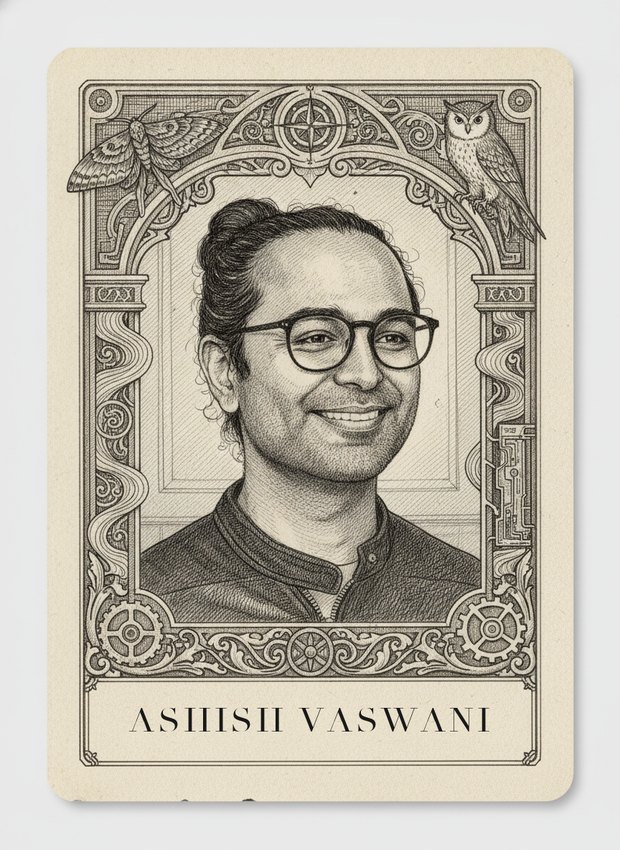
Chose Self-attention over recurrence — wrong. Porting attention to a new modality was the one that fit.
Vaswani's transformer architecture, from 2017's 'Attention Is All You Need,' eventually displaced convolutional networks as the dominant architecture for large-scale vision tasks through vision transformers, but this happened years after and as a consequence of the paradigm this problem describes, learned representations beating hand-engineered features, having already won decisively in 2012. His work is a second act in the same larger story, learned representations eating expert-crafted ones, rather than a participant in the founding 2012 event itself. Transformers were not part of the ImageNet 2012 competition or its immediate aftermath. His relevance is real at the level of the broader historical arc but not to this specific problem's 2012 moment.

Abebe's work on algorithms and inequality, and mechanism design for social good, addresses fairness and social impact in algorithmic decision-making, a research program that engages with the societal consequences of widely deployed machine learning systems, including deep learning systems descended from AlexNet, but not with the technical mechanics of convolutional feature learning or GPU-accelerated training themselves. Her research postdates and responds to the deep learning wave this problem's 2012 result triggered rather than contributing to its founding technical breakthrough. Her relevance to this specific problem, an engineering and benchmark question about representation learning, is essentially nil despite her genuine importance to the field's broader social consequences. Her concerns are downstream consequences of this result, not contributions to it.
Battle #49 · 8/9/2026, 8:37:56 PM · this result is deterministic: the same two personas on this problem always resolve the same way.