It is the 1980s, and a public-health team testing a new sanitation program faces a problem individual randomization cannot solve: if one household gets clean water, its neighbors benefit too, so treated and control individuals in the same village contaminate each other's outcomes. Randomize whole villages instead, and design the study so the spillover between neighbors becomes a feature you can measure rather than a bias that hides the effect. Account for the fact that people within a village are correlated, which shrinks your effective sample far below the head count. Get it wrong and you overstate your certainty by treating correlated villagers as independent, or you miss the very community-level benefit the program was built to deliver.
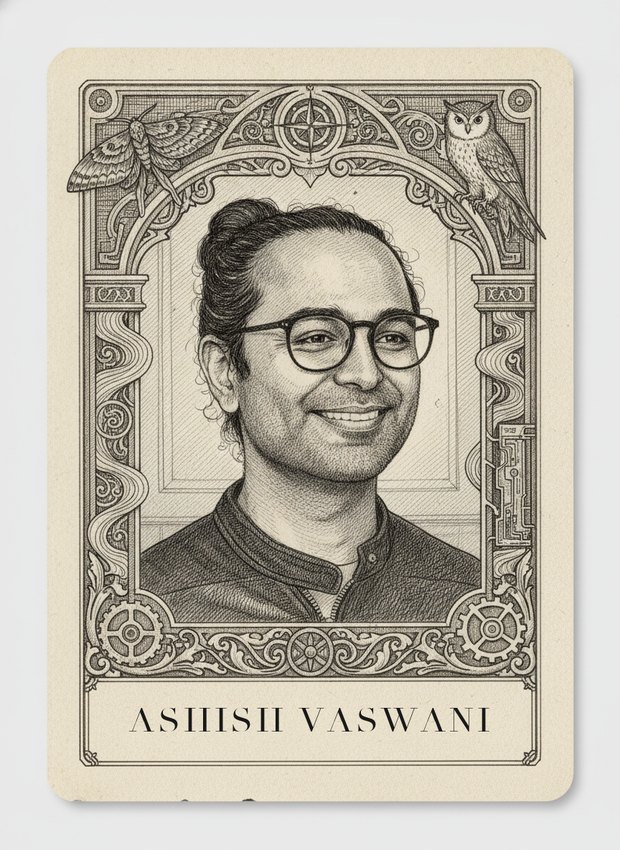
Vaswani's co-authorship of 'Attention Is All You Need' (2017), introducing the transformer architecture, revolutionized natural language processing and became the foundation of modern large language models -- a landmark deep-learning architecture contribution with no technical relationship to cluster-randomized trial design, causal inference, or intracluster correlation in public-health field studies. His work presupposes vast datasets and gradient-based training on GPU-scale computation, an entirely different world from a 1980s epidemiological team designing a village-level sanitation trial with a modest sample size. There is no meaningful conceptual or technical bridge between transformer attention mechanisms and the spillover-modeling and randomization-design questions this problem poses; his toolkit offers nothing applicable here, and his entire body of work postdates this 1980s scene by roughly three decades.

Abebe's work on algorithms and inequality, mechanism design for social good, and community-level interventions in resource-constrained settings shares this problem's substantive concern -- designing interventions that respect the reality of how benefits and effects propagate through a community rather than treating individuals as isolated units. Her research explicitly grapples with the ethics and mathematics of community-level rather than individual-level intervention design. But her technical contributions are contemporary (2010s-2020s), computer-science-adjacent, and focused on algorithmic resource allocation and fairness rather than the classical cluster-randomized-trial statistics -- intracluster correlation, effective sample size, design effects -- that a 1980s public-health team would actually need to design and analyze a village-randomized sanitation trial correctly, and her career arrives roughly three decades after the scene in a different disciplinary tradition.
Battle #55 · 8/9/2026, 9:53:55 PM · this result is deterministic: the same two personas on this problem always resolve the same way.